Safe Patient Transfer for Adult In-Patient BGH

Warning

Objectives

The objective of the guideline is to manage and reduce the risks of patient transfer and so reducing the incidence of significant adverse events occurring during these interventions.

This document represents guidance for most scenarios however there will be individual clinical situations requiring a different approach from those specified. Deviations from the guidance should be made in collaboration with the consultant in charge of the patient’s care.

The purpose of this document is to:

  • Support medical and nursing teams in ensuring the safe transfer of adult in-patients within BGH acute setting.
  • Provide a consistent standardised approach for staff using a SBAR approach to ensure effective communication. SBAR (Situation, Background, Assessment, Recommendation) is a nationally recognised communication tool, adapted by the NHS that enables information to be transferred concisely between individuals and teams.
  • Ensure that patients are transferred safely with escort staff who are competent to provide care required during the transfer.

Provide guidance on the level of competence required by the escort staff to enable safe and effective support for the patient based on the severity of their illness.

Scope

Patient movement between wards, departments and other hospital sites is an inevitable part of the patient care journey. Transfer of patients can pose a clinical risk to the patient.

The purpose of this standard operating procedure is to outline the process required to ensure that appropriate clinical risk assessments are carried out, that appropriate accompanying staff and equipment are utilised and that an accurate patient handover takes place to maximise a safe patient transfer.

Within Borders General Hospital there has been an increase in reported adverse events associated with patient transfers. Unsafe transfers can lead to poor patient experience and outcome. BGH is committed to the safe transfer of all acutely/ critically ill who require transfer to a different environment determined by their care needs.

Audience

SCNs/CNs, ward staff and clinical teams, Consultants and junior medical staff, General Services and portering staff, Radiology staff, OPD staff

Outcomes

To establish a robust process, ensuring the safe transfer of patients throughout BGH using an SBAR transfer documentation.

Process

Standards and Practice- principles for the safe transfer of patients

Planning for the safe transfer of patients must consider the rationale for transfer using clinical risk assessment.

Specific requirements for transfer will depend on:

  • NEWS 2 score
  • The medical or psychiatric condition of the patient
  • The stability of the patient’s condition
  • Any treatments, intervention and therapy currently in progress or required during transfer.

Responsibility for the SBAR transfer documentation lies with the referring consultant and nurse assigned to the patient’s care.

Prior to transfer the patient’s condition should be made as stable as possible.

It is essential that the person(s) accompanying the patient during transfers has the appropriate knowledge, skills and training required to meet the needs of the patient’s current and potential condition.

The clinical risk assessment and the level of competence required by escorting staff will be determined by the patient’s condition.

Transfer Risk Assessment
Low Medium High
NEWS 0-3
GCS 15

NEWS 4-7 or
Sats 88%-92% or
GCS <15
Infusions or Oxygen therapy

NEWS >8 or
Sats <88% or
GCS <12

Low-risk group- if the NEWS is 3 or less and there is no additional concerns, these patients should have a low risk of deteriorating during transfer. Some clinical competencies may be required during transfer such as oxygen therapy or infusions

Medium risk group-this group will require a detailed pre-transfer assessment to be undertaken by the referring medical team. The assessment should be based on an ABCDE approach. The following factors should be documented:

    • Is the general condition improving, stable or deteriorating?
    • What physiological deterioration may occur during transfer?
    • What competencies are required to ensure safe transfer?
    • What equipment is required?
    • Management of drug infusions devices/ syringe drivers?
    • Management of blood transfusions or colloid infusions?
    • Presence of significant psychiatric illness or acute confusional state?
    • Patient with communication difficulties?
    • Presence of central lines or intercostal drains?
    • Patients at risk of self-harming?

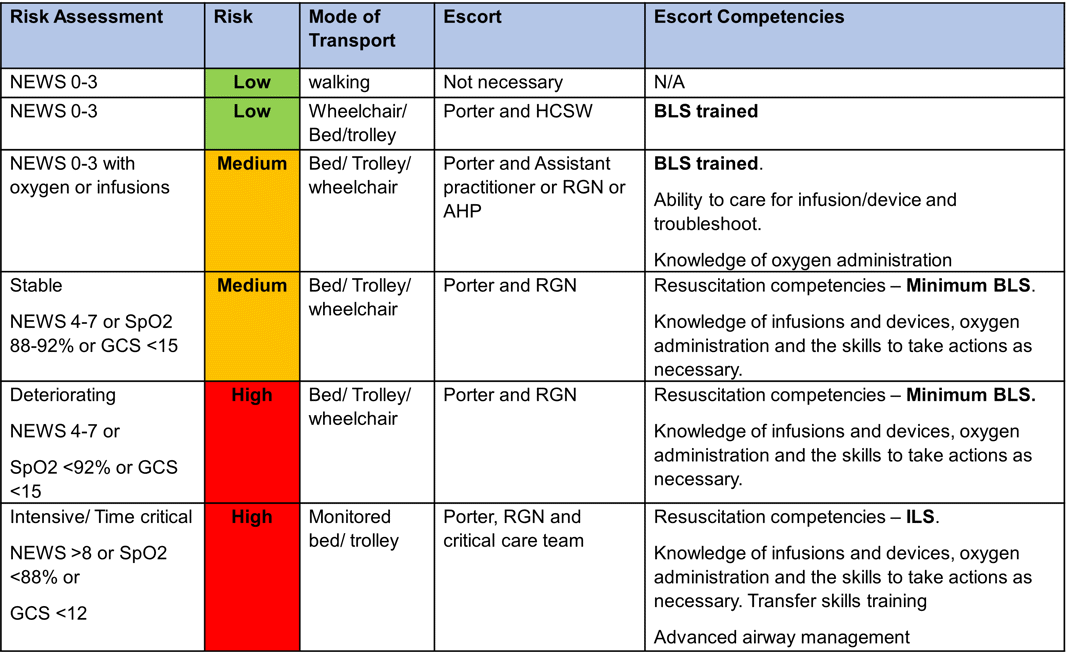
High risk group-This group should already have triggered an emergency response from the critical care team. The attending clinicians must still undertake a formal risk assessment as described for medium risk group.  Appendix 1- Guidance on   severity of illness, treatment interventions and required competencies of escort staff for transfer within BGH.
Communication

Accurate and concise multidisciplinary communication is vital for a safe patient transfer and is the joint responsibility of the referring medical and nursing team. SBAR is a nationally recognised communication tool and is used to frame communication, facilitating a structured approach to relaying key information. Appendix 2 SBAR template.

Medical records accompany patients on transfer between areas and departments within BGH. If there is no escort required, notes must be placed in a sealed envelope, and it is the responsibility of portering staff to ensure they are handed over to a registered nurse on the receiving ward.

On arrival at the accepting ward/department the escort staff will ensure that:

  • Formal patient handover using the SBAR tool and all relevant documentation in patient’s notes have been fully completed.
  • The escort staff and receiving team ensure flow rates of infusions/ therapy is correct.
  • The accepting team should complete a full set of observations and accurately document NEWS score within 15 minutes of patient arrival.
  • The admitting ward will contact patient’s next of kin/ carer to inform them of new location and ward details.
  • Report any events or issues whilst escorting a patient to senior staff and complete an incident report on In-phase (adverse events reporting system)

Development & Review Groups

May 2006

Dr T Cripps
Dr P Syme
Dr A McLaren

Reviewed January 2015

Dr D Love

Reviewed February 2025

Lynne McCutcheon       Clinical Nurse Manger, Planned Care  
Rhona Morrison            Quality Improvement Facilitator
Michelle O’Reilly           Chief Nurse Clinical & Professional Development
Elaine Dickson              ADoN Acute Services

Appendix 1 Guidance on severity of illness, treatment interventions and required competencies of escort staff for transfer within BGH

SpO2 thresholds assume patient would normally have SpO2 target of >94%, appropriate adjustment can be made for patients with a lower SpO2 targets

Appendix 2 Deteriorating patient SBAR template

Appendix 3 Patient Handover SBAR script

Editorial Information

Last reviewed: 27/02/2025

Next review date: 27/02/2028

Author(s): Cripps T.

Version: 3.0

Co-Author(s): Syme P, McLaren A.

Approved By: Deteriorating Patient Group & Acute Clinical Governance Board

Reviewer name(s): McCutcheon L, Morrison R, O'Reilly M, Dickson E.