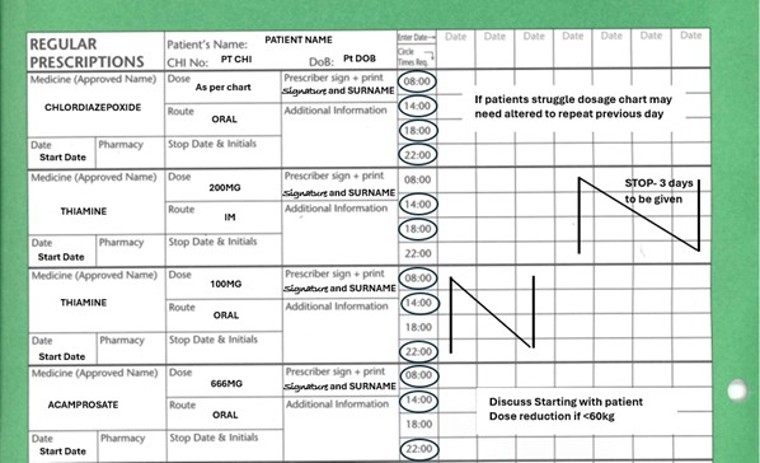
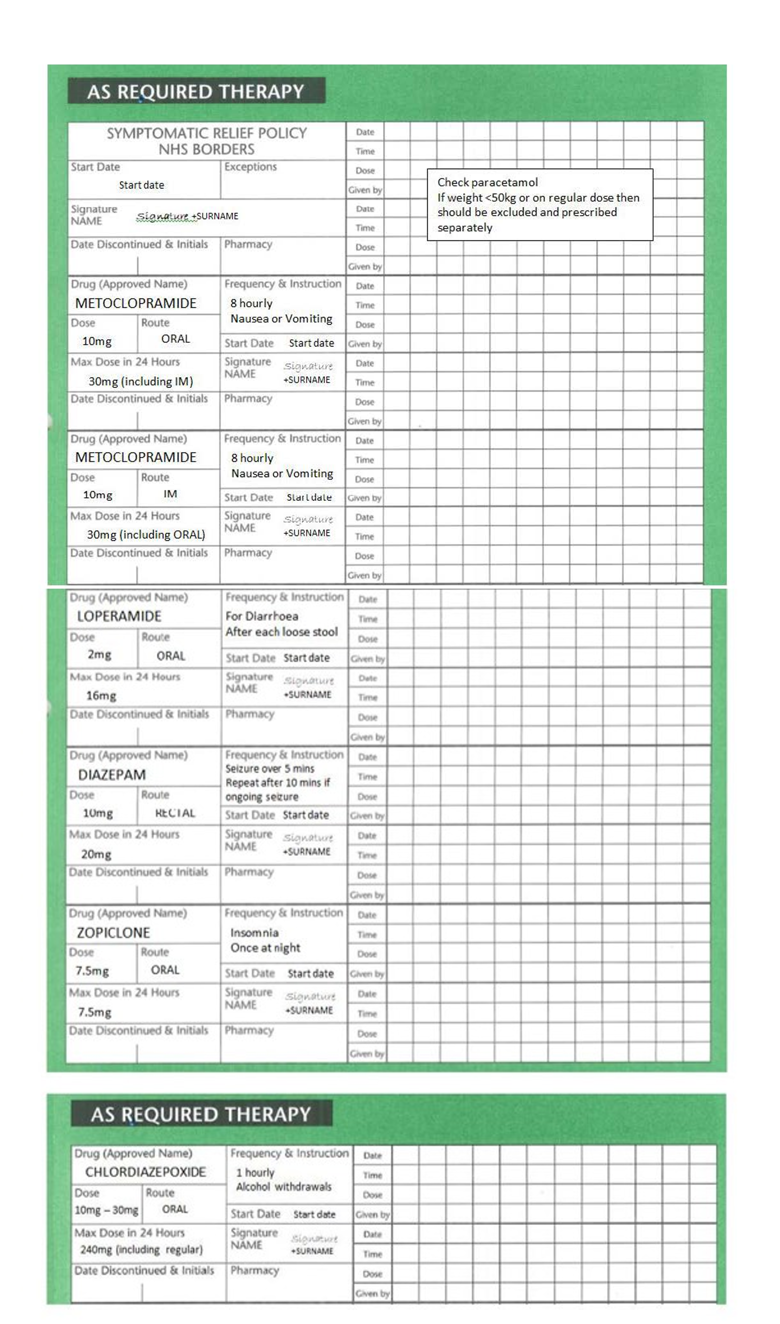
Example drugs charts showing 1st line medications used are in Appendix 1.
Benzodiazepines
1st line – Chlordiazepoxide
In medically assisted alcohol detox, the patient is required to stop alcohol intake abruptly, its effects are replaced by a benzodiazepine that has cross-tolerance in a safe and structured manner. This can be reduced at a rate that prevents withdrawal symptoms, but without promoting over-sedation, and ultimately stopped altogether. The process involves providing a large enough initial dose to prevent severe withdrawal symptoms including seizures, delirium tremens, severe anxiety or autonomic instability, but to withdraw the medication before physical dependence on its effects begins.
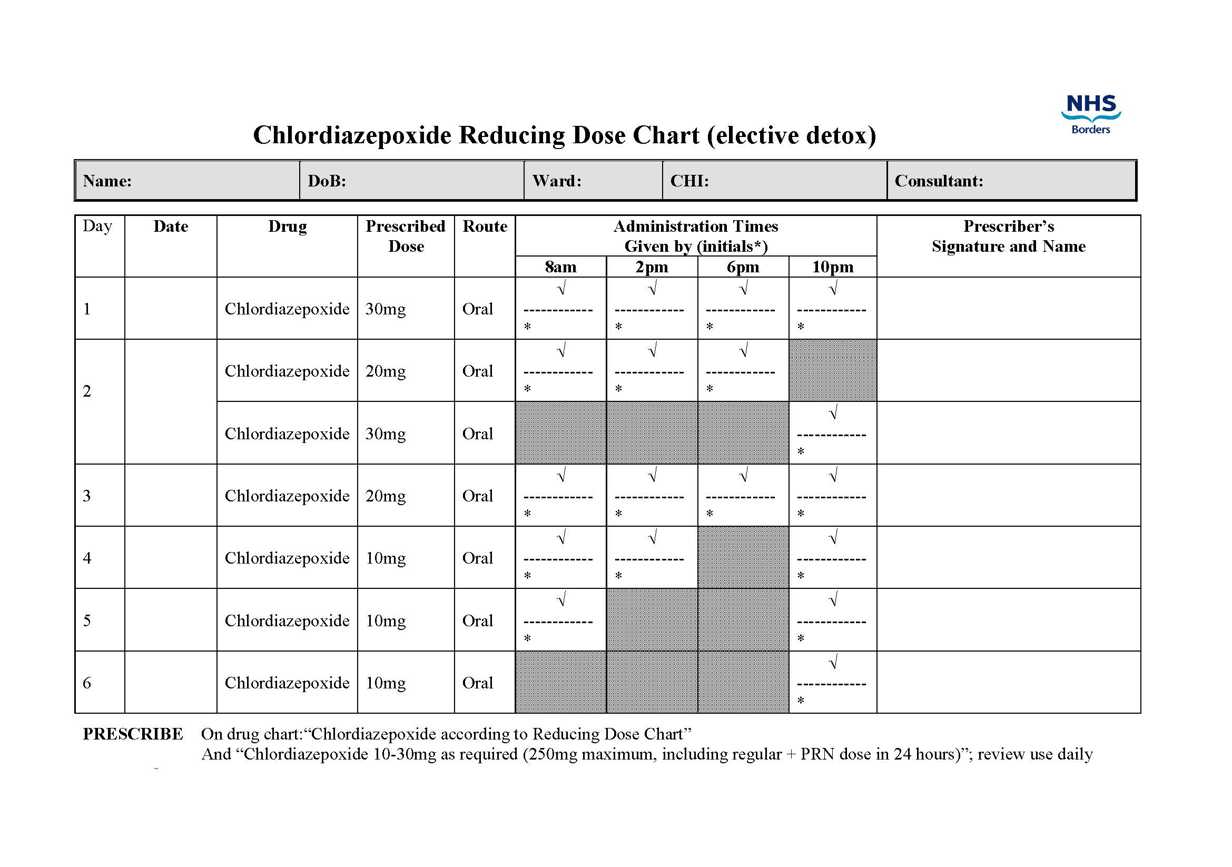
On Huntlyburn chlordiazepoxide is used 1st line as the benzodiazepine to manage alcohol withdrawal. For elective admissions, a fixed reducing regime is used, this should always be prescribed and is contained in Appendix 2.
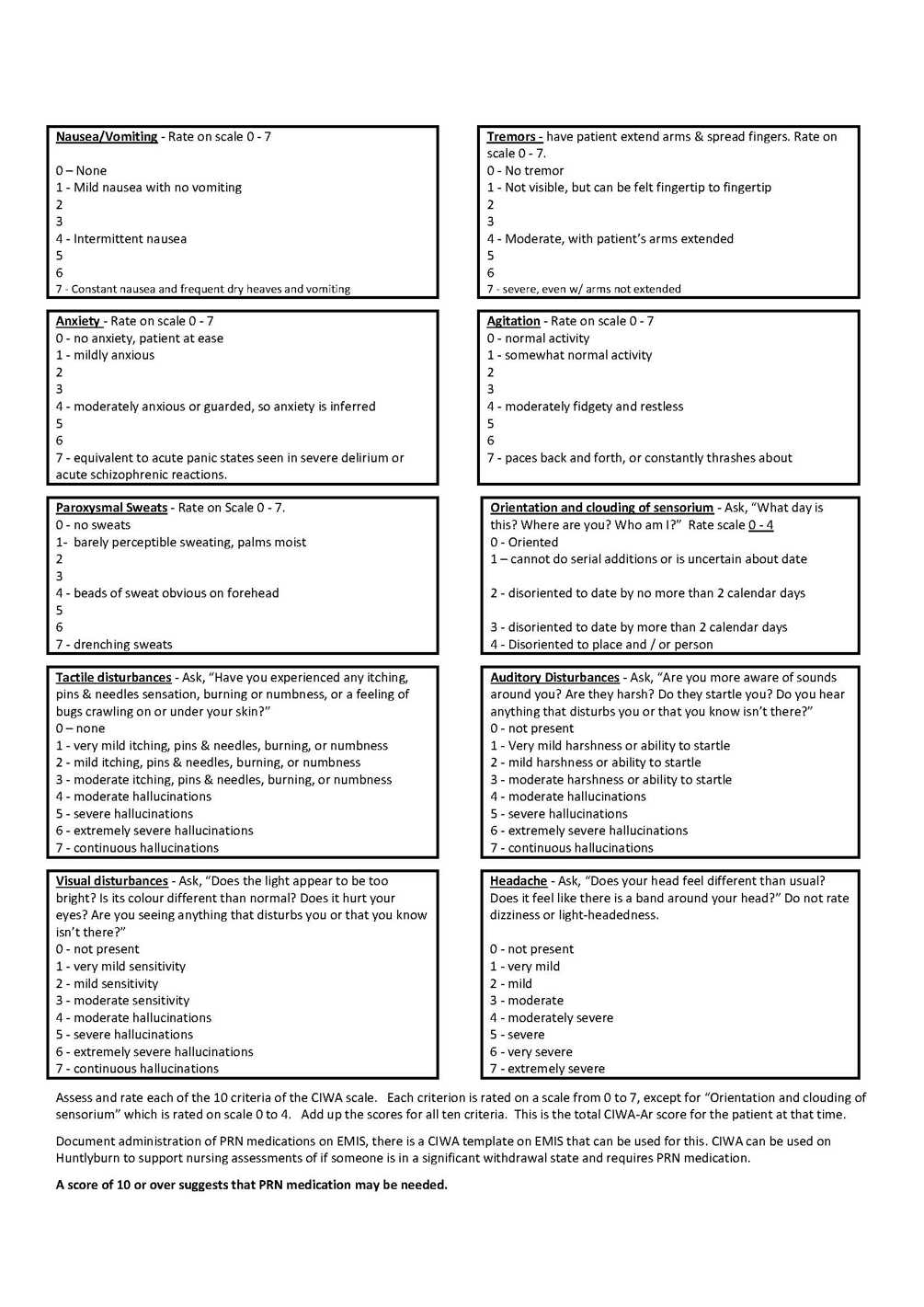
Alongside the fixed reduction, as required (PRN) chlordiazepoxide should be prescribed, with a maximum of 250 mg daily (including regular). If there is evidence of particularly severe withdrawal symptoms, discuss this with a senior doctor in BAS who may request this be increased to a maximum dose of 300 mg daily, or higher if appropriate, as well as considering any other management steps. Patients can request PRN doses from nursing staff if they are experiencing withdrawal symptoms, or these may be actively offered by nursing staff if they observe evidence of withdrawal. Nursing staff must use the Clinical Institute Withdrawal Assessment for Alcohol (CIWA - Ar) scoring to help them judge the severity of withdrawal that a patient is experiencing and to guide if PRN doses are needed (Appendix 3), a score of 10 or over generally indicates that a PRN should be given. CIWA score must be recorded in the notes prior to administration of any PRN doses and again 1hr after administration of the PRN dose.
Nursing staff should seek senior support if they are unsure if PRN doses should be administered or if they feel that PRN doses may be required during a fixed dose reduction.
Some patients, especially at the start of the detox, may struggle and need to repeat a previous day, for example restarting and repeating day one (chlordiazepoxide 30 mg QDS) the day following admission. There should be a low threshold for doing this, alongside allowing more liberal usage of PRN in the first 3 days. This is the highest risk period of the detox and more liberal chlordiazepoxide use lowers the risk of seizures or delirium tremens (DT’s) developing.
2nd line – Diazepam
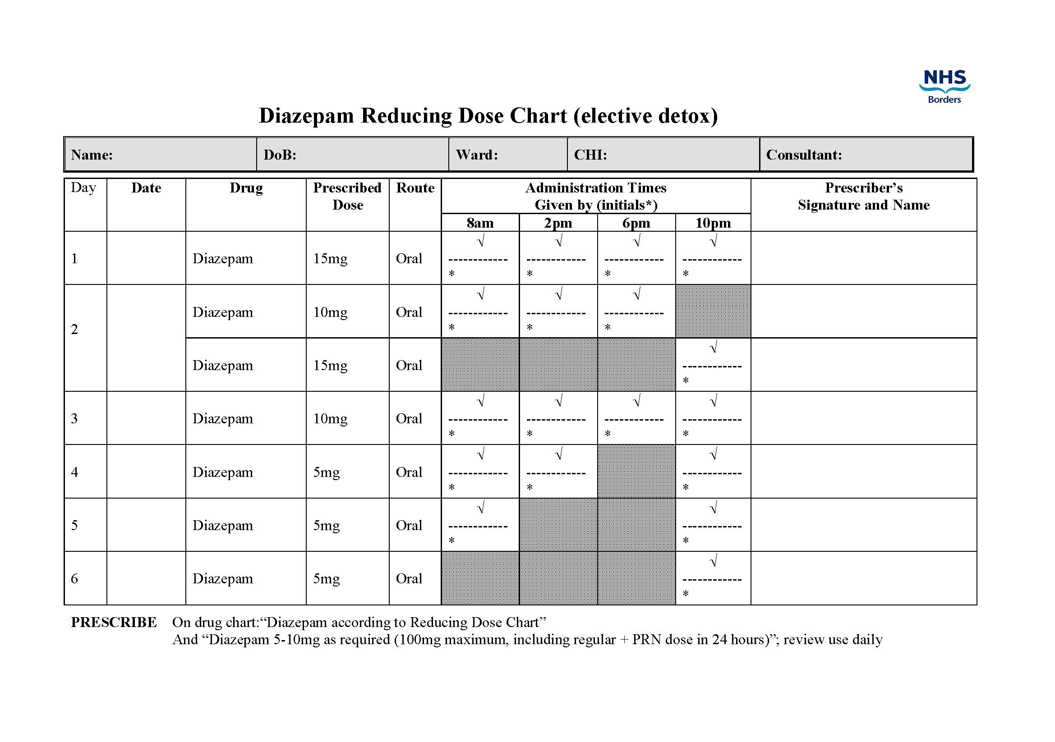
Diazepam can be used as an alternative to Chlordiazepoxide. It has a longer half-life than Chlordiazepoxide and can be more prone to accumulation and toxicity. It should only be used in place of Chlordiazepoxide where this has been specially requested by BAS. It should not be used where there is severe liver impairment. Diazepam 5 mg is approximately equivalent to 12.5 mg of Chlordiazepoxide. In addition to the reduction regime in Appendix 4 an as required dose of Diazepam 5 – 10 mg should be prescribed, total maximum of 100 mg in 24 hours.
In severe liver impairment
1st Line – Oxazepam
Where patients have severe liver impairment (often most clearly evidenced by elevated bilirubin and deranged clotting functions) consideration should be given to using oxazepam, as this is shorter acting and renally excreted. Doses for this are approximately equivalent to chlordiazepoxide, regular monitoring is needed to ensure there are no breakthrough withdrawals, given the shorter half-life.
2nd Line – Lorazepam
Use of lorazepam should be discussed with BAS to get advice around this if needed. Thiamine (including injectable thiamine)
Thiamine (including injectable thiamine)
Vitamin replacement is essential as a preventative measure against the onset of Wernicke’s Encephalopathy (WE). If untreated, WE progresses to Korsakoff’s syndrome. WE is a progressive neurological condition caused by thiamine deficiency. WE can occur in those who consume a large amount of alcohol, have a restricted diet and alcohol related reduced absorption of thiamine.
All elective inpatient admissions for alcohol detox should be treated as being at possible risk of WE and should be prescribed prophylactic thiamine, initially as injectable thiamine. Unfortunately, IVs are not available on Huntlyburn and so this should be done IM. The IM injection can be painful, but its importance should be explained to patients, and they should be supported to tolerate it if at all possible. It should be checked to ensure patients have not missed injectable thiamine doses, especially the first doses after admission; timings should be altered if needed, to ensure this is given.
Prescribe all patients injectable thiamine IM 200mg BD for 3 days.
Once injectable thiamine is stopped all patients should be prescribed oral thiamine 100 mg TDS. Any patient declining injectable thiamine should be prescribed oral thiamine from the outset. The patient’s decision to refuse injectable thiamine despite sufficient information should be clearly documented in their notes.
Acamprosate
There is evidence acamprosate reduces cravings to drink alcohol (licensed indication) and offers some neuroprotection during detox (unlicensed but agreed in Lothian and Borders – DO discuss with patient). It is routine practice on Huntlyburn to offer to start all elective admissions for alcohol detox on acamprosate. This can then if the patient wishes be continued following discharge to aid in relapse prevention.
The usual dose is 666 mg TDS. If weight <60kg, reduce dose to 666mg in the morning, 333mg afternoon and evening. Continue on discharge for up to 6 months. If very deranged LFTs (contraindicated in Childs-Pugh C) or renal insufficiency (creatinine>120 micromol/l) do not give. Use over the age of 65 is off label and should only be done if approved by a senior BAS doctor.
Other PRN Medications
Other medications that should be routinely prescribed for patients PRN as they may be required during detox include:
- Metoclopramide 10 mg PRN/max TDS (oral or IM) – For nausea or vomiting
- Loperamide 2 mg PRN/max QDS (oral) – For diarrhoea
- Diazepam 10mg PRN (rectal) – For seizure
- Treatment should be given if convulsion lasts longer than 5 minutes
- 10mg rectally - Can be repeated once after 10 minutes, if first administration does not terminate seizure
- Zopiclone 7.5 mg PRN/max ON – For insomnia
- Not to be continued out of hospital, unless it was prescribed prior to admission
Symptomatic Relief Policy
The Symptomatic Relief Policy (SRP) should be prescribed for all patients. It includes simple medications nurses can give without having to contact the duty doctor. Note, it includes paracetamol, if weight <50kg or patient on regular paracetamol, exclude from the SRP and ensure there is an alternative prescription on the Kardex.
Existing Benzodiazepine Prescriptions
If patients are already on another regular prescription of a benzodiazepine when admitted for a detox and are clear that they have been taking this reliably prior to admission, then this should be continued unchanged. The chlordiazepoxide should be prescribed as usual in addition to existing benzodiazepines. This should be clearly documented in the admission document by the patient's community mental health nurse but must be confirmed by staff on admission.
Existing benzodiazepines should only be altered where this is part of the plan from BAS or requested by BAS doctors during the admission.


 NHS Borders clinical guidelines