Standard Operating Procedure for the Use of Transcutaneous Bilirubinometers in Neonatal and Maternity Services
Definitions of Terms Used / Glossary
Transcutaneous Bilirubinometer - TCB
Serum bilirubin level - SBR
Advanced Neonatal Nurse Practitioner - ANNP
Delta NI bilirubin tester - MBJ20
Dräger Jaundice Meter - JM-105
Objective of SOP
To guide the usage of transcutaneous bilirubinometer (TCB) MBJ20 / JM-105 as a screening tool for measuring the bilirubin levels in visibly jaundiced well babies >24 hours of age and ≥35 weeks gestation to determine the need for a laboratory serum bilirubin and therefore:
- Reduce the need for invasive and painful blood sampling for determining bilirubin level.
- Reduce parental anxiety with invasive blood sampling in well babies.
- Reduce waiting time for result for parents.
- Aid in referral to neonates from community.
- Reduce the inconvenience to families arising from the potentially avoidable return visits to hospital.
Rationale for the recommendations
Approximately 60% of term and 80% of preterm babies develop jaundice in the first week of life, and about 10% of breastfed babies are still jaundiced at 1 month of age. In most babies jaundice is harmless. However, a few babies will develop very high levels of bilirubin, which can be harmful if not treated. To determine the level of jaundice in babies the bilirubin level can be checked by taking blood via heel prick or venepuncture and then sending it to the laboratory or by using the transcutaneous bilirubinometer (TCB). The TCB measures the yellowness of the subcutaneous tissue by a non-invasive method. This method has been recommended by national guidelines and followed by several regional units in UK. It is a very useful tool to estimate the level of bilirubin in babies at risk or just as part of screening. However, the gold standard method remains laboratory estimation of serum bilirubin level.
What is the benefit of using TCB?
- It reduces the number of invasive blood sampling thus reducing workload of clinical staff and laboratory and numbers of babies/families needing to return to hospital.
- More acceptable, reduces anxiety and waiting times for parent.
- Accurate screening tool for visible jaundice.
Scope of practice
- Midwives, ANNPs, Paediatric & Neonatal SHOs and Registrars, Neonatal Nurses, Nursery Nurses and Senior Maternity Care Assistants trained to use JM-105 / MBJ20
Limitations
- The availability of TCBs in the community setting.
- Workload of community staff.
Training for MBJ20
Training will be delivered by designated cascade trainers to those practitioners who will be using the TCB. A training register will then be sent to the POCT team who will maintain a register of those staff trained to use the MBJ20. It is the practitioner’s individual responsibility to ensure they are trained prior to using the MBJ20. Training refreshers will be available on Microsoft teams via video from delta team.
Process
Babies should be visibly inspected for jaundice at each midwifery contact, as part of the baby examination, ideally naked and in natural light. Inspecting the sclera, gums and blanched skin can aid in the detection of jaundice.
Ensure daily check has been done, passed and recorded before using device.
Which babies should be tested with a TCB
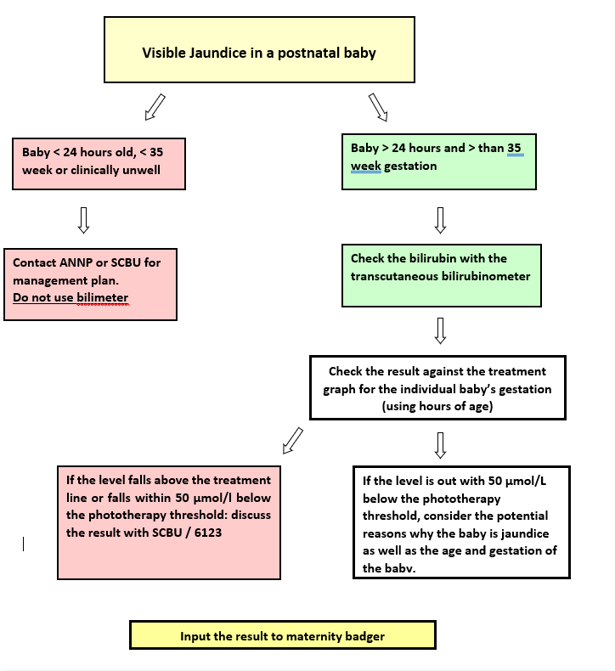
- Visibly jaundiced and more than or equal to 35 weeks gestation
- More than 24hrs of age and less than 14 days of age
- A baby who is clinically well
Which babies should not be tested with a TCB and will need review / Serum Bilirubin check (SBR)
- Any baby born under 35 weeks gestation.
- Any baby less than 24 hours old and over 14 days.
- Any baby who has received phototherapy (until > 48hrs off treatment).
- Caution should be used if suspected haemolysis
A baby who is clinically unwell (e.g. not feeding well, looks septic, dehydrated) should be referred for review regardless of jaundice level.
Once a baby has been identified as suitable for a TCB reading explain the rationale and procedure to the parents and gain verbal consent to perform the test.
Any reading over 250 micromol/litre needs referral to ANNP Bleep 6123 for SBR
Taking a reading with the MBJ20 (community staff)
(Full details can be found in POCT Delta MBJ20 Transcutaneous Jaundice Detector guidance on RDS)
- Ensure skin is clean at measurement site
- Clean tip with alcohol wipe and allow to evaporate prior to using
- Turn power switch on, it will be ready when indicator light is green
- Ensure the measuring probe is perpendicular and entire face of probe is against skin
- The measured value will appear on LCD display along with 001, press reset after noting down the result
- Take 3 readings from the MBJ20 and work out the average, plot the average result on the Bilirubin Threshold Chart on maternal badger
- If the result is below the turquoise line continue midwifery-led care considering, any feeding issues or other risk factors
- Repeat the bilirubin if jaundice has worsened on next visit.
- If the result is between the turquoise and blue line, refer to ANNP Bleep 6123 for SBR +/- review. Prepare the parents that this could mean a readmission for phototherapy.
Taking a transcutaneous bilirubin measurement JM-105 (in-patient)
- Clean the tip of the probe with an alcohol swab, allow to evaporate before using
- Press the power switch on.
- Select MENU, select MEASURE, and press OK. The letters AVE with the number of measurements selected will appear in the display
- Put in baby chi as ID number, nurse ID not required
- Select measurement site: the neonate’s mid-sternum is preferred but the forehead can be used.
- Place the Jaundice Meter JM-105 probe tip flat against the baby’s skin, not at an angle, and press lightly until you hear a click. Lift the Jaundice Meter from the skin between measurements and pause until the green READY light illuminates again. Repeat the testing procedure until 3 measurements has been taken
- Plot the result on the Bilirubin Threshold Chart on maternal badger
- If the result is below the turquoise line continue midwifery-led care considering, any feeding issues or other risk factors
- If the result is between the turquoise and blue line, refer to ANNP Bleep 6123 for SBR +/- review.


 NHS Borders clinical guidelines