Dental - Was Not Brought - Children & Young People (Age 0-18 years) & Vulnerable Adults

Warning

Objectives

This document is designed to:

  • promote the rights of children and young people (CYP)
  • support engagement with children, vulnerable adults (VA) and families regarding health & wellbeing
  • assist CYP and VA in attaining the highest standard of oral health.

This guidance is intended to set out the minimum standards and expectations for all CYP and VA who are not brought to dental appointments.  This includes face to face, remote/virtual appointments and domiciliary visits; or any other appointments where a CYP or VA needs support to attend.

It will support the early identification of barriers to engagement or safeguarding/child & adult protection concerns.

The information contained herewith must be utilised in conjunction with local existent Public Protection Policies. This document compliments, and does not replace, these policies.

Scope

This guidance observes the principles within:

  • Getting It Right for Every Child (GIRFEC)
    • This seeks to ensure that children have access to coordinated healthcare and support when they need it. It is intended to identify vulnerable CYP age 0-18 who miss planned appointments and to ensure a consistent approach is applied in managing and reducing risk to these individuals.
  • United Nations Convention on the Rights of the Child (UNCRC)
    • In 1991 the UK government included themselves in this legislation, which is a list of 42 promises made by Government to CYP aged 0-18. This includes the right to healthcare, education, equal treatment, and the right to an opinion.
  • Adult Support and Protection (Scotland) Act 2007
    • The Act specifies duties, responsibilities, and powers to safeguard adults who may be at risk of harm.

Many Significant Case Reviews (SCRs) identify that not being taken to medical and dental appointments is a common theme and often a precursor to significant harm.

Those with parental/guardianship/carer responsibilities are required to support individuals under their care with dental health, development and welfare needs. Describing CYP & VA as ‘was not brought (WNB)’ rather than ‘did not attend (DNA)’ encourages professionals to think about the situation from the individual’s perspective.  The term WNB more accurately reflects the fact that many in these groups rely on someone else to enable them to attend their appointments.

Recording or noting “Was Not Brought” allows professionals to consider all possible reasons why a CYP or VA was not brought to an appointment and the implications of this.  This will allow the professional to assess for potential risks or safeguarding concerns.

Key Principles

This guidance enforces the responsibility that all staff have to act in the best interest of those who are not brought to appointments. This guidance highlights the potential vulnerability of these individuals and outlines actions to be taken to ensure that their welfare is safeguarded.  

All staff have a duty to identify individuals experiencing, or at risk of, harm and must be aware of the processes for raising concerns:

Health professionals should aim to have an understanding of individual circumstances and care preferences, whilst encouraging discussions between family, carers, and wider partner agencies to promote meeting CYP & VA dental needs. 

Partnership working will assist in the reduction of dental health inequalities, promote attendance, and enable improvement of oral/general health and wellbeing.

All staff must be aware of the importance of recording all communication and patient information accurately and in the most appropriate location(s).  This information may be requested to inform wider professional investigations, e.g. CYP and VA review meetings.

The principles within this guidance equally apply to all CYP including aged 16-18. The majority of those aged 16 and over are presumed to have capacity to consent as an adult would.  However, they still frequently require support from a parent/carer to attend.  Therefore, consideration of wider vulnerabilities or barriers to attendance for this cohort must be considered before making the distinction between DNA and WNB.

Pathway for Child or Young Person Not Brought to Dental Appointment

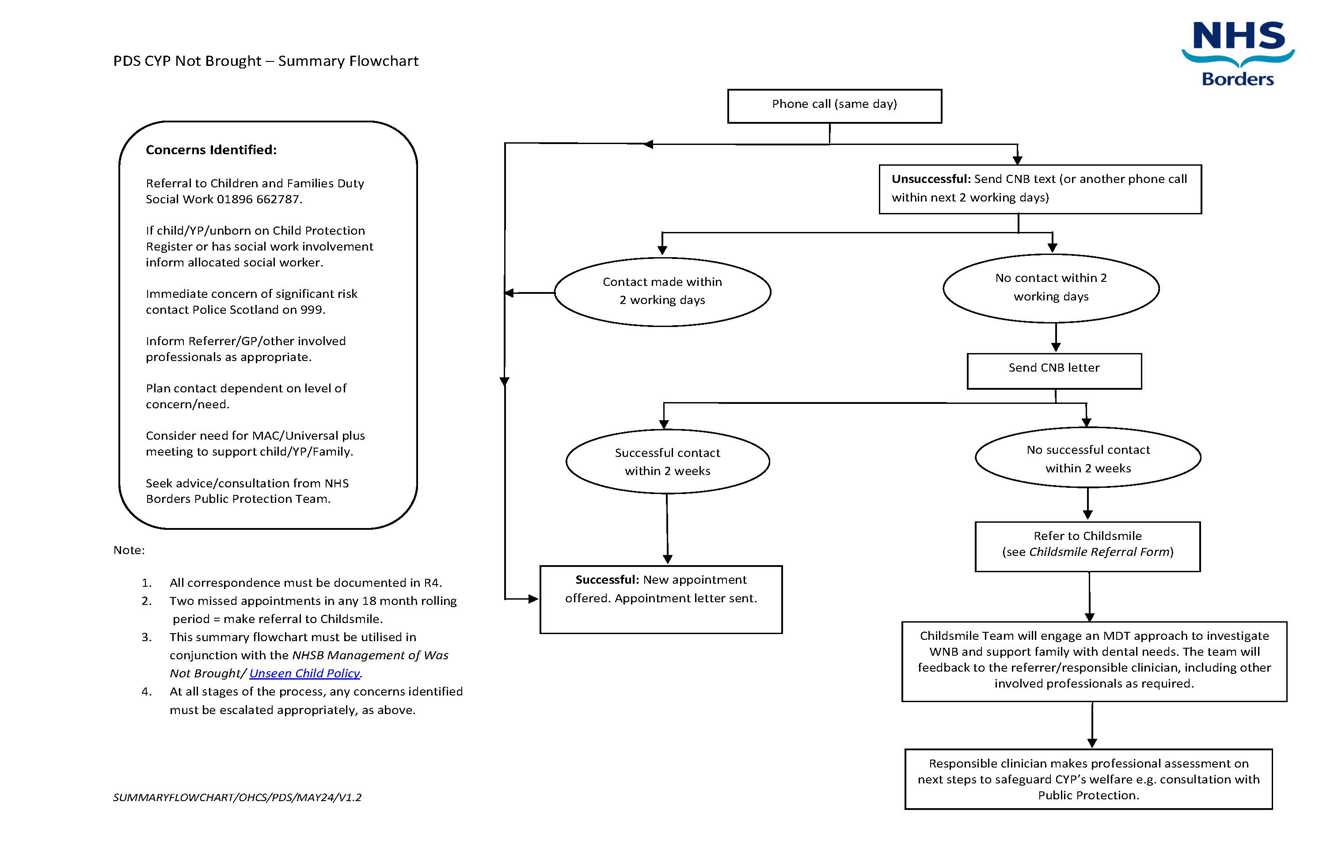
Summary flowchart available in Appendix A.

  1. If the CYP is not brought for any dental appointment, a member of the dental team will attempt to make contact with their parent/guardian by telephone the same day.  The responsible clinician must ensure this task is delegated.
  2. If telephone contact is successful, another appointment will be offered.  This will be followed up with an appointment letter.   
  3. If telephone contact is unsuccessful, a CNB text message must be sent that day, (or another phone call must be undertaken within the next 2 working days).
  4. If contact is made by the parent/guardian within 2 working days of the text message, then the CYP will be appointed and no further WNB action will be taken at this stage.  This will be followed up with an appointment letter.
  5. If within 2 working days there has been no response to the text message, a CNB letter will be sent. (See Appendix G & Appendix H for age-appropriate letter).
  6. If contact is made by the parent/guardian within 2 weeks of this letter, then the CYP will be appointed and no further WNB action will be taken at this stage.  A follow up appointment letter will be sent.
  7. If there is no response to the letter within two weeks, a Childsmile referral is required (see referral form in Appendix D).  . 
  8. All correspondence including telephone communication must be documented within the CYP R4 comms.
  9. If a child does not attend for 2 appointments within a rolling 18-month period (whether consecutive or not), a Childsmile referral must be submitted via the appropriate referral pathway (further information on the Childsmile referral pathway is available in Appendix C)..  The responsible clinician must be copied into all referral correspondence.
    1. If significant barriers to attendance or suspicion of disguised compliance is identified at any stage, regardless of appointment status, a referral must be made to Childsmile.
    2. The Childsmile team will investigate why the CYP has not been brought and will offer assistance to overcome any barriers identified.  It must be noted that the responsibility of the clinician remains throughout.  They will be fed back all information gained by the Childsmile team and must use this to make a professional judgement on any next steps to safeguard a CYP’s welfare.

The Duty Team are also available to advise any staff on any concerns they have about an individual.

If you consider a child or young person to be in immediate danger, call the police on 999 without delay. If you need advice, information or to report a concern contact the Children & Young Persons Social Work Duty Team on 01896 662787.
Pathway for Vulnerable Adult Not Brought to Dental Appointment

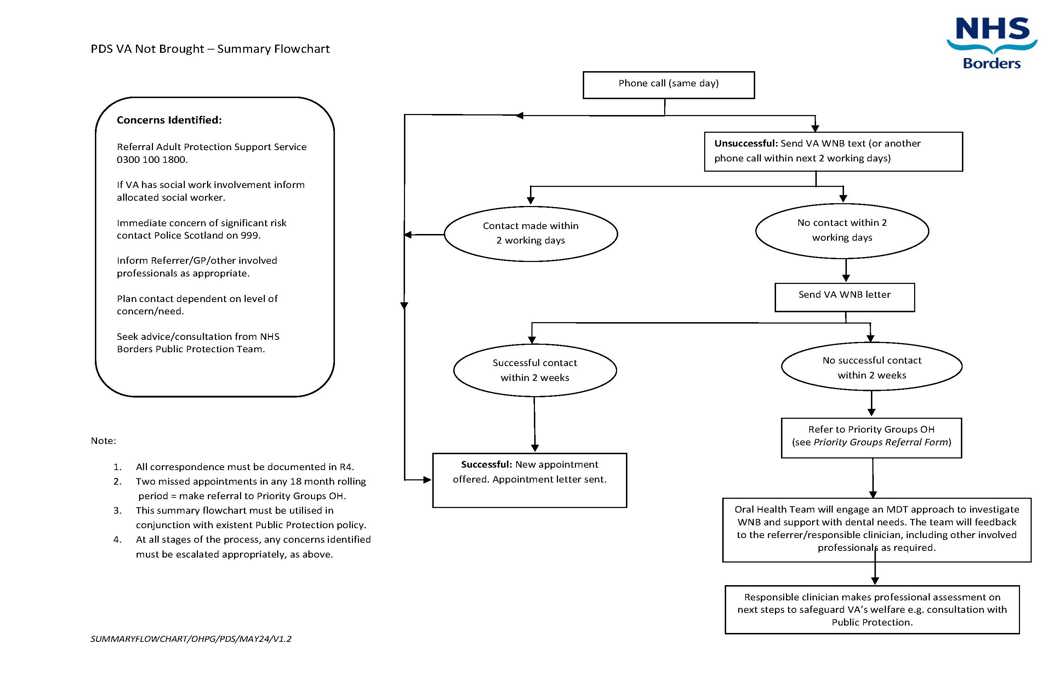
Summary flowchart available in Appendix B.

  1. Note: Many VA rely on a care team to assist them in making and attending appointments. In these circumstances, the care team should be contacted, as well as the welfare guardian (or relevant other), if known.
  2. If a VA is not brought for any dental appointment, a member of the dental team will attempt to make contact with them or their welfare guardian (or relevant other) the same day.  The responsible clinician must ensure this task is delegated.
  3. If telephone contact is successful, another appointment will be offered. This will be followed up with an appointment letter.       
  4. If telephone contact is unsuccessful, a VA text message must be sent that day, (or another phone call must be undertaken within the next 2 working days).
  5. If contact is made by the patient or their welfare guardian (or relevant other), within 2 working days of the text message, then the patient will be appointed and no further WNB action will be taken at this stage.  This will be followed up with an appointment letter.
  6. If within 2 working days there has been no response to the text message, a ‘VA letter’ will be sent.
  7. If contact is made by the patient or their welfare guardian (or relevant other), within 2 weeks of this letter, then the patient will be appointed and no further WNB action will be taken at this stage.  A follow up appointment letter will be sent.
  8. If there is no response to the letter within two weeks, a Priority Groups referral is required.  
  9. All correspondence including telephone communication must be documented within the patient’s R4 comms.
    1. If a VA does not attend for 2 appointments within a rolling 18-month period (whether consecutive or not), a Priority Groups referral must be submitted via the appropriate referral pathway.  The responsible clinician must be copied into all referral correspondence.
    2. If significant barriers to attendance or suspicion of disguised compliance is identified at any stage, regardless of appointment status, a referral must be made to the Priority Groups team within Oral Health.
    3. The Priority Groups team will investigate why the VA was not brought and will offer assistance to overcome any barriers identified.  It must be noted that the responsibility of the clinician remains throughout.  They will be fed back all information gained by the Priority Groups team and must use this to make a professional judgement on any next steps to safeguard a VA’s welfare.

The Duty Team are also available to advise any staff on any concerns they have about an individual. If you consider a vulnerable adult to be in immediate danger, call the police on 999 without delay.

If you need advice, information or to report a concern contact the Adult Protection Support Service on 0300 100 1800

Glossary of Terms

  • CYP – children and young people (aged 0 to 18th birthday).
  • Disguised compliance – where there is the appearance of engagement from a parent/guardian, but appointments are still frequently missed/cancelled. Or, after periods of non-engagement may attend appointments to reduce professional’s concerns.
  • DNA – did not attend. The term used to describe a missed appointment for an individual who does not rely on a third party to support their attendance (i.e., not a CYP or VA).
  • Responsible clinician – the Dentist or Dental Care Professional whom the patient has missed their appointment with.
  • Significant Case Review – this is a multi-agency process for establishing the facts of and learning lessons from a situation where a vulnerable individual has died or been significantly harmed.
  • VA – vulnerable adult.
  • Vulnerability – in need of special care, support or protection because of age, disability, risk of abuse or neglect.
  • WNB – was not brought. CYP or VAs who require the support of a parent/guardian/care giver to attend appointments and do not attend them are classified as WNB. This term replaces ‘did not attend (DNA)’ as it more accurately reflects the reliance on a third party to enable the CYP or VA to attend.

Useful Contacts

Appendix A - CYP Not Brought – Summary Flowchart

Appendix B - PDS VA Not Brought – Summary Flowchart

Appendix C Oral Health Improvement Childsmile Referral Pathway

Appendix D - Public Dental Service Childsmile Referral

Appendix E - Oral Health Improvement Priority Groups Referral Pathway

Appendix F - Dental Services Priority Groups Referral

Appendix G - CNB 0-15 Letter

Appendix H - CNB 16-18 Letter

Appendix I - Vulnerable Adult letter

Editorial Information

Last reviewed: 18/06/2024

Next review date: 30/06/2027

Author(s): Bryce C.

Version: DEN002/2.4

Co-Author(s): Children's Dental Needs Group.

Approved By: Child not Brought policy group

Reviewer name(s): Clinical Governance & Quality.

Related guidelines
Related resources

Adult Support and Protection: Ensuring Rights and Preventing Harm pdf (scot.nhs.uk)

BDA: Implementing Was Not Brought in Your Practice Was Not Brought implementation guide AW.pdf (bda.org)

Children & Young People’s Commissioner Scotland https://www.cypcs.org.uk/rights/uncrc/

Getting It Right for Every Child (GIRFEC)  https://www.gov.scot/policies/girfec/

National Guidance for Child Protection in Scotland 2021 https://scotgov.theapsgroup.scot/national-guidance-for-child-protection-in-scotland/ 

NHS GGC Was Not Brought Guidance for Children and Young People was-not-brought-guidance-final-2-25.pdf (scot.nhs.uk)

United Nations Convention on the Rights of the Child UN Convention on the Rights of the Child - UNICEF UK

Vulnerabilities: Applying All Our Health Vulnerabilities: applying All Our Health - GOV.UK (www.gov.uk)