Assessment and Investigation of the floppy infant

Warning

Objectives

This guideline is to assist in the evaluation of infants under 6 months old presenting with unexplained, persistent low muscle tone and delayed gross motor skill development.

Scope

This document applies to all healthcare professionals involved in the care of children and young people within NHS Tayside.

Any baby who is acutely unwell can become floppy.  These babies will have a history of normal tone, behaviours and motor skill development prior to the illness and are not covered by this guidance.   

Audience

All healthcare professionals involved in the care of children and young people within NHS Tayside primary and secondary care.

Introduction

Babies who are hypotonic may present to health visitors, GPs, paediatric physiotherapists, neonatal clinic, neurology clinic, community child health clinic or the Paediatric Assessment Unit. They may present with other health issues and hypotonia is noted as part of that assessment. 

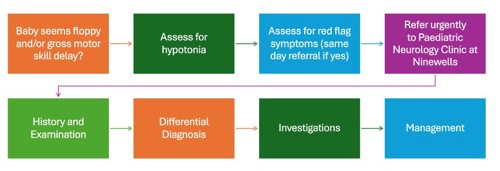
True hypotonia is uncommon in babies and is almost always the result of a significant underlying health issue. Some of these medical conditions, such as Spinal Muscular Atrophy, are treatable and earlier treatment is associated with improved outcomes.  For this reason, floppy babies need to be assessed promptly by an experienced paediatrician.  In Tayside, hypotonic infants should be referred urgently to the Paediatric Neurology team, as per the pathway below.
Definitions

Definition of Muscle Tone: 

Muscle tone is the resting tension of muscle, and the resistance of muscle to passive stretch.  Low tone, or hypotonia, results in babies appearing floppy at rest and feeling floppy on movement.   

Definition of Muscle Weakness: 

Muscle weakness is a reduction in the power that muscle can generate.  


Weakness is always accompanied by hypotonia, but hypotonia may be present without weakness.  

In clinical practice it can be difficult to distinguish low tone from weakness in an infant.  Neither is a normal finding.

Assessment of hypotonia

Resting position:  

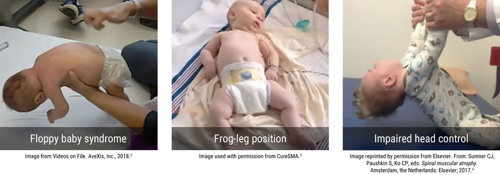
Young babies should maintain a flexed posture at rest.  A hypotonic baby may lie in a more open ‘frog legged’ position.

Head Lag:   

A normal term infant should be able to briefly hold their head in line with their back when held prone. By 2 months of age, they should be able to lift their head higher than their shoulders when held prone. By 4 months of age a baby should have no head lag when being pulled to sit from lying supine. A hypotonic baby will have persistent head lag and adopt a ‘rag doll’ posture with minimal antigravity movement when held prone.  

Response to being lifted: 

Typically developing infants will resist gravity when being picked up.  A hypotonic baby will feel like they are slipping through your hands when lifted.

Pictures of floppy baby
From: https://www.zolgensma-hcp.com/understand-sma/what-is-sma. Accessed 26/11/2025.

History (including red flag symptoms)

Key considerations:

In addition to the usual paediatric history, there are key elements to ask about: 

  • Antenatal: polyhydramnios, reduced foetal movements and malpresentation 
  • Delivery: concerns about hypoxia in labour, mode of delivery, APGAR scores, resuscitation 
  • Post natal: post delivery care needs, early feeding 
  • Family History: consanguinity, history of cardiac or muscle issues, does mum look myotonic? 

Red flag symptoms:

Hypotonia and muscle weakness can be life threatening.    

Feeding: 

Babies who are very hypotonic may not be able to effectively coordinate sucking, swallowing and breathing and may therefore feed poorly.   

Babies who are weak may not have a safe swallow and will be at risk of aspiration.   

Any feeding or weight concerns in the context of hypotonia requires prompt assessment by a Speech and Language Therapist to consider NG feeding. This may require an inpatient admission if they are at home.  

Breathing: 

Hypotonic babies are at risk of aspiration.  Any suspected chest infection in a floppy baby is a red flag and requires prompt feeding assessment.  

Weak babies may have respiratory muscle weakness and find it difficult to breathe effectively.  If a floppy baby has signs of respiratory distress (increased respiratory rate, nasal flaring, intercostal recession, sternal recession, subcostal recession, pectus excavatum or hypoxia) they require inpatient admission and respiratory assessment.   

Examination

Assessment of tone and red flag signs as above 

A top-to-toe assessment should be carried out, paying particular attention to:

  • Dysmorphic features 
  • Facial movements – does the baby open and close their eyes and mouth normally?  Do they screw up their face when crying?  
  • Congenital malformations 
  • Weight, length and head circumference 
  • Organomegaly 
  • Genitalia 
  • Deep tendon reflexes

Differential Diagnosis

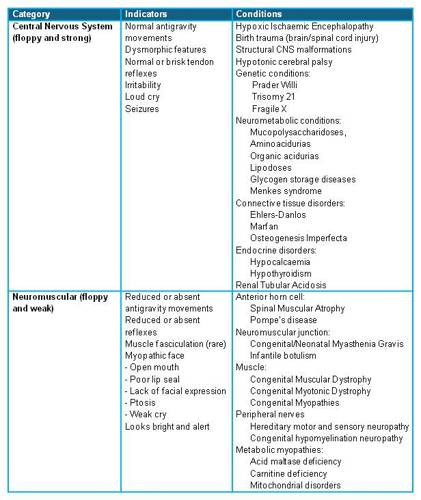
Persistent infant hypotonia +/- weakness can be caused by many conditions.  These can be divided into pathology of the central nervous system (brain and spinal cord) and pathology elsewhere.

Table showing floppy infant - differential diagnoses
Floppy infant - differential diagnoses

Investigations

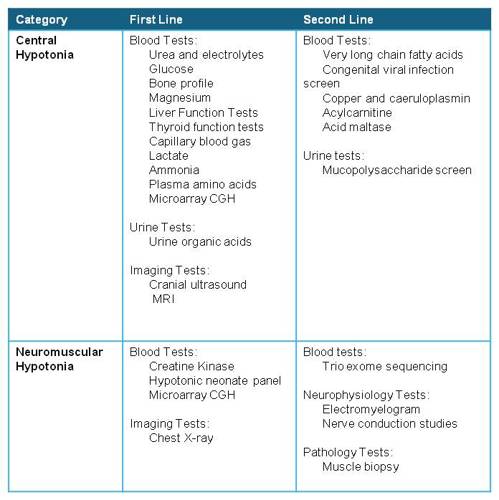
Investigations will usually be directed by either a consultant neonatologist, if the baby is in the neonatal unit, or a paediatric neurologist, if the baby is an outpatient. Investigations will be guided by the clinical picture and most likely differential diagnoses.  

Investigations are likely to include biochemical tests looking for evidence of systemic disorders, metabolic conditions and genetic conditions.   

There is a neonatal hypotonia gene panel available under the Genetics tab on ICE which tests for Prader Willi Syndrome, Spinal Muscular Atrophy and Myotonic Dystrophy.  A microarray CGH should be sent at the same time. It is important to discuss the baby with a clinical geneticist if this panel is to be requested.  

Imaging of the baby’s brain with an MRI scan may also be appropriate. Most young infants will manage this without sedation, using the feed and wrap protocol.  

Suggested Investigations include:

Table showing investigations for floppy infant
Floppy infant - investigations

Management

Medical management will depend on the cause of the hypotonia. For some conditions such as SMA and some metabolic disorders there are specific treatments available. In many cases treatment will be supportive and require an MDT approach.  

Babies who are hypotonic are likely to need support from Allied Health Professionals.  You should consider a referral to their local Integrated Therapy Team, comprising community based physiotherapists, occupational therapists and speech and language therapists.  

Babies who have a confirmed or suspected neuromuscular disorder, or who have complex health needs, should be referred to the community based neurodisability team for ongoing care coordination and multi system medical management.  

Editorial Information

Last reviewed: 12/12/2025

Next review date: 12/12/2027

Author(s): Dr Jennifer McInally.

Version: 1

Author email(s): Jennifer.Mcinally@nhs.scot.

Approved By: NHS Tayside paediatric clinical governance group

References

Ahmed MI, Iqbal M, Hussain N. A structured approach to the assessment of a floppy neonate. J Pediatr Neurosci. 2016 Jan-Mar;11(1):2-6. doi: 10.4103/1817-1745.181250. PMID: 27195025; PMCID: PMC4862282.