

Osteoarthritis
 NHS Tayside RefGuide

Referring to secondary care
- Referral for consideration of surgery for those with joint symptoms which have a substantial impact on their quality of life and are refractory to non-surgical treatment
- Referral to the pain service or psychological services may be appropriate in some patient
- Refer to Rheumatology if there is concern regarding an inflammatory form of arthritis
Background
OA is the most common joint disease worldwide and is a leading cause of chronic disability in older adults.
Joint damage may occur through repeated excessive loading and stress of a joint over time, or by injury. Damage triggers repair processes leading to structural changes within a joint, causing typical features of:
- localized loss of cartilage
- remodelling of adjacent bone and formation of osteophytes
- mild synovitis
In some people, these repair processes may alleviate symptoms, but in others they cannot fully compensate for the joint damage meaning symptoms of pain and stiffness may occur.
Risk factors for the development of OA include increasing age, female sex, obesity, previous joint injury and exercise and occupational joint stresses.
Diagnosis
OA should be diagnosed clinically without investigations if a person:
- is 45 or over and
- has activity-related joint pain and
- has either no morning joint-related stiffness or morning stiffness that lasts no longer than 30 minutes.
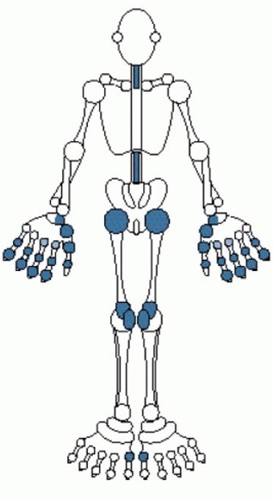
Typical joints affected are shown in the illustration below:
On examination there may be:
- Bony swelling and joint deformity.
- Joint effusions (uncommon except for the knee).
- Restricted and painful range of joint movement and crepitus
Routine X-ray is not usually needed to confirm the diagnosis.
Consider arranging an X-ray:
- If there is diagnostic uncertainty
- To exclude alternative conditions
- If there is a sudden clinical deterioration in symptoms
Radiological features of OA include subchondral bone thickening and/or cysts, osteophyte formation and loss or narrowing of the joint space.
Note: structural changes on X-ray may not correlate with reported symptoms and functional impairment.
Non-pharmacological management
- Provide information leaflets such as those available from Versus Arthritis (see below)
- Weight loss if the person is overweight or obese
- Exercise is a core treatment irrespective of age, comorbidity, pain severity or disability. Exercise should include local muscle strengthening and general aerobic fitness
- Additional options such as appropriate footwear, local heat or cold packs, and/or transcutaneous electrical nerve stimulation (TENS)
- Psychological support if there is associated stress, anxiety or depression
- Occupational health assessment, to consider alteration of work tasks, working hours and workplace modifications, if needed
- Consider referral to a physiotherapist for individualised physical treatment
- Consider referral to an occupational therapist for hand OA
- Consider referral to a podiatrist for foot pain.
Pharmacological management
- Paracetamol for pain relief in addition to core treatments. Regular dosing may be required
- Topical non-steroidal anti-inflammatory drugs (NSAIDs) should be considered ahead of oral NSAIDs or opioids
- If paracetamol or topical NSAIDs are insufficient for pain relief, then the addition of opioid analgesics or oral NSAIDs should be considered. Risks and benefits should be considered, particularly in older people
- Use oral NSAIDs at the lowest effective dose for the shortest possible period of time.
Resources
- Versus Arthritis booklet on osteoarthritis and knee osteoarthritis
- Pain Association Scotland is a charity which organises community based group education and self-management programmes for patients with chronic pain.
- NICE Clinical Knowledge Summary 2018
- NICE Clinical guideline CG 177 Osteoarthritis: care and management