NHS Tayside RefGuide
- Ideally the patient takes oral analgesia half an hour before the procedure (type according to the patient’s preference) +/-
- Inject local anaesthesia to tenaculum/ vulsellum site (if requested by patient) +/-
- Apply cervical block (type according to clinician’s preference) (if requested by patient)
"Lost" IUD/IUS threads guidance for Primary Care

Warning
This guidance is written for health care providers in Primary Care to help them to deal with patients using an intrauterine device (IUD) or intrauterine system (IUS) and presenting with “lost threads”.
General advice
Please assume that IUS/IUD with “lost threads” is not in situ and consider the need of a pregnancy test (PT), emergency contraception and a bridging contraceptive method.
The “lost threads” flow charts are aimed at clinicians at different levels of competency and experience in dealing with this clinical presentation. Which pathway to take depends on whether the patients want to keep their IUC or wants it replaced/removed.
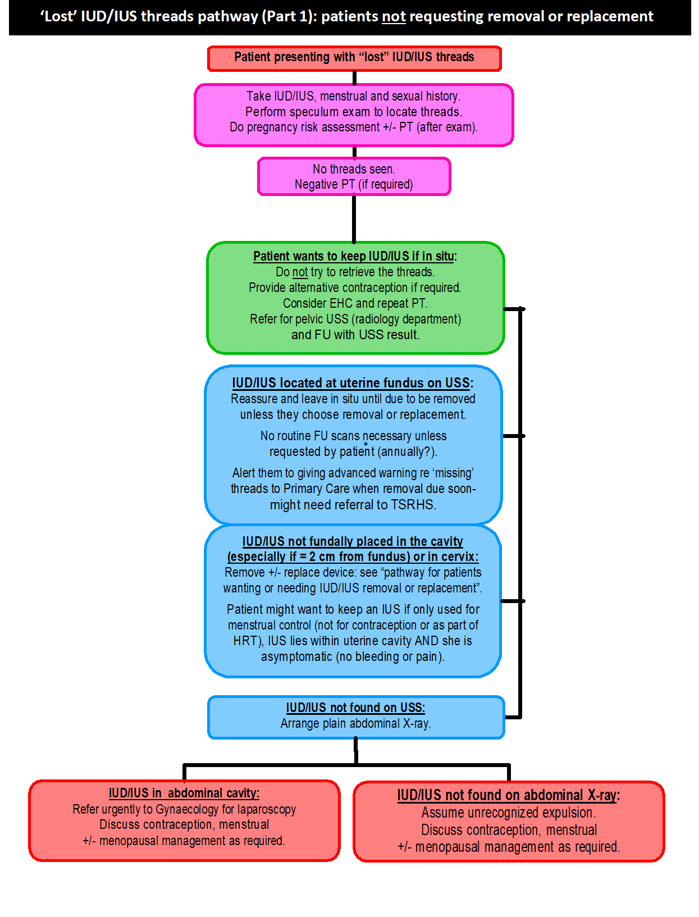
For those wanting to keep their IUC, please request a pelvic USS (Radiology Department).
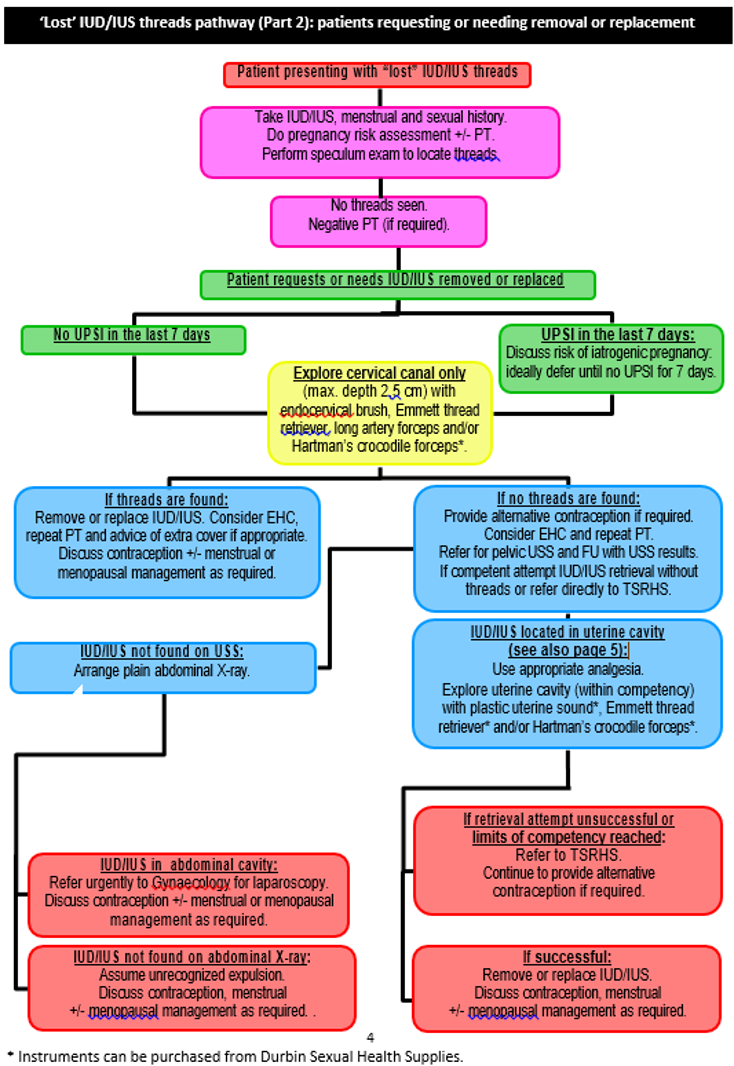
Device retrieval in patients with “lost threads” who want the device removed or replaced can be attempted by practitioners within their competency and experience and with appropriate analgesia. The cervical canal could be explored without a pelvic USS confirming the presence of the device. However, it’s not recommended to explore the uterine cavity if not sure that the device is in place.
Please refer the patient electronically to Tayside Sexual & Reproductive Health Service (TSRHS) via SCI Gateway either directly, or if attempt to remove the IUD/IUS was not successful.
Some important points to remember:-
- Most “lost threads” reported by a patient can be found on VE or speculum exam.
- Reasons for lost IUS/IUD threads on speculum examination (in descending order of frequency):
- they are curled up in the cervix or endometrial cavity,
- the IUD/IUS was inserted lower than the uterine fundus and has moved up, pulling the threads on the way (“fundal-seeking”),
- the threads were cut short (accidentally or on purpose) or broke off,
- the threads are very short for one of the reasons above and only are visible part of the cycle,
- the IUD/IUS has expelled (more likely the six months after insertion and in patients with heavy menstrual bleeding (HMB) but can happen at any time),
- the patient is pregnant and the IUS/IUD has been pulled up by the growing uterus.
- the IUD/IUS perforated and is lying abdominally.
- Nonetheless: please assume that IUS/IUD with “lost threads” is not in situ as default and consider the need of a pregnancy test (PT), emergency contraception and a bridging contraceptive method.
- Please arrange a pelvic USS (Radiology Department) for patients who have lost threads but want to keep their IUD/IUS. Patients who are referred to TSRHS for an IUD/IUS removal or replacement will get their TV USS scan at their appointment.
- Please do not try to bring down “lost threads” in patients who want to keep their device as this can displace the device and reduce its effectiveness.
- Please do not explore the uterine cavity to remove an IUD/IUS with “lost threads” unless the patient had a recent USS¹ showing the device being in situ.
- If removing an IUD/IUS within 7 days of unprotected sexual intercourse (UPSI) on the request of a patient who accepts the risk of an iatrogenic pregnancy: please discuss emergency hormonal contraception (EHC) and recommend a follow-up pregnancy test (PT) three weeks after the last UPSI.
- Emergency contraception: (if indicated) do not give ulipristal acetate (EllaOne®) emergency contraception to patients with (possibly) an IUS in situ as any systemic hormone level might reduce its effectiveness. Give levonorgestrel (Upostelle®, Levonelle®, Emerres Una®) emergency contraception instead.
- Due to the uterine contractions a very short intracervical thread might reappear spontaneously around menstruation. The retrieval +/- reinsertion procedure might also be easier.
- Please remember that a patient who is pregnant with an IUS/IUD in situ has an up to 50% risk of having an ectopic pregnancy. There is also an increased miscarriage risk. Do not attempt to remove the IUD/IUS in Primary Care. Please refer any pregnant woman with (possibly) an IUD/IUS in situ to the Early Pregnancy Assessment Clinic (EPAC) at Ninewells (632 069) or, if she is in pain, to the Gynaecology Assessment Unit (GAU) (632 761) for an urgent USS to locate the pregnancy +/- the IUD/IUS.
"Lost" IUD/IUS threads pathway (part 1): patients not requesting removal or replacement
"Lost" IUD/IUS threads pathway (part 2): patients requesting or needing removal or replacement