NHSL Referral Pathways
Peyronie's Disease Information Letter

Warning
Thank you for referring this patient with symptoms of Peyronie’s disease. We have also sent a copy of this letter to the patient along with the British Association of Urological Surgeons (BAUS) information leaflet. It would be most useful if the patient could work through this leaflet before their clinic appointment.
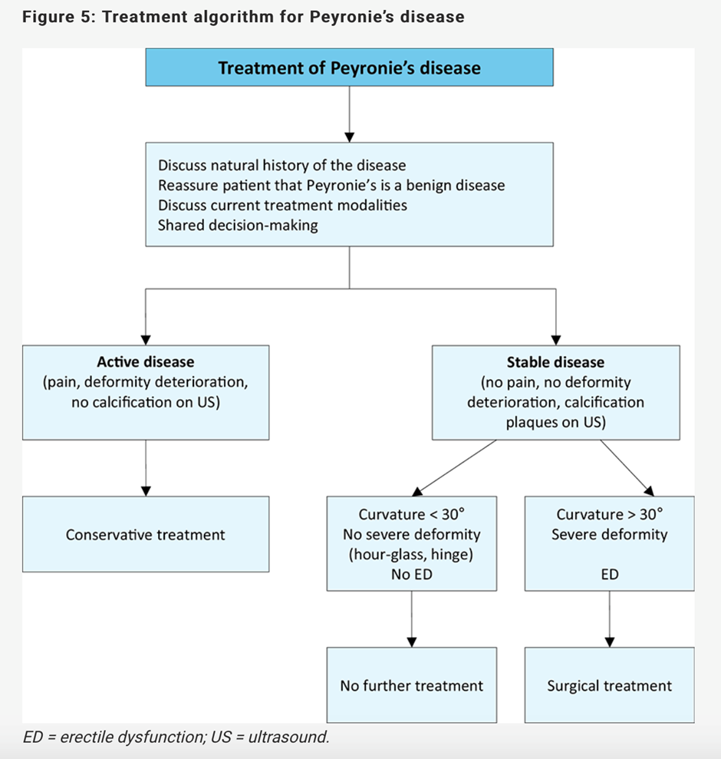
Peyronie’s disease is a benign condition characterised by penile curvature caused by a fibrous plaque of remodelled connective tissue. This condition could be associated with erectile dysfunction. There is an acute and a chronic phase to the disease.
The initial acute painful phase, which lasts for 3-6 months is associated with active inflammation and remodelling still occurs. The end of the acute phase is usually marked by cessation of pain. The curvature arises from reduced elasticity of the plaque and worsens during the acute phase as inflammation is ongoing.
The chronic phase or stabilized phase where the curvature should stabilize (70%), re-enter the acute phase (20%) or occasionally (10%) improve. It is during the chronic phase where secondary care intervention can be considered and patients should be referred at this stage.
Our current guidelines suggest managing the acute phase of Peyronie’s disease (0-6 months) in the primary care setting. We recommend the following steps.
- History taking including duration of disease, associated pain, extent of deformity, inability of penetrative intercourse, erectile dysfunction either pre-existing or post onset
(EAU guidelines – Strong).
- Examination of the penis (for palpable plaques)
(EAU guidelines – Strong).
- Trial of NSAIDS (if tolerated) for pain during acute phase
(AUA guidelines – Expert opinion, EAU guidelines - Strong).
- Self-measurement and photographs (of the erect penis by patient at onset of symptoms for use in determining treatment at later stage if required. Patient to bring photo to clinic.
- The International Index of Erectile Function (IIEF-5) form should be brought to clinic when re-referred (EAU guidelines – Strong).
- Trial of NSAIDS (if tolerated) for pain during acute phase
(AUA guidelines – Expert opinion, EAU guidelines – Strong)
- Treat erectile dysfunction with phosphodiesterase-5 (PDE5) inhibitors (unless contraindicated)
(EAU guidelines – Weak)
N.B Oral or topical treatment are NOT recommended due to insufficient evidence and risk of serious side effects. (AUA guidelines – Moderate, EAU guidelines – Strong)
Referral to secondary care is indicated if patients show signs of the chronic phase of Peyronie’s disease and wish to consider surgical options. Indications at this stage any of the following:
- Inability achieve penetrative intercourse due to deformity
- Persistent erectile dysfunction (Refractory to trial of two PDE5 inhibitors at maximum dose or where PDE5 inhibitors are contraindicated or not tolerated.
https://www.baus.org.uk/_userfiles/pages/files/Patients/Leaflets/Peyronies.pdf
Above is a link to further information on the topic form the British Association of Urological surgeons.