1. Right Decisions
  2. Back
  3. Optimal cancer diagnostic pathways
  4. Colorectal cancer
Warning

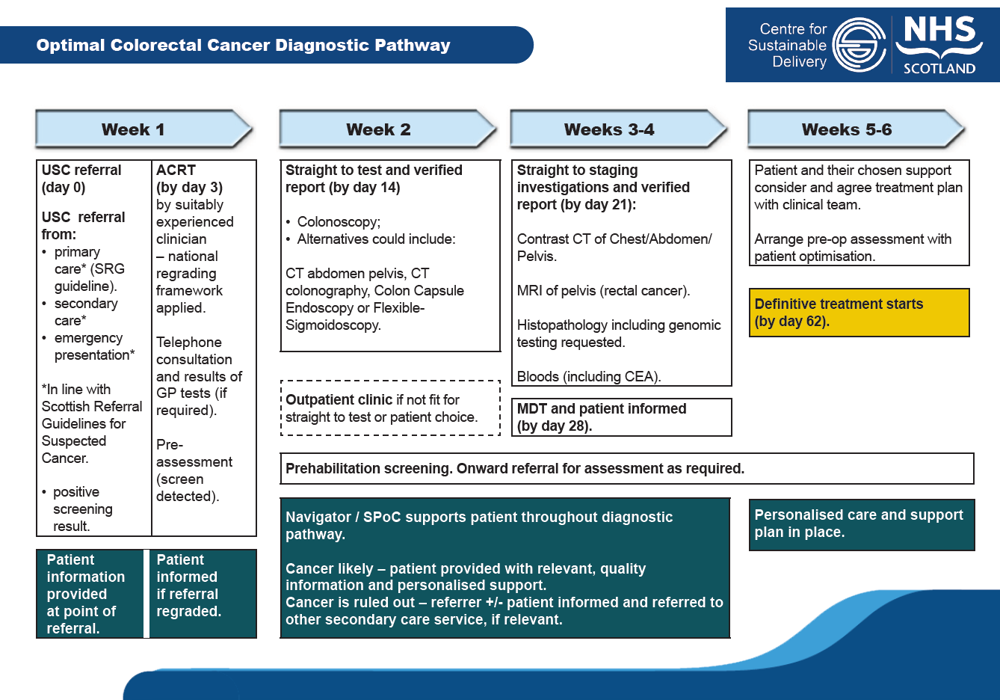
Click the image below to open a pdf of the pathway diagram.


Pathway recommendations

Week 1

The Urgent Suspicion of Cancer (USC) Primary Care referral pathway should be used for patients who meet the Scottish Referral Guidelines (SRG) for Suspected Cancer criteria.

Patients will also be referred, who meet the screening threshold, through the Scottish Bowel Screening Programme which invites those aged between 50 and 74 to participate in bowel screening every 2 years.

Primary care should inform the patient that they are being referred as USC at the point of referral, while reassuring them that the majority of referrals result in a non-cancer diagnosis.

Primary care should also make the patient aware of their responsibility to make themselves available for tests and appointments in the coming days/weeks, as they may be invited at short notice. 

Including as much relevant information and supporting materials in the initial referral from primary care is key to enabling active clinical triage to ensure the patient is on the right pathway at the right time. As per the Scottish Referral Guideline, if lower gastrointestinal cancer is suspected:

  • Perform an abdominal and rectal examination;
  • Arrange blood tests for renal function, liver function and full blood count plus ferritin/iron studies if anaemic.

Active Clinical Referral Triage (ACRT)

Clinical triage can be done by a suitably experienced clinician – preferably by a consistent group, regularly and should be complete within 3 days of the patient being referred (allowing for the weekend).

A national consensus was reached by the clinical community across NHS Scotland regarding the use of qFIT for prioritisation of patients with new lower gastrointestinal symptoms and should be adopted in all Health Boards - National Quantitative Faecal Immunohistochemical Testing (qFIT) for Patients with New Lower Gastrointestinal Symptoms 2024. Where possible, the referrer should provide details of any weight loss and the numerical value of the qFIT when referring to secondary care to allow effective triage.

If a USC referral is regraded at the point of vetting, the USC National Regrading Guidance should be adopted with the initial referrer and patient informed.

Pre-assessment (screen detected)

Patients referred through the National Bowel Screening Programme should have a pre-assessment to assess their suitability for diagnostic testing. How the pre-assessment is undertaken is for Health Boards to determine.


Week 2

The patient should have their first diagnostic test with a verified report, by day 14.

The majority of patients will have a colonoscopy as their initial diagnostic test, however there will be instances where this is not suitable for the patient. As such, alternatives could include CT abdomen pelvis, CT colonography, Colon Capsule Endoscopy or Flexible-Sigmoidoscopy.

If cancer is suspected or diagnosed during the diagnostic test, staging investigations should be booked as soon as possible. Allowing and supporting staff such as nurse endoscopists to request staging investigations can help speed up the process.

Where possible, a navigator or Single Point of Contact (SPOC) should be identified to provide consistent contact, build trust and generally support the patient throughout the diagnostic pathway.

Patients should be informed about cancer being ruled out, or diagnosed, at the earliest opportunity using the preferred method of communication agreed with the patient, this could be face to face or via telephone/virtual.

In cases where cancer is likely, the patients should meet the Cancer Nurse Specialist (CNS), be considered for a prehabilitation referral and further tests arranged.

In cases where cancer is excluded, USC patients can be removed from tracking on a 62 day pathway and referred back to Primary Care where appropriate.

Prehabilitation (prehab)

When prehab is effectively embedded it can improve a patient’s chance of positive clinical outcomes, helping them to recover more quickly from surgery, chemotherapy and radiotherapy, and reduce the chance of developing other problems during and after treatment.

All patients should be screened to identify level of prehabilitation need (universal, targeted or specialist intervention) to ensure they are supported by the right people, at the right place, at the right time.

Those who are identified with higher level of support needs (targeted and specialist) should be referred for onward assessment.

Useful first steps to delivering prehab are included in the NHS Scotland prehab website and the Maggies website.  


Weeks 3-4

Standard imaging protocols should be applied for all CT, MRI and ultrasound and these should comply with Royal College of Radiologists’ recommendations or equivalent. Where MRI is required for suspected rectal cancer, reporting should be completed by day 21.

Reports for tissue sampling should be available in advance of the multi-disciplinary team (MDT) meeting by day 28.

All histopathology should have a clear indicator which clarifies the urgency and date that the report is required by, this will ensure that the timescales for MDT reporting is not lost between different clinicians or teams. Genomic results, though needed, should not result in a delay to the MDT meeting taking place, these results can be considered after MDT meeting has taken place.

The MDT meeting is the culmination of patient examinations/consultations and diagnostic investigations.

The MDT meeting provides a professional forum to discuss patients’ results and explore and agree the most effective treatment options available.

It is crucial that all MDT meetings are coordinated and managed effectively to ensure there’s clinical agreement on the next step of the patient’s pathway and a decision to treat is not delayed. Recommendations on delivering effective MDT meetings can be found in the Framework for Effective Cancer Management. The patient should be informed of their diagnosis by day 28, following the MDT meeting.


Weeks 5-6

Personalised care and support planning should be based on the patient and clinician(s) completing a holistic needs assessment (HNA), shortly after diagnosis.

The HNA ensures conversations focus on what matters to the patient and considers wider health, wellbeing and practical support required. This helps enable shared decision-making regarding treatment and options.

Useful resources include the nutrition and psychological therapies and support frameworks. 

Improving the Cancer Journey (ICJ) Teams across NHS Scotland have shown that they are particularly good at engaging and supporting those in lower SIMD quintiles which could help address inequalities among colorectal cancer patients. Patients are invited to engage with ICJ as early as possible and the ICJ Team can help to address all non-clinical needs.

Treatment

Within weeks 5 to 6, patients should jointly agree their treatment plan (decision to treat) with their clinical team.

To ensure that the referral for treatment happens as efficiently as possible, prompt notification to the treating specialist is required. This should include the results of pre-operative tests already performed such as biopsy reports and genetic testing.


Best practice examples

NHS Tayside

NHS Tayside found that triage and virtual vetting of bowel screening colonoscopy referrals does not have a negative impact on colonoscopy uptake.

It was agreed that continuing telephone pre-assessment for all positive tests would incur significant delays and therefore an alternative option had to be found.

NHS Tayside aimed to replicate 'virtual vetting' which is fully embedded in the symptomatic service for vetting new referral for colonoscopy - in which the vetting clinician reviews the patient's electronic patient record for comorbidity, medications, mobility etc. (through which the majority of patients are triaged straight to test).

Full details are available here.


NHS Highland

NHS Highland introduced a centralised booking system for endoscopy that has improved their waiting times -copy of their booking flowcharts below

Full details are available here.


 NHS Tayside

In NHS Tayside staging imaging is requested by either the endoscopist or specialist nurse at the time of endoscopy whilst awaiting biopsy results. Specialist nurses inform the patient if a possible cancer diagnosis is expected following their endoscopy procedure. This means that the patient and their relatives are well informed about what happens next, about timelines re further investigations and are advised that they will be discussed at the next MDT meeting. 

The specialist nurse uses this contact with the patient to find out more about the patient and their symptoms / personal wishes to complete the person-centred section of the MDT outcome form. Patients are given details of who to contact as well as ‘worsening advice’ if required. Patients and relatives have expressed that they like being able to put a face to a name when they are contacting the service thereafter.

A Colorectal Patient Passport has been developed and trialled with patients and has received very positive feedback. This will be provided to all patients at this point of contact with the specialist nurses.

If you would like more information, please contact tay.cancercare@nhs.scot


NHS Dumfries & Galloway

In NHS Dumfries & Galloway, a direct to colonoscopy pathway has been in place since January 2024 - this includes protected colonoscopy slots being made available with the aim that all patients are offered a colonoscopy date within 14 days of GP referral. Although this can’t be directly attributed to the pathway, NHS D&G has seen an increase in non-screened performance from 84.4% in 2023 to 96.4% in 2024.


NHS Lothian

NHS Lothian use a biopsy protocol to categorise tissue removed after scope in terms of prioritisation.

Full details are available here.


NHS Lanarkshire

NHS Lanarkshire has implemented weekly Patient Tracker List (PTL) meetings during which the CNS can feed in and provide advice to Cancer Trackers, allowing for an effective escalation process where necessary.


Our best practice examples are continually being reviewed and updated. If you have any examples you would like us to share, please contact us to discuss. Equally if you would like any further information on the examples above, please contact us at cfsdcancerandedteam@nhs.scot


Further resources

Framework for Effective Cancer Management (2025) - https://www.gov.scot/publications/framework-effective-cancer-management-2/

National Quantitative Faecal Immunohistochemical Testing (qFIT) for Patients with New Lower Gastrointestinal Symptoms 2024 – https://www.nhscfsd.co.uk/media/hifbxk0i/quantitative-faecal-immunohistochemical-testing-2024-v6.pdf

Detect Cancer Earlier (DCE) Programme (Colorectal) - https://getcheckedearly.org/bowel-cancer

Scottish Referral Guidelines for Suspected Cancer (Lower gastrointestinal cancers) - https://rightdecisions.scot.nhs.uk/scottish-referral-guidelines-for-suspected-cancer/lower-gastrointestinal-cancers/

Urgent Suspicion of Cancer: national regrading guidance (2023) - Vetting of Urgent Suspicion of Cancer Referrals by Secondary Care

Centre for Sustainable Delivery’s High Impact Changes (incl. ACRT) - https://www.nhscfsd.co.uk/our-work/modernising-patient-pathways/high-impact-changes/

Centre for Sustainable Delivery’s Gastroenterology Specialty Delivery Group - https://www.nhscfsd.co.uk/our-work/modernising-patient-pathways/specialty-delivery-groups/gastroenterology/

Centre for Sustainable Delivery’s General Surgery Specialty Delivery Group - https://www.nhscfsd.co.uk/our-work/modernising-patient-pathways/specialty-delivery-groups/general-surgery/

National Prehabilitation for Scotland - https://www.prehab.nhs.scot/

Key Principles for Implementing Cancer Prehabilitation across Scotland - https://www.prehab.nhs.scot/for-professionals/key-principles/

Macmillan Principles and Guidance for Prehabilitation Within The Management and Support of People with Cancer - https://www.macmillan.org.uk/healthcare-professionals/news-and-resources/guides/principles-and-guidance-for-prehabilitation

Nutrition Framework for People Affected by Cancer - https://www.prehab.nhs.scot/wp-content/uploads/Published-Nutrition-Framework-Nov-2022-1.pdf

Psychological therapies and support framework for people affected by cancer - https://www.prehab.nhs.scot/wp-content/uploads/Psychological-therapies-and-support-framework-for-people-affected-by-cancer-April-2022.pdf

Single Point of Contact (SPOC) scalability assessment - https://www.healthcareimprovementscotland.scot/publications/scalability-assessment-for-single-point-of-contact-for-cancer-care-march-2025/


  cfsdcancerandedteam@nhs.scot

  www.nhscfsd.co.uk

@NHSScotCfSD

Centre for Sustainable Delivery

  Scan the code to visit our website

Editorial Information

Last reviewed: 01/07/2025

Next review date: 30/09/2028

Author(s): The Centre for Sustainable Delivery.