Detect Cancer Earlier initiatives - NHS Lothian
Working with primary care (community services/dental services), secondary care and third sector, a Detect Cancer Earlier (DCE) project was established locally to address health inequalities and associated risk factors, by improving the recognition of possible early signs of head and neck cancers, especially oral cancers.
Secondary care helped to identify higher-risk groups of patients already attending Urgent Suspicion of Cancer (USC) ENT / Oral Maxillofacial Surgery clinics who have a history of smoking or other key risk factors and had been discharged having had cancer ruled out. Having experienced a ‘near miss’ in the acute sector, this presents a timely moment to offer support and information to reduce their risk.
A head and neck cancer prevention support tool was developed for high risk, vulnerable groups often challenged by deprivation to reduce both social and health inequalities, focusing on service and individual barriers to support risk behaviour reduction and awareness. This comprises of two patient information leaflets: Resources for head and neck cancer prevention and Self examination of the mouth.
Patient-led triage - NHS Greater Glasgow & Clyde
An online form has been developed for patients to complete, following referral, to support triage in secondary care and help ensure the patient is on the right pathway.
Symptoms risk assessment - Liverpool University Hospitals NHS Foundation Trust
In Liverpool, the symptoms included in the referral letter from primary care are used to complete a risk assessment in secondary care with responses added to a spreadsheet. The patient navigator carries out this triage process then all patients are seen in the same (parallel) clinic, with those assessed as high-risk seen by a Consultant, and those assessed as low-risk seen by a Registrar or Head & Neck non-clinician.
Ear, Nose, and Throat Diagnostic Hub - NHS Greater Glasgow & Clyde
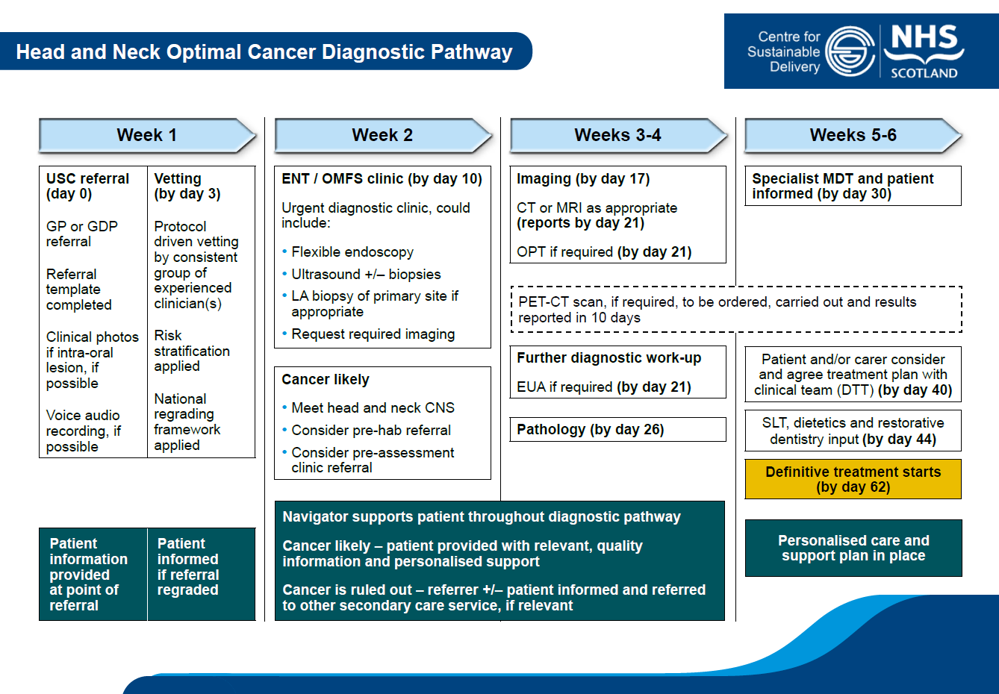
To expand diagnostic capacity, NHS Greater Glasgow & Clyde established an ENT Diagnostic Hub, introducing several key initiatives:
- Advanced Clinical Nurse Specialists were trained to perform and interpret flexible nasendoscopy, perform neck examinations, and take comprehensive red-flag histories, significantly increasing diagnostic throughput.
- The Urgent Neck Lump Clinic now offers a streamlined one-stop service, including ultrasound-guided biopsies.
- In collaboration with radiology, same-day CT staging slots have been introduced to further accelerate the pathway.
- All initial face-to-face appointments now include the option for oral and endoscopic biopsies under local anaesthetic, reducing both pathway times and the need for general anaesthetic procedures for some patients.
- Strengthened collaboration with the Head and Neck surgical team and cancer specialties has enabled faster, more coordinated onward referrals and facilitated more timely MDT presentation.
- Initial assessments also incorporate prehabilitation, nutritional, and pain management needs. Early involvement of the Clinical Nurse Specialists enhances patient care throughout the cancer journey.
Through prompt triage and integrated working, the ENT Diagnostic Hub has shortened the diagnostic pathway, reduced variation, and improved both efficiency and patient experience.
Nurse Specialist attendance at clinics - NHS Dumfries & Galloway
In NHS Dumfries & Galloway, since September 2024, a Nurse Specialist attends the neck lump and standard Ear, Nose and Throat (ENT) clinics and escalates any patients with a clinical diagnosis of malignancy, or high risk of a diagnosis of malignancy, to the cancer improvement manager who then co-ordinates with radiology to have the scan carried out within 7 days.
To date, they are achieving 7 days to CT from initial clinic for all patients highlighted through this process (Range 0-7 days, median 3 days).
If you’d like to discuss Scotland’s optimal cancer diagnostic pathways, or share any other best practice examples with us, please get in touch via cfsdcancerandedteam@nhs.scot. If you have any questions in regards to a specific example on these pages, please reach out to the named Boards’ Cancer Manager in the first instance.


 Optimal cancer diagnostic pathways



 @NHSScotCfSD
 Centre for Sustainable Delivery
 Scan the code to visit our website