- The patient’s airway should be secured with endotracheal intubation.
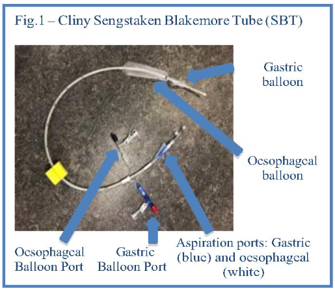
- Manually inspect the S-B tube to ensure it is intact, familiarise yourself with where the gastric balloon is in relation to tube tip and test the gastric and oesophageal balloons with 50 ml of air and deflate both fully before passage.
- Spigot the aspiration channels.
- Lubricate the tube.
- Insert the tube ORALLY (OG distance is nose - earlobe – xiphisternum) to ensure the gastric balloon is safely in stomach before inflation. Then remove the guide wire. If the tube is not straight it is not possible to remove the guide wire. If the guide wire cannot be removed with ease do not proceed to step 6, pull the tube back approx. 5cm and try again. If unsuccessful remove the tube and attempt insertion again.
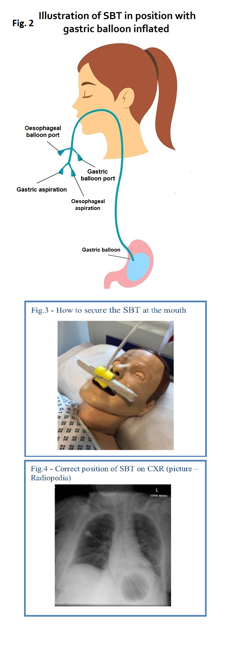
- Inflate the gastric balloon with 50ml of air at a time to a maximum of 150ml of air (Fig.2). Do not routinely inflate the oesophageal balloon*.
- Once inflated, apply gentle traction on the tube against the gastroesophageal junction and secure it at the patient’s mouth eg. with tongue depressors and tape to maintain traction once satisfied tube is in place (Fig.3).
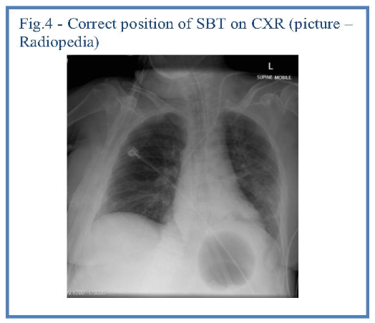
- Arrange an urgent portable CXR to confirm the position (Fig.4).
- If not already aware or present, urgently contact the gastroenterology consultant on call to arrange endoscopy. RHCYP GI mobile 07890 388650
- The insertion should be clearly documented in the medical notes including the distance the tube is inserted to.
- Ensure that medical treatment (as per RHCYP guidelines), and resuscitation (with IV fluid, blood products and appropriate medications) is ongoing as per upper GI bleed guidance.
* If the oesophageal balloon is to be inflated, this should be done on the instruction of a gastroenterologist. If you are in a remote centre without an on-call gastroenterologist, please contact your Regional Paediatric GI service for advice and refer to local bleeding guidelines.
Figure 4 - Gaillard F Sengstaken-Blakemore tube. Case study, Radiopaedia.org (Accessed on 20 Feb 2025) https://doi.org/10.53347/rID-12118


 Paediatric guidelines (in development)