

 Patient information leaflets
A lumbar puncture, also known as a spinal tap, is a procedure used to collect a small sample of cerebrospinal fluid (CSF) for testing. CSF is the clear fluid that surrounds and protects the brain and spinal cord. This test helps diagnose conditions affecting the brain and spinal cord.
Understanding your lumbar puncture: A Patient guide

Warning
NHS Borders
Borders General Hospital
Huntlyburn Terrace
Melrose
TD6 9BS
"Information given on this site is not meant to take the place of a talk with your doctor or health worker."
You will either lie on your side with your knees pulled up to your chest or sit up and lean forward on some pillows. The health care professional will first clean a small area of your lower back with an antiseptic solution. They will then inject a local anaesthetic to numb the area over a space between the lower spinal bones. You may feel a brief stinging sensation when the anaesthetic is injected, but this will quickly numb the area to make the procedure more comfortable.
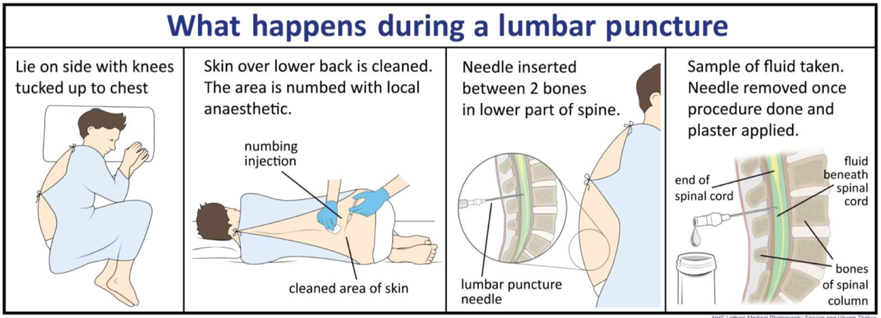
NHS Lothian Medical Photography Service & Thakur, V. (2022). Having a lumbar puncture for your diagnosis. NHS Lothian.
The health care professional will then insert a thin needle through the numbed skin into the space around your spinal cord where the cerebrospinal fluid (CSF) is located. Most people do not feel pain, but you may experience some pressure as the needle is pushed in. Some people may feel a brief sharp sensation in the back when the needle is passes through. Occasionally, a shooting pain or tingling may travel down one leg – if this happens, let the doctor know, and they will adjust the needle to stop the sensation.
The cerebrospinal fluid (CSF) will slowly drain through the needle and be collected in small containers. In some cases, the doctor may also measure the pressure of the CSF inside the spinal canal by attaching a special tube to the needle while the fluid is flowing out. The needle usually remains in place for about 1 to 5 minutes. Once enough fluid has been collected, the needle is carefully removed, and a small plaster (bandage) is placed over the area.
This entire procedure typically takes 15 to 30 minutes.
Lumbar puncture is generally a safe procedure, but like any medical test, it carries some risks. Most side effect are mild and temporary. They rarely cause significant problems. If your health care professional recommends the procedure, it is because benefits of a lumbar puncture almost always outweigh the risk. They will also discuss any specific risk relevant to you.
Common side effects and complication of lumbar puncture
- Back pain or discomfort - You may experience pain or discomfort around the area where the needle was inserted. In most cases, the pain will ease after a few days, and it can be treated with simple painkillers (up to 25% of cases).
- Headache - It may develop within 24 to 48 hours after the procedure and can last few days. It usually improves when lying down and can be managed with rest, fluids, and pain relief. This occurs in 10 – 30% of cases.
- Swelling and bruising – mild bruising or swelling at the puncture site is common and usually fades on its own. Contact your doctor if it worsens or does not improve.
- Shooting or tingling leg pain during the procedure – this happens when the needle touches a nerve. It is usually brief and stops once the needle is repositioned, this happens in about 15% of cases.
- Persistent leak of fluid around the spine – this may require blood patch to treat
There are some other more serious but rare complication of lumbar puncture
- Infection – the procedure is done under strictly sterile conditions, but there is a very small risk of infection in form of abscess (1 in 47,000 people) or meningitis (1 in 200,000 people). If you develop fever, worsening pain, or redness at the puncture site, seek medical advice.
- Bleeding (Spinal Haematoma or Subdural Haematoma) – a small amount of bleeding can occur, but significant bleeding is rare (<0.01% of cases). The risk is higher in people taking blood thinners or those with bleeding disorders.
- Cerebral venous thrombosis (blood clot in brain veins) – extremely rare (<0.01% of cases) but can cause severe headaches and neurological symptoms.
- Intracranial hypotension (low pressure of fluid around the brain and spinal cord) as well as brain herniation - extremely rare but can happen as complication of lumbar puncture.
- Permanent nerve damage causing numbness or paralysis – extremely rare.
If you decide not to have a lumbar puncture, it may affect your diagnosis and treatment. A lumbar puncture is often done to check for serious conditions such as infection (e.g. meningitis), bleeding around the brain (subarachnoid haemorrhage), or other brain or spinal cord disorders. Without this test, your doctor may have limited information to guide your care.
Alternative Tests – In certain cases, other investigations such as MRI, CT scans, or blood tests may provide helpful information, though they may not fully replace the diagnostic value of cerebrospinal fluid (CSF) analysis. Your doctor will discuss the best next steps based on your individual situation.
If a lumbar puncture is not successful, your doctor may discuss alternative approaches depending on the reason for the difficulty. In some cases, the procedure may be attempted again, either by a more experienced clinician or using a different technique or positions.
- You should take a short period of rest immediately after the procedure and drink plenty of fluid.
- Notify medical staff if you have any concerns or feel unwell.
- Take paracetamol if needed and appropriate.
- Avoid strenuous activity, heavy lifting or the operation of heavy machinery for at least 24 hours. Your spinal fluid and blood samples will be sent for testing, and your doctor will inform you of the result.
- A severe or persistent headache that does not improve with rest, fluids, or pain relief.
- Signs of infection, such as high temperature, feeling hot and shivery, or redness, swelling, warmth, or discharge around the puncture site.
- Vomiting, confusion, or any other unusual symptoms.
- New tingling, numbness, or weakness in your legs.
- Difficulties urinating or loss of bowel control.
If you are concerned about any of these symptoms, seek medical advice from the department where the procedure was performed, your GP, or call NHS 24 (111).