Patient information leaflets
NHS Borders is committed to promoting and supporting breastfeeding as the healthiest way to feed your baby. Breastfeeding is a unique interaction between mother and baby which not only feeds and comforts but also helps prevent against infection and disease. It is well known that exclusive breastfeeding (that means your baby has your milk and nothing else to eat or drink) for the first 6 months has many proven health benefits.
Antenatal Hand Expressing

Warning
NHS Borders
Borders General Hospital
Huntlyburn Terrace
Melrose
TD6 9BS
"Information given on this site is not meant to take the place of a talk with your doctor or health worker."
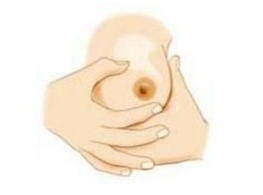
“What I see in mothers is the inner confidence that their body is producing milk and that there is a supply there in anticipation of baby’s arrival. These women are more confident in hand expressing. It is such a positive approach to preparing for baby’s arrival”. Louise Scott - Midwife, NHS Borders.
This is the process of expressing and freezing colostrum (first breastmilk) while you are pregnant for use after your baby is born. Any expectant mother could potentially express her breast milk starting from 37 weeks pregnant, but it is particularly useful if the baby is at an increased risk of having a low blood sugar in the first few hours after birth.
Colostrum is the first milk that you will produce for your baby. It is full of all the nutrients your baby needs for the best start in life and is the perfect nutrient to stabilise blood sugars in babies whose mothers have diabetes.
Breastfeeding and Diabetes:
- Babies who are breastfed are less likely to develop childhood diabetes.
- It is thought that cows’ milk (the main ingredient of formula milk) can trigger diabetes in some babies; this is probably more likely for your baby if you or your partner have diabetes.
- Therefore, it is very important that mothers who are diabetic avoid giving their baby formula milk if at all possible until the baby is at least 6 months old.
- If you have diabetes and are insulin dependent you may find that you need less insulin when you are breastfeeding and that you need to eat more.
- If you have gestational diabetes you are less likely to go on to develop diabetes in later life if you breastfeed your baby.
- Women with diabetes in pregnancy (pre-existing or gestational)
- Babies diagnosed during the antenatal period with cleft lip and/or palate
- Babies diagnosed with congenital conditions such as Down’s Syndrome or a cardiac complication
- Women having an elective caesarean section
- Infants known to have Intrauterine growth restriction
- Women with breast hypoplasia (under-developed breasts)
- Women with hyperandrogenesis (polycystic ovaries)
- Women who have had reductive breast surgery
- Mothers taking beta blockers (e.g labetalol)
- Strong family history of dairy intolerance or inflammatory bowel disease
- Women with multiple sclerosis
- Mothers who are overweight or obese
- Women who have previously had a poor breastfeeding history
Antenatal Hand expressing is NOT recommended in the following:
- In women known to have cervical incompetence
- In women who have a cervical suture in situ (to prevent pre-term
- In women who have had threatened or actual premature labour
- In women who have a multiple pregnancy (twins, triplets)
- In women who have polyhydramnios (excess amniotic fluid)
- In women who have had contractions, vaginal bleeding or premature rupture of membranes in their current pregnancy.
Only after consultation with your obstetrician can we support women with contraindications to harvest colostrum
You will be supplied with a hand expressing pack by your midwife. This will include Sterilised syringes with labels
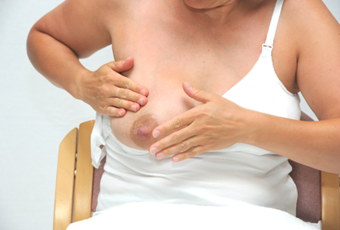
Step 1
Ensure your hands are clean by washing thoroughly before you start hand expressing and have a sterile syringe ready. Get comfortable and make sure you are as relaxed as possible. A bath or shower or using a warm cloth or massage of your breasts may help. To express by hand, start by gently massaging your breast and nipple to stimulate the hormones needed to release milk.
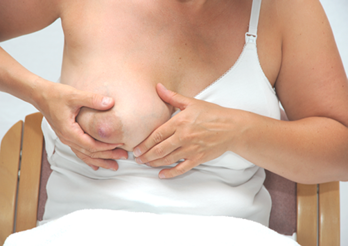
Step 2
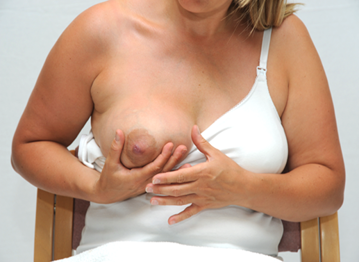
Position your thumb and fingers in a ‘C’ shape, 2 to 3 cm back from the base of your nipple.
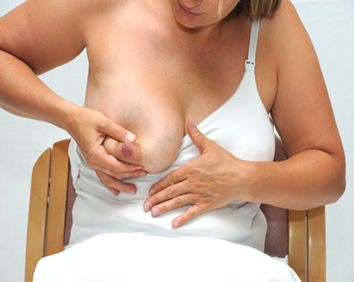
Step 3
Gently press and release, press and release, and keep repeating until your milk starts to flow. This may take a few minutes. Because your colostrum is concentrated it is thick and will come out of your breast drop by drop.
Step 4
When the flow slows down, move your fingers round to a different part of your breast and start again. Aim to use each breast and you can hand express 2-3 times each day.
UNICEF Hand expressing video

UNICEF Meeting your baby for the first time

UNICEF Building a close and loving relationship together

Best Beginnings breast feeding video resource page

- You may not see or be able to collect any colostrum in the first few days of hand expressing. You may only see a glisten of colostrum at the end of your nipple rather than drops that you can harvest – Don’t worry! This is very normal.
- The action of stimulating your breasts will be helping to produce the hormone oxytocin which is essential in the production of breast milk ... so keep practising.
- You may only be able to collect tiny amounts of colostrum in the syringe, but every drop is precious and will help feed and protect your baby.
- Colostrum is produced in small quantities. You are only likely to produce very small amounts at any time - this can mean less than 1ml. A newborn baby’s stomach is only the size of a small marble so they will just need a few mls of colostrum to be full and content.
- Practising hand expressing will help build confidence in using this skill when your baby arrives and may help you feel confident about your ability to produce milk for your baby.
- Don’t worry if you only collect a tiny amount of colostrum. Any amount of colostrum is fantastic and may help get breast feeding off to a good start for you and your baby.
- Its best for mothers to cup or spoon feed any harvested colostrum to their baby rather than use a syringe. You can be supported to do this by maternity staff when you have had your baby.
- Maternity staff are trained and experienced in supporting you with feeding your baby. They will be very happy to help and support you in any way you need.
Collection and Storage of your breastmilk
- You can collect your colostrum 2-3 times on the same day and store in the same syringe and kept in the back of the fridge between uses (fridge temperature must be a maximum of 4 degrees centigrade).
- At the end of the day your syringe of colostrum should be placed in a zip lock bag which is clearly labelled with the date and time of hand expressing and the date and time of freezing. Please include your full name and date of birth.
- It can be stored in the freezer compartment of a fridge for a maximum of two weeks or in a deep freeze at -18 degrees for six months.
- When you are coming into hospital bring 3-4 frozen syringes of colostrum with you. Once defrosted colostrum must be used within 24 hours. Only defrosting small amounts at a time reduces the possibility of wastage.
- The frozen syringes should be transported in a cool bag
- On arrival please give your labelled syringes to a member of staff who will check that is clearly labelled and store it in the milk fridge.
- Local guidance on storage of expressed breast milk will then be followed.
Follow the QR code to the Breastfeeding Network page on the safe storage of breastmilk.