Warning

Please see list of red flags

Intro/background

Cubital tunnel syndrome Cubital tunnel syndrome

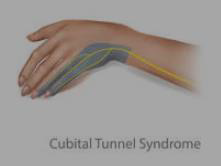
Cubital tunnel syndrome occurs due to compression of the ulnar nerve at the elbow. It is the second most common nerve compression and causes para/anaesthesia of the little and ulnar half of the ring finger with weakness of small muscles of the hand and/or the thumb.
History - what to ask

  • Mechanism of onset, location of symptoms (ulna nerve distribution??), severity and longevity of symptoms, limitation to function.

Examination

Diagnosis is made on a combination of subjective history and clinical findings.

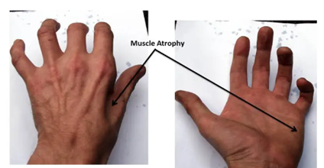
  • Inspect for evidence of hypothenar and first dorsal interosseous wasting and intrinsic muscle loss. In severe disease clawing of the little and ring fingers may occur.

Muscle atrophy in hand

  • Assess for sensory loss in the correct distribution, although more likely to be positive in severe cases. Decreased sensation should be restricted to the ulnar nerve distribution (the little and ulnar half of the ring finger). Preserved dorsal ulnar hand sensation suggests a more distal lesion, such as compression within Guyon’s canal.
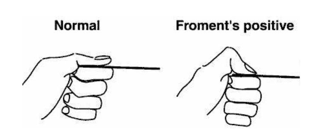
  • Froment's Sign: The patient is asked to hold a piece of paper between the thumb and a flat palm as the paper is pulled away. Positive response: flexion of the thumb to try to maintain a hold on the paper.

Froment's sign

Froment's sign video (YouTube)

  • Elbow flexion test: Elbow held fully flexed, with the wrist in neutral for 1 minute.
  • Tinels over elbow

Tinel's sign video (YouTube)

Investigations

  • Chest x-ray and bloods if clinical concern of chest/apical pathology (Pancoast)
  • Nerve conduction studies are not indicated in primary care.

Differential diagnosis

  • Cervical spine/ radiculopathy
  • Thoracic outlet syndrome
  • Diabetic polyneuropathy
  • Pancoast tumour.

Management within primary care/self-management guidelines

  • Treatment of any underlying condition, e.g. diabetes, OA, RA hypothyroidism.
  • Advice on avoiding movements or positions that aggravate activities, i.e. leaning on the elbow, maintaining the elbow in a flexed position for long periods. May be given advice on use of towel, taping or splint to prevent elbow flexion.
  • Sign post to MSK A&A CBTS webpage
  • CBTS patient leaflet.

When & how to refer

  • Diagnostically uncertain
  • Symptoms persist beyond 2-3/12 and/or interfere with ADLs consider severity
  • Exceptionally severe symptoms (e.g motor loss/clawing – refer urgently)

If suspect a cervical source, particularly if bilateral symptoms – refer to physiotherapy through usual pathway.

Editorial Information

Next review date: 01/10/2027

Author(s): Reid J.

Version: 01.0

Approved By: Trauma & Orthopaedics Acute Governance