Warning

Please see list of red flags

NB: Please note, referrals pertaining to asymptomatic wrist ganglion are no longer reviewed routinely, in line with the agreed ACRT (Active Clinical Referral Triage)

Intro/background

Dupuytren's disease

Dupuytren’s disease is shortening and thickening of the palmar fascia in the palm or overlying the affected digit(s). These flexion contractures generally develop slowly and are permanent and irreversible. More men than women are affected by this condition. Of note, 20% of people with diabetes will go on to develop Dupuytren's disease. Often diabetics will be more severely affected by this disease.
History - what to ask

  • Family history, severity and longevity of symptoms, limitation to function.

Examination

  1. Check for nodules/ cord and record where.
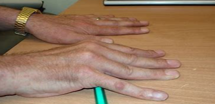
  2. Table top test or pen under metacarpophalangeal joint (MCPJ) – can the patient get their hand flat?

     Dupuytren's test

  1. Measure angle of fixed flexion deformity if able.

Differential diagnosis

  • Trigger digit
  • RA synovitis.

Investigations

None required.

Management within primary care/self-management guidelines

When & how to refer

Diagnostically uncertain.
Minimum degree of contracture >30° metacarpophalangeal joint (MCPJ) and /or significant proximal interphalangeal joint (PIPJ) contracture (BSSH guidance) and/or functional impediment and patient would consider surgery.

Editorial Information

Next review date: 01/10/2027

Author(s): Reid J.

Version: 01.0

Approved By: Trauma & Orthopaedics Acute Governance