Warning

Please see list of red flags

Intro/background

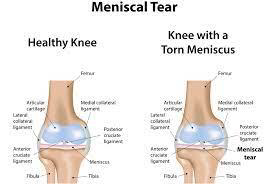
Meniscal tear

Injuries to the menisci are the second most common injury to the knee. A high incidence of meniscal tears occur with injury to ACL. Young people are more likely to sustain traumatic injuries. Cutting and pivoting sports are related to acute meniscal tears.

History - what to ask

  • Mechanism of injury - twisting, cutting and pivoting
  • Pain situated – joint line
  • Effusion.

Examination

  • Sharp/stabbing pain on the med/lat joint line.
  • Patient reports locking/giving way and effusion.
  • Loss of knee extension or flexion.
  • The knee can be locked.
  • Joint line tenderness.

Investigations

  • Xray rule degenerative joint disease (DJD)
  • MRI to confirm diagnosis.

Differential diagnosis

Medial joint OA, ACL tear, collateral tear, osteochondral injury.

Management within primary care/self-management guidelines

If knee is locked patient should be referred to on-call team from ER or urgently to Orthopaedics from other referring practitioners.

When & how to refer

  • Locked knee
  • Positive findings on investigations
  • Failure for symptoms to settle.

Editorial Information

Next review date: 01/10/2027

Author(s): Reid J.

Version: 01.0

Approved By: Trauma & Orthopaedics Acute Governance