

 RefHelp - NHS Ayrshire and Arran
Please remember there is a Paediatric Clinical Mailbox that can be used for any non-urgent queries: clinical_paediatrics_crosshousehospital@aapct.scot.nhs.uk
Headache

Warning
Headache is common in children, increasing in incidence from early childhood to adolescence.
Primary Headache – Has no specific underlying cause, most common cause of chronic headaches in children. This includes migraine and tension-type headache.
Secondary Headache – Due to an underlying cause. This includes trauma, sinusitis, raised ICP, hypertension, substance use or its withdrawal. This is less common in children.
Chronic Headache – >15 days per month > 3 months. Can be due to any primary or secondary headache type.
History
- Past history – including childhood periodic syndromes – colic, benign paroxysmal torticollis, BPV, cyclical vomiting, abdominal migraine.
- Growth, development and puberty.
- Systemic enquiry – features of systemic disease.
- Drug history – prescription, OTC, Illicit – consider medication overuse.
- Lifestyle – sleep, eating and drinking, screen time, exercise.
- Family history.
- Psychosocial and emotional history – anxieties, pressures, school/friends/academic performance, family structure and events.
Children with primary headache are more likely to exert self-imposed pressure and have depression, anxiety and somatisation that interfere with home, learning, and friendships.
Examination
- Weight/height/BMI/OFC/pubertal status
- HR and BP
- Skin – neurocutaneous stigmata, deliberate self harm
- Scalp and face – tenderness
- Neck – range of movement, neck muscle tenderness
- Local pathology – dental, eye, sinuses, ENT, TMJ
- Neurological examination.
Red Flags
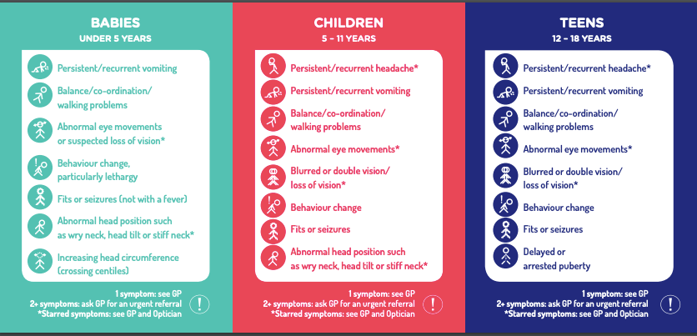
When to refer
- Red flags in history or examination
- Concern about secondary headaches
- Ongoing management and treatment advice
- Progressively severe headaches.
Referrals to Paediatrics should be made via the SCI Gateway.
Please note, these are vetted in a timely manner so the priority status of a referral may change upon review.
General management of primary deadache
- As full participation in work and play activities as possible.
- Regular and sufficient sleep with limitation of screen time.
- Regular rest.
- Regular meals – especially breakfast.
- Adequate hydration – suggested daily volumes are
- Age 1-2yrs: 900ml
- Age 2-3yrs: 1L
- Age 4-8yrs: 1.2L
- Age 9-13yrs: boys 1.6L, girls 1.5L
- Over 13yrs: boys 2L, girls 1.6L.
- Regular exercise.
- Avoid restriction of activity/food/drink unless evidence this is a trigger.
- Medication overuse counselling – paracetamol or ibuprofen for >15 days/month over past 3 months; other analgesics for >10 days/month over past 3 months.
Optician review.
Migraine
Common, can occur at any age.
Can be short lasting, more likely to be bilateral than adults.
May have a history of childhood periodic syndromes.
Can be familial, including familial hemiplegic migraine.
Triggers – physiological, environmental, emotional/psychological, dietary.
Avoid aggravating factors – headache diary can help identify these.
Pharmacological management
- Paracetamol/ibuprofen.
- Triptans
- Contraindicated in hemiplegic migraine
- For migraine with or without aura in combination with NSAID/paracetamol
- Nasal faster onset, easier if vomiting
- Nasal may produce an unpleasant taste/feeling
- Can try alternative formulations/triptans.
- Antiemetic e.g. prochlorperazine.
- Consider prophylaxis if missing >2 days/month of school – propranolol or amitriptyline.
- The Brain Tumour Charity. Better safe than tumour.
- The Migraine Trust - general overview for families.
- NICE Clinical Knowledge Summaries. Scenario: young people aged 12-17 years. Last revised February 2024.
- Howells, R. Headache in childhood and adolescence. Paediatric Neurology 2010: 10(5) 27- 29.
- Dooley JM, Gordon KE, et al. The utility of the physical examination and investigations in the paediatric neurology consultation. Paediatr Neurol 2003 Feb; 28(2):96-99.
- Abu-Arafeh I and MacLeod S. Serious neurological disorders in children with chronic headache. Arch Dis Child 2005 Sep; 90(9): 937-940.
- Strine TW, Okoro CA, et al. The associations among childhood headaches, emotional and behavioural difficulties, and health care use. Pediatrics 2006 May; 117(5): 1728-1735.
- Whitehouse, WP, Agrawal S. Management of children and young people with headache. Arch Dis Child Educ Pract Ed 2017; 102: 58-65.