

 RefHelp - NHS Ayrshire and Arran
- General Rheumatology consultations (consultants, specialty doctors, specialist nurses, ANP, senior Pharmacist)
- AHP (Rheumatology Physiotherapy, Podiatry, Occupational Therapy)
- US scan of the joints (for internal referrals only)
- Intraarticular steroid injections (for internal referrals only or performed by Rheumatology Physiotherapist)
- Training for self-delivered subcutaneous injections (internal use only)
- Medical Day Unit (internal service for delivery of intravenous medication, subcutaneous medication, Short Synacthen test)
- Rheumatology on-call (quick access to the service, prompt reply to enquiries via email)
- Rheumatology page 1439 – covered by resident doctor
- Rheumatology helpline - 01292513316 – service run by Rheumatology Specialist nurses.
Giant cell arteritis (GCA)

Warning
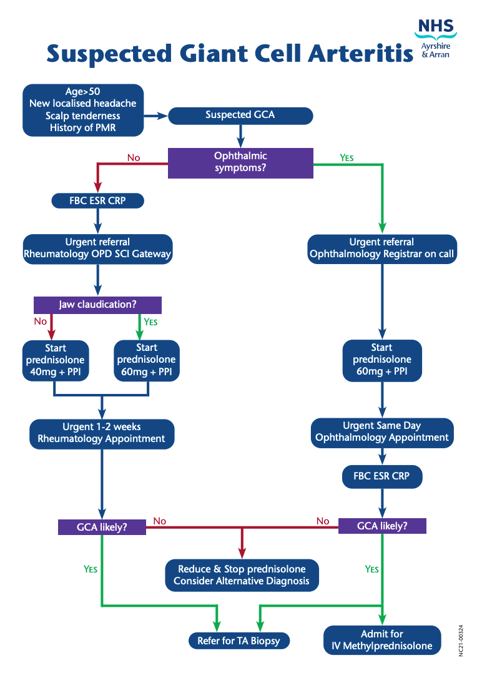
Suspected GCA (please refer to local emergency referral pathway)
History
- New onset of persistent localised headache (usually unilateral and in the temporal area, but can be bilateral) in a patient age >50 years.
- Jaw or tongue claudication (pain over masseter muscles on chewing)
- Tenderness or pain over scalp.
- Visual disturbance , e.g. diplopia, visual field defect, visual loss.
- Constitutional symptoms: malaise, weight loss, unexplained fever, night sweats.
- There may also be symmetrical pain and stiffness affecting the shoulder and pelvic girdle polymyalgia rheumatica like.
Examination
- Often normal.
- Occasionally focal tenderness and thickening over temporal artery or pulseless artery.
- Visual field defects or reduced visual acuity.
- Cranial nerve defects.
Refer to Rheumatology with urgent priority if the patient displays persistent symptoms as above, by using SCI OP Gateway.
Please you refer to Oral & Maxillofacial for temporal artery biopsy on the same time, as the biopsy must be done ideally in the first week of staring steroids, otherwise the histopathology would be negative for inflammation.
Refer to Ophthalmology urgently if visual symptoms present.
Do not refer to Rheumatology any patient with headache with normal inflammatory markers when the diagnosis of GCA is unlikely and other possible causes are more plausible explanations. The rheumatology service does not cover general headache.
Do not send new referrals only for updates or to ask for urgent review do to flares for patients already known to rheumatology, being on the list waiting for reviews, as we cancel such referrals to avoid duplication.
Please do not hesitate to keep in touch with us regarding your patients with any updates, symptom changes or flare ups using the Rheumatology Clinical email inbox: clinicalr@aapct.scot.nhs.uk or by Rheumatology pager 1439.
Investigations
- ESR and CRP- almost always elevated.
- Further investigations like ultrasound may be organised by Rheumatology following referral. Ultrasound is only useful if done within a week of starting the steroids and therefore the urgency to get the patient in for scanning asap.
The GCA probability scoring system can be used to assess likelihood of GCA based on clinical features:
ESR/CRP typically raised but if clinical history is entirely typical and inflammatory markers are normal, GCA cannot be excluded.
Please you refer to Oral & Maxillofacial for temporal artery biopsy on the same time, as the biopsy must be done ideally in the first week of staring steroids, otherwise the histopathology is negative for inflammation.
Refer to Ophthalmology urgently if visual symptoms present.
GCA probability scoring system
| Age | Points | Symptoms | Points |
| Age <50 | 0 | Headache | 1 |
| Age 50-60 | 1 | Polymyalgia | 2 |
| Age 60-65 | 2 | One constitutional symptom | 1 |
| Age >66 | 3 | Two or more constitutional symptoms | 3 |
| Sex | Points | Signs | Points |
| Male | 1 | Visual signs | 3 |
| Female | 2 | Temporal artery tender | 1 |
| Symptom duration | Points | Temporal artery thickened | 2 |
| >24 weeks | 0 | Temporal artery pulse loss | 3 |
| 12-24 weeks | 1 | Other extracranial artery tender | 1 |
| 6-12 weeks | 2 | Other extracranial artery thickened | 2 |
| <6 weeks | 3 | Other extracranial artery pulse loss | 3 |
| CRP | Points | Cranial nerve palsy | 3 |
| <5 mg/L | 0 | Other potential cause | Points |
| 6-10 mg/L | 1 | Infection, cancer, other pathology | -3 |
| 11-25 mg/L | 2 | ||
| >25 mg/L | 3 |
Interpretation: If the score is <9, then probability of GCA is low and referral is not required. If the score is 9 or greater then refer urgently to rheumatology for further investigations. Oral prednisolone 40mg daily should be commenced in primary care in those with a score of>12, pending review at the rheumatology clinic. Prednisolone should not be started in those with a score between 9 and 12.
Immediate management
In a patient suspected to have GCA with a probability score of 9 or greater, do the following:
Tests
- Check FBC, U&E, LFT, CRP, ESR
- Check HbA1c (if starting prednisolone).
Steroids
- Start steroid if visual symptoms present – prednisolone 60mgs
- If no visual symptoms then start steroids only if GCA probability score is >12 prednisolone 40mg; 60mg if jaw claudication present.
- Warn patient about symptoms of hyperglycaemia.
If the diagnosis of GCA is correct, symptoms should have improved markedly within a week and inflammatory markers should start falling.
Long term management
Steroid dose reduction
Gradually reduce the prednisolone doses guided by the Rheumatologist. Typically, we advise that prednisolone should be continued at the starting dose until symptoms have improved and inflammatory markers have returned to normal (usually 2-4 weeks). Thereafter the daily dose of prednisolone should be reduced by 10mg every 2 weeks until the patient is on 20mg daily. Then reduce the dose by 2.5mg every 2-4 weeks until the patient is on 10mg daily, then reduce by 1mg every 1-2 months.
Vascular risk factors
Patients with GCA who have poor vascular health are highest risk for developing complications of GCA such as blindness or stroke. Traditional vascular risk factors such as hypertension, diabetes and hyperlipidaemia should be addressed and treated appropriately.
Gastroprotection
Treatment with proton pump inhibitors should be considered for people at high risk of gastrointestinal bleeding or dyspepsia. (previous GI bleed, known GORD/peptic ulcer disease, currently on anticoagulants)
Bone protection
Treatment should be commenced after a dental review with alendronic acid 70mg once a week accompanied by cholecalciferol 800 units daily. Alternatives include risedronate 35mg once a week or liquid buffered alendronate (Binosto, 70mg weekly). A combined calcium and vitamin D supplement (Accrete D3, 1000/880) is indicated in patients with dietary calcium intake <700mg daily.
All patients should be considered for vitamin D supplements (Colecalciferol 800 u daily) and calcium supplements if their dietary calcium intake is <700 mg/day.
Recurrence of GCA during steroid dose reduction
If GCA symptoms recur during steroid dose reduction, check ESR/CRP and increased the prednisolone to the dose that was last controlling symptoms and contact rheumatology for advice.
Recurrence of GCA with visual symptoms
If a patient with a diagnosis of GCA has a recurrence of headache and visual symptoms, please check ESR and CRP, increase or restart prednisolone to 60mg daily and contact Rheumatology.
- British Society for Rheumatology Adult Rheumatology Referral Guidance. September 2021. Accessed at: https://www.rheumatology.org.uk/Portals/0/Documents/Policy/Adult-rheumatology-referral-guidance.pdf?ver=2022-08-04-104812-413
- NHS Lanarkshire Rheumatology referral guidelines. March 2022. Accessed at: https://rightdecisions.scot.nhs.uk/media/2014/ebooklet-rheumatology-referrals-2022.pdf
- NHS Lothian. RefHep. Accessed at:RefHelp – Instant Acces s to Referral Guidelines for Lothian