Scottish Palliative Care Guidelines

This guidance should not be used for people with the following conditions without specialist palliative care advice:
- neurological conditions including Parkinson’s Disease, Parkinson’s Plus syndromes, and myasthenia gravis
- complex metabolic conditions, such as porphyria
- neuroendocrine tumours that are secreting hormones, such as phaeochromacytoma
- a history of significant adverse effects with previous antipsychotics, such as neuroleptic malignant syndrome, serotonin syndrome, tardive dyskinesia, akinesia, need for long term procyclidine.
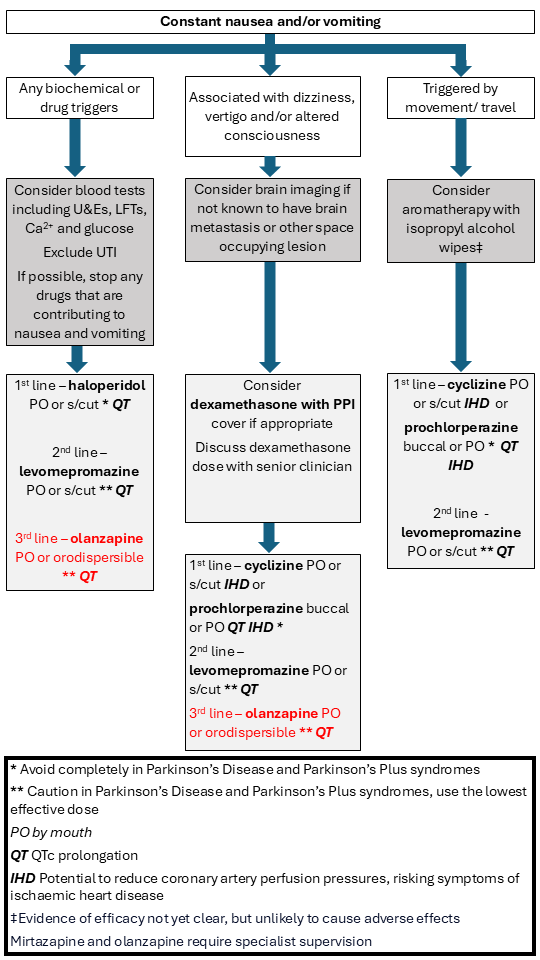
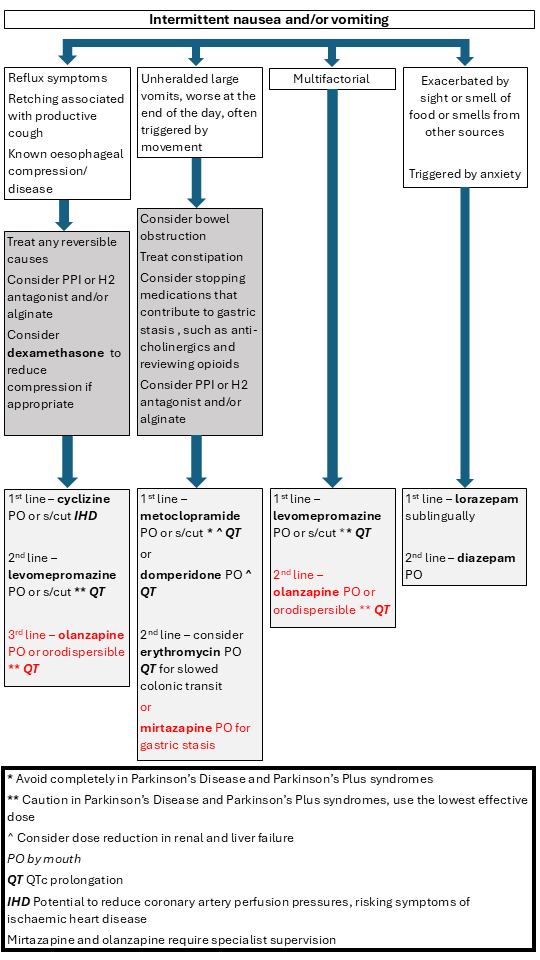
- Always try to identify the underlying causes of nausea and vomiting and treat if possible (see Assessment).
- For patients with chemotherapy-induced nausea and vomiting (CINV) and systemic therapy-induced nausea and vomiting, refer to local oncology guidelines. For persistent problems, seek specialist oncology advice. Comprehensive assessment is needed, including ascertaining whether the presence of nausea is intermittent or constant.
- Assessments of hydration and nutritional status are essential and management should be considered in the context of the patient’s clinical picture (refer to Subcutaneous fluids guideline).
- Consider non-pharmacological measures (refer to Non-pharmacological management).
- Correct any reversible causes of nausea and vomiting when possible (eg renal failure, hypercalcaemia, hyponatraemia, hyperglycaemia, constipation, symptomatic ascites, cerebral oedema or raised intracranial pressure).
- Deprescribe potentially inappropriate medication to reduce tablet burden and polypharmacy where possible (see the Polypharmacy guidance).
- If bowel obstruction is identified, manage according to the guideline on Bowel obstruction.
- When pharmacological management is indicated, consider timing of medications, eg administering antiemetics before meals when appropriate.
- Select an antiemetic appropriate to the likely identified cause.
- Consider the formulation of drugs and route of administration of medication as:
- the oral route may not provide adequate absorption or be available as a result of nausea (which inhibits gastric emptying) or vomiting
- swallowing tablets may trigger nausea, therefore, liquids or crushable formulations may be preferred. Additionally, it may take longer for the medication to absorb as nausea is frequently associated with delayed gastric emptying
- buccal or sublingual medication administration may be helpful if swallowing is difficult
- the transdermal or parenteral route may be used if the oral route is not appropriate or to reduce tablet burden.
- Consider switching from transdermal or parenteral routes to the oral route if symptoms are well controlled and clinically appropriate.
- A broad-spectrum antiemetic, such as levomepromazine, may be indicated if multiple concurrent factors are present, eg biochemical triggers of nausea and oesophageal irritation occurring concurrently.
- If first-line treatment is only partially effective, a combination of antiemetics may be appropriate.
- Try to avoid the concurrent prescribing of prokinetics (eg metoclopramide) and anticholinergics (eg cyclizine) medication. The anticholinergics will diminish the prokinetic effect.
- It may be necessary to combine antiemetics with adjuvants such as corticosteroid and/or benzodiazepine.