1. Right Decisions
  2. Scottish referral guidelines for suspected cancer
  3. Back
  4. Further information
  5. Context and purpose of these guidelines
Warning

Cancer is a common condition with 36,036 new cases diagnosed in 2022 in Scotland (excluding non-melanoma skin cancers)1. Cancer remains a national clinical priority for the Scottish Government and National Health Service (NHS) Scotland.

The Scottish Government’s Cancer Strategy 2023 to 2033 launched in June 2023. This strategy aims to strengthen core elements of the cancer pathway while focusing on crosscutting issues that will enable success. The strategy focuses on improving the prevention, detection, and treatment of cancer, reducing both late-stage diagnosis and the health inequality gap, particularly for those from areas of deprivation.

Cancer survival is dependent on disease biology, stage at diagnosis and patient access to timely treatment. Earlier diagnosis can reduce premature deaths from some cancers and have a positive effect on overall life expectancy. A new Earlier Cancer Diagnosis Vision was developed as part of the Scottish Government’s ‘Cancer Strategy for Scotland’. The vision is to reduce later stage disease by 18 percentage points by 2033.

A key objective to is to work with healthcare professionals and wider primary care teams to promote referral or investigation at the earliest reasonable opportunity for people with clinical features suspicious of cancer, while making the most efficient and equitable use of NHS resources, avoiding adverse impact on access to services.

Cancer incidence in Scotland

Table 1: number of cases of each of the 10 most common cancers in Scotland in 20221 (excluding non-melanoma skin cancers).

Cancer type

ICD-10 code

Total new cases in 2022 (Scotland)1

No. cases per average GP practice per year

Trachea, bronchus, and lung

C33-C34

5,391

6.08

Breast

C50

5,183

5.84

Prostate

C61

5,064

5.71

Colorectal

C18-C20

4,337

4.89

Malignant melanoma of skin

C43

1,656

1.87

Head and neck

C00-C14, C30-C32

1,389

1.57

Kidney

C64-C65

1,115

1.26

Non-Hodgkin’s Lymphoma

C82-C86

1,021

1.15

Oesophagus

C15

992

1.12

Pancreas

C25

866

0.98

Column four shows the expected number of new cases per year in an average (mean) General Practitioner (GP) practice (based on GP practice count of 8872 and 2021 census population figures3, giving 6,129 individuals per practice). It should be noted that the variability in GP practice populations (e.g. list size, age distribution, urban versus rural and socioeconomic factors) affects the applicability of this data to an individual practice.


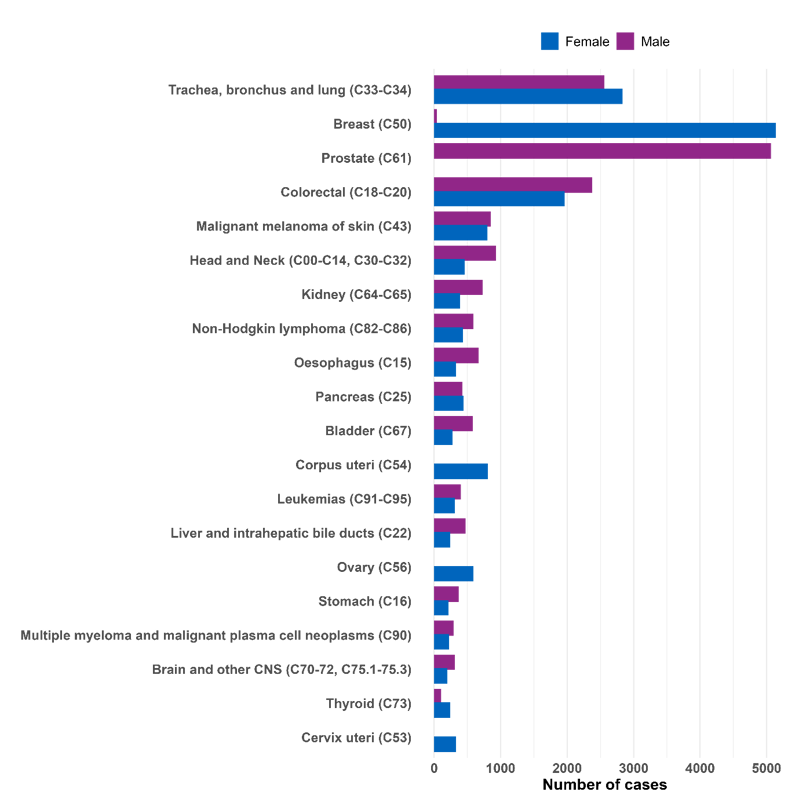
Figure 1:  Twenty most common cancers in Scotland in 2022 (not including non-melanoma skin cancers), by sex1.

Graph showing the twenty most common cancers in Scotland in 2022 (not including non-melanoma skin cancers), by sex


Demographic factors

Socio-economic deprivation affects the incidence of, and mortality associated with cancers. Cancer risk has been shown to increase from those living in the least deprived to those in the most deprived areas of Scotland. For the period 2015 to 2019, age-standardised incidence rates were 35% higher in the most deprived areas compared with the least deprived1. In 2021, the difference was 30%4. Staging data from 20225 shows that patients from more deprived areas tend to be diagnosed at a later stage.

The Inverse Care Law6 describes how access to healthcare is poorest for those who need it the most, driven by a variety of factors. It is essential that any consultation or other opportunity where a person from a deprived area presents with symptoms suggestive of cancer is used to full advantage.

Some cancers occur more frequently in certain communities, e.g. the lifetime risk of prostate cancer in black men is twice that of white men7. Risk factors such as these have been highlighted in each referral guide to aid primary care in assessing the risk of cancer and making referrals.

A practical guide has been developed by the Scottish Primary Care Cancer Group (SPCCG) that can be used to help address inequalities in cancer care - Cancer Inequalities in Scotland: A Practical Guide for GP Practices.


Comorbidity

The ageing population and the increasing number of people with long-term conditions and co-morbidity pose major clinical challenges. This affects both the incidence of and mortality from cancer. Chronic disease management programmes may afford an opportunity to identify symptoms suggestive of cancer.

In this context, a healthcare professional must differentiate between people whose symptoms may be due to cancer and the much larger number of people with similar symptoms arising from other causes. For certain symptoms, it may be entirely appropriate for a clinician to wait to see if they resolve. Persistence or worsening of symptoms, or recurrent presentations, may alert the healthcare professional to the possibility of cancer. These Guidelines have been developed to support healthcare professionals with this task.


Purpose of the guidelines

These Guidelines support delivery of the Cancer Strategy for Scotland’s earlier diagnosis vision. Reducing the number of later stage (3 or 4) diagnoses will improve cancer survival and patient outcomes.

These Guidelines have been developed to support healthcare professionals to identify and refer people with symptoms suspicious of cancer. The Guidelines will also aid secondary care clinicians in vetting referrals to ensure people with symptoms suspicious of cancer are prioritised for further assessment. In addition, they describe the impact that socio-economic and health inequalities can have on cancer referrals. The Guidelines will also help healthcare professionals to identify those who are unlikely to have cancer and may be managed or referred through other pathways.


Development of the guidelines

The Scottish Referral Guidelines (SRGs) for Suspected Cancer were first published in 2002 and subsequently revised in 2007, 2014, and 2019. In 2023, the Scottish Government commissioned the Centre for Sustainable Delivery (CfSD) to conduct a full clinical review and update of the SRGs according to current evidence and clinical consensus.

CfSD commissioned Healthcare Improvement Scotland (HIS) and Cancer Research UK (CRUK) to undertake a review of the current worldwide cancer referral guidelines and emerging evidence for each tumour group. Relevant demographic data was also obtained from Scottish Government and Public Health Scotland (PHS). A Project Team and Steering Group were established to oversee the clinical review process (see Guideline group membership details/SRG Steering Group).

In the context of Urgent Suspicion of Cancer (USC) referrals, a Positive Predictive Value (PPV) describes the chance of a person having cancer when they present with defined clinical features. The prior SRGs used a threshold of equal to or above 3 per cent (≥3%). This meant that a person should be referred for urgent assessment if there was a 3% (or greater) chance of their clinical features being due to cancer. It was accepted that PPV data was not available for all cancer types.

HIS and CRUK were commissioned to review the suitability of reducing the PPV below 3% for this guideline review. Published data has shown that decreasing this threshold would increase referrals (e.g. change from 3% to 2% would increase referrals by 8%) but could detect a small proportion (<5%) of cancers in the year preceding development of more significant clinical features (i.e. those exceeding the 3% threshold)8,9. The effect was not the same for all cancer types8,9. Considering this modest effect on cancer detection and the current pressures on diagnostic services the Steering Group decided to keep the current guideline PPV threshold at equal to or greater than 3%. This threshold is in line with other cancer referral guidelines including National Institute for Clinical Excellence (NICE).

Peer Review Sessions (PRSs) were held for each of the tumour types. A session was also held to create a new guideline on assessing and referring people with non-specific symptoms of cancer. As national guidelines on Malignant Spinal Cord Compression (MSCC) had been produced recently, the Steering Group decided not to hold a PRS specifically for MSCC and it was not included in the guidelines.

Scotland’s 3 cancer networks were approached to nominate at least 3 representatives for each session, who were responsible for liaising with their respective tumour groups both ahead of the sessions and on the draft produced. The SPCCG was approached to identify health board GP Cancer Leads for each session. There was a minimum of 2 in attendance at each PRS. HIS also identified a public partner to attend each PRS who was responsible for representing the public/patient perspective. There were also attendees who had participated in the previous SRG review - for a full list of attendees see Guideline group membership details/Peer Review Sessions 2024. This process ensured geographic balance in representation.

Demographic data alongside the findings of the evidence reviews undertaken by HIS and CRUK were presented at each PRS. Decisions on the content of the new guidelines were made based on evidence and clinical consensus. Where national guidelines were in place or being revised, effort was made to ensure consistency between these and the refreshed SRGs. CfSD has published several directly relevant pathways and guidelines to date - references and links to these have been included throughout the refreshed SRGs.

Decision logs for each PRS were produced to keep a record of all changes made. Attendees identified, reviewed, and systematically considered differences in recommendations based on their expert clinical knowledge and practical experience, while considering the Scottish context.

Following the 14 PRSs, a task and finish sub-group of the Steering Group was established to take the SRGs from updated drafts to a finalised version, ready for publication (see Guideline group membership details/Guideline Task & Finish Subgroup). This group aimed to ensure that the language and formatting was clear and consistent throughout.

A 6-week wider stakeholder engagement phase then commenced, beyond those who had participated in a PRS. This helped ensure that the draft Guidelines were well populated across NHS Scotland and had the consensus needed to be effectively implemented at the point of publication.


 

Terminology used throughout the guidelines

Throughout the SRGs ‘woman/women’ refers to the biological sex of a person born female and the term ‘man/male’ refers to the biological sex of a person born male as defined by the Equality Act 2010.

It may be necessary to widen the definition for certain cancer types to account for anatomical considerations that would be applicable to a transgender woman or transgender man.

The reason for this is that the risk of a particular cancer type relates to biological sex and the effects of gender reassignment treatment. For example, transgender individuals are reported to have a higher risk of breast cancer compared to men, but a lower risk compared to women10.

Where anatomical considerations or gender reassignment are relevant, this has been highlighted in the individual clinical guidelines.

Under the Children and Young People (Scotland) Act 2014, the term ‘child’ refers to anyone under the age of 18. However, for the purpose of our Children and Young People Cancer Guideline, a ‘child’ refers to someone between the ages of 0 and 14, and a ‘young person’ between the ages of 15 and 24.

Throughout the Guidelines ‘people of colour’ are referred to where clinically relevant, such as in the Skin Cancer Guideline. This term refers to diverse skin colours and includes people of African, Asian, Latino, Mediterranean, Middle Eastern, and Native American descent.


Equality impact assessment

The Scottish Government and NHS Scotland are committed to embedding the principles of equality, diversity and inclusion, and protecting the human rights of everybody in Scotland with respect to the nine protected characteristics: age, disability, gender reassignment, marriage and civil partnership, pregnancy and maternity, race, religion or belief, sex, and sexual orientation. Throughout the SRG refresh process, consideration was also given to how the updated Guidelines would impact those with carer status and those from a lower socio-economic background.

An equality impact assessment (EQIA) was used throughout the development process. At the end of each PRS the nine protected characteristics were reviewed and attendees were asked to consider any impact on changes made to the Guidelines. The purpose of this was to ensure that there were no unintended consequences for any of the protected groups.


Dissemination of the guidelines

The Guidelines will be made available to all healthcare professionals to whom someone may first present with symptoms of a possible cancer. This includes GPs, Advanced Nurse Practitioners (ANPs) and other nursing staff, Allied Health Professionals (AHPs), pharmacists, dentists, optometrists, NHS24, paramedics and Accident and Emergency (A&E) departments. The Guidelines will also be brought to the attention of secondary care clinicians of all grades to encourage equal access to investigation and to facilitate interdepartmental referrals.

The Guidelines will be actively disseminated through the Regional Cancer Networks, SPCCG, NHS Cancer Managers, Royal Colleges, Scottish Government Primary Care Directorate, Directors of Pharmacy, Dental Directorates and through CfSD Board Champions. The delivery of a robust communications plan will support broad dissemination across all relevant groups, networks and stakeholders across NHS Scotland.


Future refreshes

The SRGs will be reviewed every 3 years although they may be subject to update before this period should new clinical evidence emerge. Timings will be considered with the SPCCG and CfSD’s Primary and Secondary Care Interface Group (PCSCI).


Monitoring effectiveness

USC referrals, and associated conversion and detection data, will be collected by Public Health Scotland (PHS). In addition, it is recommended that NHS Boards conduct audits on the use of the Guidelines and any regrading or Active Clinical Referral Triage (ACRT) trends, at least every year, to ensure effectiveness.


Editorial Information

Last reviewed: 30/06/2025

Next review date: 30/06/2027

Author(s): Centre for Sustainable Delivery (CfSD).