

 Gastroenterology
Inflammatory Bowel Disease (IBD) is a group of inflammatory conditions of the colon and small intestine. This pathway sets out a process of best practice to be followed in the treatment of patients suspected of having IBD.

Inflammatory Bowel Disease (IBD) is a group of inflammatory conditions of the colon and small intestine. This pathway sets out a process of best practice to be followed in the treatment of patients suspected of having IBD.
This pathway is intended to be used by primary and secondary care health care professionals who are concerned that a patient may have a yet undiagnosed inflammatory bowel disease.
This pathway is not suitable for patients where malignancy is suspected or those with fulminant symptoms.
For patients meeting the criteria for urgent suspected cancer, please refer to those pathways.
 Red flag/alarm symptoms
Refer to inpatient services.
Consider:
*See pathway recommendations below
*the text in the document actually says 'see main document'. Is that referring to a different document or to a part of this one?
***A patient presenting with isolated small bowel Crohn’s may not have a raised calprotectin and so patients with weight loss (5% body weight) and at least 1 of the following:
***this part doesn't make sense to me. Does it mean patients with small bowel Crohn’s need to display 5% weight loss and at least 1 of the other symptoms in the list to be considered as possibly having IBD? If yes, could I title this section 'Patients with small bowel Crohn’s disease?
Click on the image below to open the pathway.
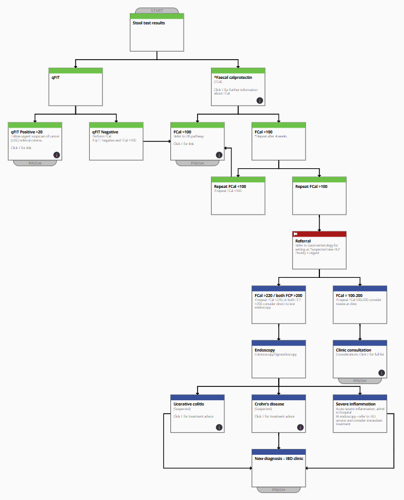
Please indicate where absent or present in the referral to secondary care:
***If bowel cancer suspected, refer to local Health Board Urgent Suspicion of Cancer (USOC) guidelines.
***Should this link to the SRG lower GI page instead?
Please see below two scoring methods to help determine severity of disease and inform decisions around treatment choice.
Mayo Sub Score - The Mayo Endoscopic Subscore (a component of the Mayo Clinic Score), is a four-point scoring system in which patients with normal or inactive, mild, moderate or severe disease are given scores of 0, 1, 2 or 3, respectively.
Score |
Disease activity |
Endoscopic features |
| 0 | Normal or inactive | None |
| 1 | Mild | Erythema, decreased vascular pattern, mild friability |
| 2 | Moderate | Marker erythema, absent vascular pattern, friability, erosions |
| 3 | Severe | Spontaneous bleeding, ulceration |
The Simple Endoscopic Score for Crohn's Disease (SES-CD) assesses the size of mucosal ulcers, the ulcerated surface, the endoscopic extension, and the presence of stenosis.
SES-CD score key |
||||
| 0 | 1 | 2 | 3 | |
| Size of ulcers | None |
Aphthous ulcers 0-5mm |
Large ulcers 5-20mm |
Very large ulcers >20mm |
| Ulcerated surface | None | <10% | 10-30% | >30% |
| Affected surface | Unaffected segment | <50% | 50-75% | >75% |
| Narrowing | None | Single stricture, can be passed | Multiple strictures, can be passed | Stricture(s) cannot be passed |
SES-CD segmental score |
||||||
| Rectum | Sigmoid & left colon | Transverse colon | Right colon | Terminal ileum | Total | |
| Size of ulcers | Total 1: | |||||
| Ulcerated surface | Total 2: | |||||
| Affected surface | Total 3: | |||||
| Narrowing | Total 4: | |||||
| SES-CD score | ||||||
NHS inform Illnesses and conditions: Inflammatory bowel disease (IBD
Chron's & Colitis UK. Understanding Crohn's Disease, Ulcerative Colitis and Microscopic Colitis crohnsandcolitis.org.uk
Crohn's & Colitis Foundation What is IBD?
Royal College of General Practitioners. IBD toolkit Course: Inflammatory Bowel Disease Toolkit
European Chron’s and Colitis Organisation (ECCO). IBD Guidelines ***link in pdf on CfSD website not working***
Royal College of General Practitioners. Diagnosing IBD ***link in pdf on CfSD website not working***
Direct to Test Colonoscopy for IBD Walker GJ, Lin S, Chanchlani N, et al. Quality improvement project identifies factors associated with delay in IBD diagnosis. Aliment Pharmacol Ther. 2020 Aug;52(3):471-480. DOI: 10.1111/apt.15885
IBD Standards Kapasi R, Glatter J, Lamb CA, A etal. Consensus standards of healthcare for adults and children with inflammatory bowel disease in the UK. Frontline Gastroenterol. 2019 Jul 24;11(3):178-187. DOI: 10.1136/flgastro-2019-101260
Truelove & Witts Criteria Travis SP, Farrant JM, Ricketts C, Nolan DJ, Mortensen NM, Kettlewell MG, Jewell DP. Predicting outcome in severe ulcerative colitis. Gut. 1996 Jun;38(6):905-10. DOI: 10.1136/gut.38.6.905
York FCP Testing Jones, A. The York Faecal Calprotectin pathway for primary care. Scarborough, Hull and York Pathology Service 2024
Chron's & Colitis UK Lower GI primary care diagnostic pathway (Adults)
 @NHSScotCfSD
 Centre for Sustainable Delivery
 Scan the code to visit the CfSD website

