Inguinal hernia

Background

A hernia occurs when an internal part of the body pushes through a weakness in the muscles or surrounding tissue wall, which are usually strong and tight enough to keep organs and intestines in place.

An Inguinal or Groin Hernia is the most common type of hernia. It can appear as a swelling or lump in the groin, or as an enlarged scrotum. The swelling may be painful. The lump often appears when lifting something and disappears when lying down.

This standardised national pathway supports clinical and patient decision making around the management and treatment of inguinal hernia. It includes the use of Active Clinical Referral Triage (ACRT process) and the option for patients to Opt In, proceeding to surgical repair when indicated.

The Opt In period can be open ended or time limited. Since Inguinal Hernia can become more symptomatic over time, an open ended approach may be appropriate to mitigate the need for GP Re-referral.

Patients may prefer a non-mesh hernia repair. In line with Scottish Health Technologies Group advice, access to alternative hernia management options should be available.

Those who need surgical intervention should be able to access this in a timely manner, while allowing those who do not wish to proceed with surgery to have information available to support decision making, helping to ensure effective use of available resources.
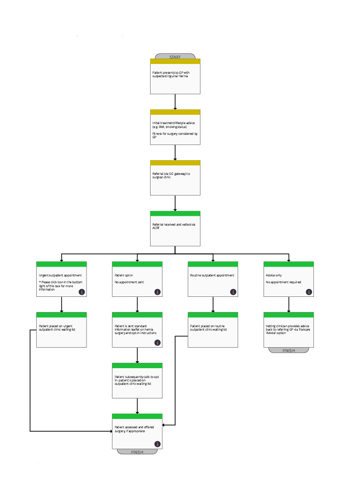
Pathway recommendations

Click on the image below to open the pathway in a new window: 

Inguinal hernia pathway

References

This pathway complies with the updated HerniaSurge guidelines which are supported by the British Hernia Society (BHS) and the European Hernia Society

The HerniaSurge Group, International guidelines for groin hernia management. Hernia. 2018 Jan; 22(1):1–165. DOI: 10.1007/s10029-017-1668-x.

Update of the international HerniaSurge guidelines for groin hernia management. BJS Open. 2023 Sep; 7(5). DOI: 10.1093/bjsopen/zrad080.

European Hernia Society guidelines on the treatment of inguinal hernia in adult patients. Hernia. Updated 2014

Patient information leaflets are as recommended by the BHS

British Hernia Society, Groin hernia and you   

NHS Ayrshire & Arran Patient information leaflet

NHS Greater Glasgow & Clyde Patient information leaflet

NHS Lothian RefHelp Groin pain guidance 

Additional comprehensive patient decision aids are now also available which comply with the NICE recommendation on patient decision aids. These clearly explain the option of no surgery and no mesh repair.

NHS England, Decision support tool: making a decision about inguinal hernia

NHS England, Making a decision about an inguinal hernia - easy read version 

British Hernia Society, Mesh and your hernia repair 

NICE. Standards framework for shared-decision-making support tools, including patient decision aids (ECD8)

The work on the use of mesh from the Scottish Health Technology Group (SHTG) has also been noted Elective surgery using mesh to repair primary or incisional hernias in adults 

Guidelines from the Association of Surgeons of Great Britain and Ireland (ASGBI) and the Getting it Right First Time (GIRFT) programme have also been considered. Inguinal hernia pathway