Warning

Click the image below to open a pdf of the pathway diagram.

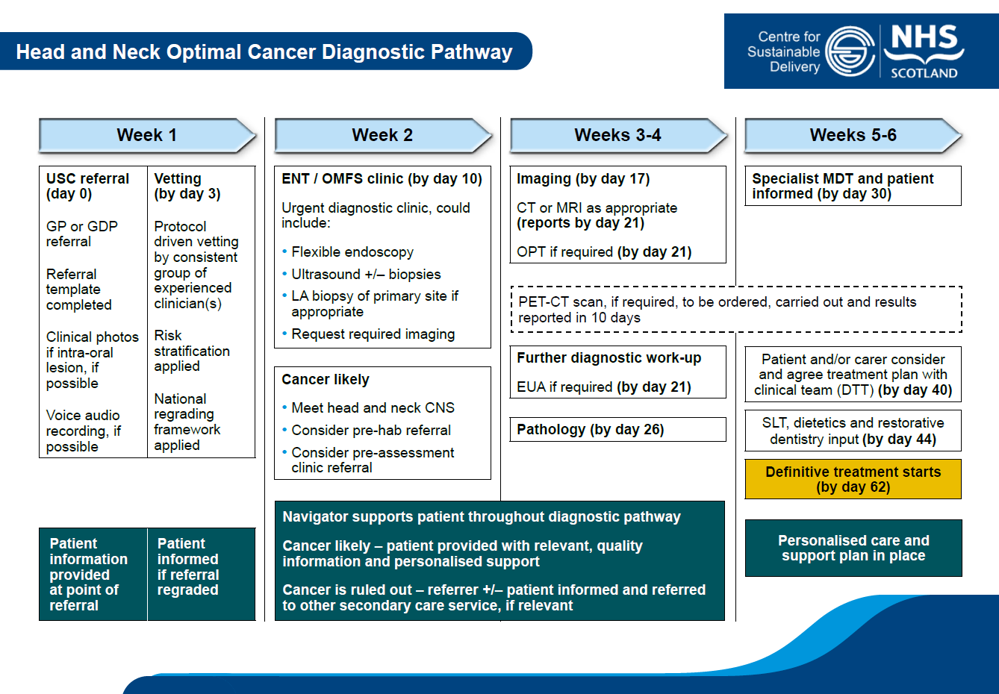
Diagram of head and neck optimal cancer diagnostic pathway


Pathway recommendations

Week 1

An Urgent Suspicion of Cancer (USC) referral should be made by the primary care clinician (including general dental practitioners) for patients who meet the criteria in the Scottish Referral Guidelines for suspected cancer.

Primary care should inform the patient that they are being referred as USC at the point of referral, while reassuring them that the vast majority of referrals result in a non-cancer diagnosis.

Primary care should also make the patient aware of their responsibilities to make themselves available for tests and appointments in the coming days/weeks.

Including as much relevant information and supporting materials in the initial referral from primary care is key to enabling active triage to ensure the patient is on the right pathway at the right time. Clinical triage can be done by a suitably experienced clinician – preferably by a consistent group, regularly – based on SRG guidance.

Risk-calculator tools are widely embedded in head and neck diagnostic pathways across the UK, including Scotland, with emerging evidence supporting their role in risk-stratifying at the front-end of the pathway. Available tools should be considered alongside the Principles of Realistic Medicine.

If a USC referral is regraded at the point of vetting, the USC National Regrading Guidance should be adopted with the initial referrer and patient informed.


Week 2

Following vetting, the first diagnostic test should happen by day 10.

Coordinating and bundling diagnostic tests where possible can help reduce the number of times a patient needs to visit the hospital. This could be supported through the establishment of a diagnostic hub, but alternative models are available for Boards with a smaller number of patients moving through the Head and Neck Pathway.

The aim is to physically ‘see’ the possible cancer via flexible endoscopy, imaging or biopsies to help confirm or rule out cancer.

Where possible, a navigator/Single Point of Contact (SPOC) should be identified to provide consistent contact, build trust, and generally support the patient throughout the diagnostic pathway.

The patient should be informed about cancer being ruled out, or diagnosed, via the preferred method of communication agreed with the patient – this could be face-to-face or via telephone/virtual.

In cases where cancer is likely, the patient should meet the Clinical Nurse Specialist (CNS) and be considered for a prehab referral. In cases where cancer is excluded, USC patients can be removed from tracking on a 62 day pathway.


Weeks 3-4

Standard imaging protocols should be applied for all Computed Tomography (CT), Magnetic Resonance Imaging (MRI), ultrasound and Positron Emission Tomography Computed Tomography (PET-CT). These should comply with Royal College of Radiologists recommendations or equivalent.

CT/MRI, where appropriate, should be reported by day 21.

PET-CT should be carried out and reported within 10 calendar days, to allow preparation for treatment planning discussion by day 40.

Reports for tissue sampling should be available by day 26.

All histopathology should have a clear indicator, clarifying the urgency and date that the report is required by to ensure that the timescales for reporting is not lost between different clinicians or teams.


Weeks 5-6

Multidisciplinary team meeting (MDT)

The multidisciplinary team meeting (MDT) is the culmination of patient examinations/consultations and diagnostic investigations. Most MDTs take place on a weekly basis, usually on the same day each week and can be local (discussing patients from within one NHS Board), or regional (discussing patients from more than one Board within a region).

The MDT provides a professional forum to discuss patients’ results and explore and agree the most effective treatment options available. It is crucial that all MDTs are coordinated and managed effectively to ensure there’s clinical agreement on the next step of the patient’s pathway and a decision to treat is not delayed. Recommendations on delivering effective MDTs can be found in the Framework for Effective Cancer Management

Holistic Needs Assessment (HNA)

Personalised care and support planning should be based on the patient and clinician(s) completing a Holistic Needs Assessment (HNA) shortly after diagnosis.

The HNA ensures conversations focus on what matters to the patient and considers wider health, wellbeing and practical support required. This helps enable shared decision-making regarding treatment and options.


Best practice examples

NHS Dumfries & Galloway

In NHS Dumfries & Galloway, since September 2024, a Nurse Specialist attends the neck lump and standard Ear, Nose and Throat (ENT) clinics and escalates any patients with a clinical diagnosis of malignancy, or high risk of a diagnosis of malignancy, to the cancer improvement manager who then co-ordinates with radiology to have the scan carried out within 7 days. 

To date, they are achieving 7 days to CT from initial clinic for all patients highlighted through this process (Range 0-7 days, median 3 days)​.


NHS Greater Glasgow & Clyde 

An online form has been developed for patients to complete, following referral, to support triage in secondary care and help ensure the patient is on the right pathway.


NHS Lothian

Working with primary care (community services/dental services), secondary care and third sector, a Detect Cancer Earlier (DCE) project was established locally to address health inequalities and associated risk factors, by improving the recognition of possible early signs of head and neck cancers, especially oral cancers. 

Secondary care helped to identify higher-risk groups of patients already attending Urgent Suspicion of Cancer (USC) ENT / Oral Maxillofacial Surgery clinics who have a history of smoking or other key risk factors and had been discharged having had cancer ruled out. Having experienced a ‘near miss’ in the acute sector, this presents a timely moment to offer support and information to reduce their risk.  

A head and neck cancer prevention support tool was developed for high risk, vulnerable groups often challenged by deprivation to reduce both social and health inequalities, focusing on service and individual barriers to support risk behaviour reduction and awareness. This comprises of two patient information leaflets: Resources for head and neck cancer prevention and Self examination of the mouth.


NHS Greater Glasgow & Clyde 

To expand diagnostic capacity, NHS Greater Glasgow & Clyde established an ENT Diagnostic Hub, introducing several key initiatives:

  • Advanced Clinical Nurse Specialists were trained to perform and interpret flexible nasendoscopy, perform neck examinations, and take comprehensive red-flag histories, significantly increasing diagnostic throughput.
  • The Urgent Neck Lump Clinic now offers a streamlined one-stop service, including ultrasound-guided biopsies.
  • In collaboration with radiology, same-day CT staging slots have been introduced to further accelerate the pathway.
  • All initial face-to-face appointments now include the option for oral and endoscopic biopsies under local anaesthetic, reducing both pathway times and the need for general anaesthetic procedures for some patients.
  • Strengthened collaboration with the Head and Neck surgical team and cancer specialties has enabled faster, more coordinated onward referrals and facilitated more timely MDT presentation.
  • Initial assessments also incorporate prehabilitation, nutritional, and pain management needs. Early involvement of the Clinical Nurse Specialists enhances patient care throughout the cancer journey.

Through prompt triage and integrated working, the ENT Diagnostic Hub has shortened the diagnostic pathway, reduced variation, and improved both efficiency and patient experience.


Our best practice examples are continually being reviewed and updated. If you have any examples you would like us to share, please contact us to discuss. Equally if you would like any further information on the examples above, please contact us at cfsdcancerandedteam@nhs.scot


Further resources

Framework for Effective Cancer Management (2025) - https://www.gov.scot/publications/framework-effective-cancer-management-2/

Detect Cancer Earlier (DCE) Programme (Head & Neck) - https://getcheckedearly.org/head-and-neck-cancers

Scottish Referral Guidelines for suspected cancer (Head and neck and thyroid cancers) -  https://rightdecisions.scot.nhs.uk/scottish-referral-guidelines-for-suspected-cancer/head-and-neck-and-thyroid-cancers/

Urgent Suspicion of Cancer: national regrading guidance (2023) -  https://www.gov.scot/publications/urgent-suspicion-cancer-national-regrading-guidance/

Centre for Sustainable Delivery’s High Impact Changes (incl. ACRT) - https://www.nhscfsd.co.uk/our-work/modernising-patient-pathways/high-impact-changes/

Centre for Sustainable Delivery’s Ear, Nose and Throat Specialty Delivery Group - https://www.nhscfsd.co.uk/our-work/modernising-patient-pathways/specialty-delivery-groups/ear-nose-and-throat/

National Prehabilitation for Scotland - https://www.prehab.nhs.scot/

Key Principles for Implementing Cancer Prehabilitation across Scotland - https://www.prehab.nhs.scot/for-professionals/key-principles/

Macmillan Principles and Guidance for Prehabilitation Within The Management and Support of People with Cancer - https://www.macmillan.org.uk/healthcare-professionals/news-and-resources/guides/principles-and-guidance-for-prehabilitation

Further information on Holistic Needs Assessment - https://www.macmillan.org.uk/healthcare-professionals/innovation-in-cancer-care/holistic-needs-assessment

Single Point of Contact (SPOC) scalability assessment - https://www.healthcareimprovementscotland.scot/publications/scalability-assessment-for-single-point-of-contact-for-cancer-care-march-2025/


  cfsdcancerandedteam@nhs.scot

  www.nhscfsd.co.uk

@NHSScotCfSD

Centre for Sustainable Delivery

  Scan the code to visit our website

Editorial Information

Last reviewed: 31/01/2024

Next review date: 31/01/2027

Author(s): The Centre for Sustainable Delivery.