Advanced Nurse Practitioner-led vetting and pathway - NHS Lanarkshire
NHS Lanarkshire has developed and implemented two Advanced Nurse Practitioner (ANP)-led pathways to support Urgent Suspicion of Lung Cancer referrals. On completion of vetting, patients are appointed to the most suitable ANP clinic determined by chest radiographic appearance.
Patients with 'red flag' symptoms but without chest radiographic evidence of thoracic malignancy are appointed to a low-suspicion pathway, virtually managed to coordinate further diagnostic investigations. Where the chest radiograph is concerning for thoracic malignancy, patients are seen face-to-face for assessment and the necessary investigations requested.
In all cases, CT imaging results are discussed with a Respiratory Consultant to confirm the management plan, with outcomes including discharge, appointment to a lung cancer clinic (with PET-CT scan undertaken if indicated), appointment to a non-cancer respiratory clinic, or onward referral to another specialty. Results and outcomes are communicated directly to patients by the ANP.
These pathway changes have delivered significant benefits, including improved patient flow and patient experience through timely communication. In addition, the approach has optimised the use of Respiratory Consultant-led lung cancer clinic appointments ensuring capacity is prioritised for patients with the highest clinical need, reducing unnecessary face-to-face attendances, and supporting earlier diagnosis where thoracic malignancy is suspected.
Single Point of Contact - NHS Borders
In NHS Borders, all patients referred as a USC are contacted by the Single Point of Contact (SPoC) team following vetting, to confirm that they have been added to a cancer pathway and are offered information (including a leaflet) to describe the support available. During the diagnostic phase of the pathway, patients can contact the SPoC team to discuss any concerns they or their friends/family may have.
If a cancer is diagnosed, patients are contacted by the SPoC team to offer screening for universal prehabilitation and are referred for completion of Holistic Needs Assessment.
Chest X-ray AI - Accelerated National Innovation Adoption (ANIA) Pathway
NHS Grampian and NHS Greater Glasgow and Clyde have been piloting the use of AI technology to accelerate the diagnosis of suspected lung cancer from chest x-rays (CXRs).
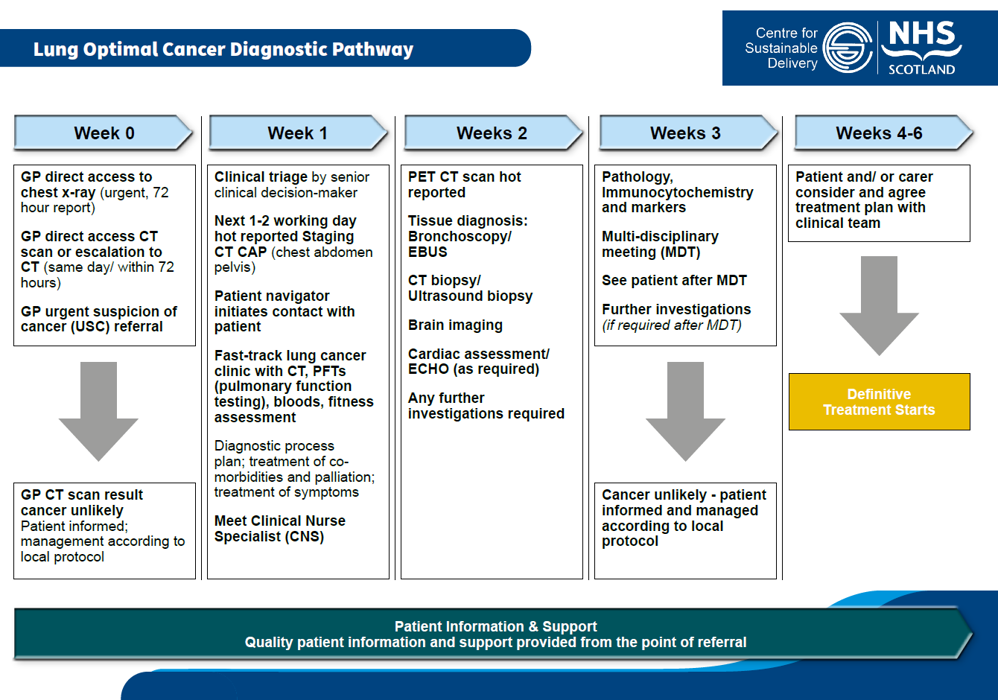
Building on this work, and as part of the Accelerated National Innovation Adoption (ANIA) Pathway, a Value Case is in development which aims to accelerate the diagnosis of lung cancer following a GP requested CXR by the national deployment of this pathway enhancement. This will see CXRs identified by the AI technology as ‘high risk’ and reported speedily (Scotland’s optimal lung cancer diagnostic pathway says within 72 hours) with diagnostic CTs taking place within the subsequent 72 hour period.
Fast-tracked CT scans - NHS Tayside
When a suspicious chest x-ray is identified by Radiology, they immediately arrange a CT scan. An alert code triggers a notification to the cancer team with the patient’s GP copied. The patient is contacted by the hospital and a CT scan and urgent chest clinic appointment arranged for the earliest date.
"Why wait?" pathway approach - NHS Lothian
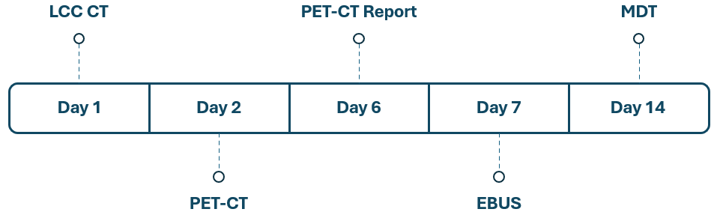
We have CT slots scheduled on the same day as clinic appointments. These are hot reported by radiology alongside the respiratory physician to allow planning for next steps and immediate relay of results to patients. Any unused CT slots can be used for inpatients to avoid waste. Also built around our clinic is our lung function service providing basic spirometry and protected full lung function tests (TCO/IWT) for radically treatable disease; capacity is extended at very short notice as required.
The ethos of our service has been 'why wait', trying to minimise pathway days with no activity. Assisting with this, our radiologists will email all radiology concerning for lung cancer allowing us to liaise urgently with GPs and triage to our service rapidly. This frequently leads to a 1 day turnaround between abnormal CXR and patients attending a CT or clinic appointment. Every step and day matters so it may feel like a particular initiative may only improve the pathway by 2 or 3 days but the cumulative effect will be impactful. We will guarantee that those services within our control can be offered within 7 days, e.g. time from abnormal CXR to diagnostic CT/clinic, time from referral with CT to clinic, time to endobronchial ultrasound/bronchoscopy. We have taken a pan-Lothian approach in sharing and creating capacity for this.
The major advance in our pathways has been the introduction of our next day scheduled PET-CT service. After auditing the number of PET-CT requests and understanding how many were crucial to the next diagnostic test i.e. endobronchial ultrasound following stage 2/3 disease where lymph nodes staging was required, the PET team agreed to 2 scheduled PET-CT slots the day following our lung cancer clinic (trialled at a single site). It adds another step in an administrative heavy pathway for the clinician but the impact has been tremendous. This has now been extended to the other sites in NHS Lothian. Allowing 2 working days for a PET-CT report allows us to schedule endobronchial ultrasound, where appropriate, the day after report. Most patients not on this accelerated PET-CT pathway are on a different pathway i.e. growing nodules so are not disadvantaged.
Protected PET-CT slots - NHS Greater Glasgow & Clyde
Across the West of Scotland, 5 PET-CT slots per day are currently allocated for priority booking for lung cancer patients (who are fit and appropriate for radical treatment). The aim is for these patients to have PET-CT within 7-10 days of referral. Between March 2024 and March 2025, 671 referrals were received. 73% of patients referred for these slots had their scans and reports completed within 10 days (40% within 7 days). This has allowed these patients to progress more quickly along the optimal pathway and has had no noticeable effect on the waiting times for other cancers.
Virtual clinic and vetting after CT scan - NHS Ayrshire & Arran
In NHS Ayrshire & Arran, a virtual clinic takes place every Monday afternoon to review all those that have had a CT scan although the report doesn’t have to be ready. This is alternated each week between two Respiratory Consultants. Active Clinical Referral Triage (ACRT) is then undertaken and if lung cancer is suspected, patients will be seen in the weekly lung clinic to agree a diagnostic plan. A letter is issued to all patients not identified as high risk to manage their expectations and reduce anxiety as quickly as possible. This process enables around a third of patients to be discharged and ensures that clinic and any additional diagnostic capacity is efficiently used.
The National Bronchoscopy and Endobronchial Ultrasound (EBUS) Training Programme - NHS Scotland Academy
The National Bronchoscopy and Endobronchial Ultrasound (EBUS) Training Programme, offered by the NHS Scotland Academy, has been developed to improve lung cancer outcomes for patients across Scotland. The programme delivers training in basic bronchoscopy, endobronchial ultrasound and transbronchial needle aspiration of mediastinal lymph nodes.
The programme is being delivered over a 3 year period and will train 45 respiratory trainees in basic bronchoscopy, and approximately 40 senior trainee consultants in endobronchial ultrasound and transbronchial needle aspiration. Further information on the programme and how to apply can be found here.
Rapid On Site Evaluation (ROSE) during Endobronchial Ultrasound - NHS Forth Valley
In early 2025, Forth Valley Royal Hospital (FVRH) introduced a new Rapid On Site Evaluation (ROSE) service to help speed up and improve the urgent suspicion of lung cancer pathway. The ROSE service is a collaboration between the Respiratory and Pathology teams, and involves having a pathologist in the room during Endobronchial Ultrasound (EBUS) to provide real-time feedback on specimen collection. This helps to improve the quality of the samples obtained, so that a clear diagnosis can be made, as well as ensuring that sufficient material is acquired for genetic analysis. The ROSE team consists of doctors, biomedical science staff, and a dedicated team of endoscopy nurses, all working alongside FVRH’s Respiratory Consultants who carry out the EBUS procedures.
Between January and August 2025, 98 patients had ROSE performed alongside their EBUS. During this time, the team achieved a major improvement in service quality, reducing the repeat procedure rate from 14.1% to just 4.9% compared with the same period in 2023. Implementing ROSE has also enabled a 48-hour turnaround for these patients, allowing full pathology results to be discussed at the Multidisciplinary Team (MDT) meeting within the same week (samples taken on Tuesdays for MDT discussion on Thursdays). Before ROSE, this turnaround time was 72 hours which meant patients could not be discussed at MDT in the same week. This reduction in turnaround time therefore potentially speeds up the pathway in FVRH by around 7 days.
The service has been very well received by the respiratory team, who have seen a clear reduction in the number of patients needing repeat procedures. ROSE is also supported by a dedicated team of endoscopy nurses - all of whom have quickly adapted to the new sample-handling process. Plans are underway to train additional laboratory staff to support the ongoing service.
If you’d like to discuss Scotland’s optimal cancer diagnostic pathways, or share any other best practice examples with us, please get in touch via cfsdcancerandedteam@nhs.scot. If you have any questions in regards to a specific example on these pages, please reach out to the named Boards’ Cancer Manager in the first instance.


 Optimal cancer diagnostic pathways



 @NHSScotCfSD
 Centre for Sustainable Delivery
 Scan the code to visit our website