Warning

Background

Venous leg ulcers are common and are associated with significant morbidity to the patient and cost to the NHS. Recent evidence has shown that early endovenous intervention on patients with active ulceration improves healing rates and reduces recurrence.

The National Venous Leg Ulcer Treatment Pathway should ensure timely and standardised treatment for patients with ulcers, with access to community venous leg ulcer clinics and early, streamlined referral into a vascular one-stop clinic where patients can be assessed and venous intervention planned and delivered in an appropriate timeframe.
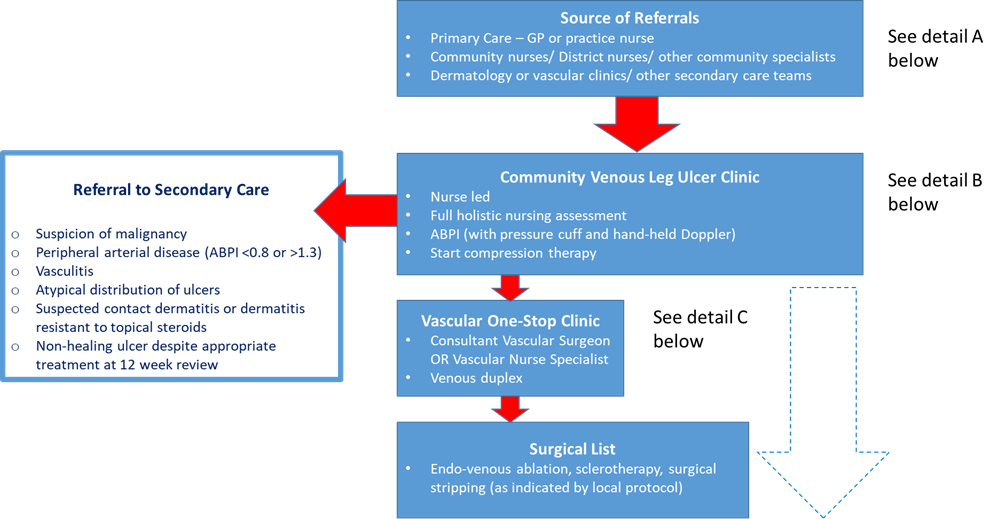
 

Pathway overview

Click on the image to view a larger version


Image of venous leg ulcer pathway recommendations


Red flag symptoms

Immediately escalate to the relevant clinical specialist and/or service:

  • Acute infection (e.g. increasing unilateral erythema, swelling, pain, pus, heat)
  • Symptoms of sepsis
  • Acute or suspected chronic limb threatening ischaemia (e.g. PAD in combination with rest pain, gangrene, or lower limb ulceration of more than 2 weeks duration
  • Suspected acute deep vein thrombosis
  • Suspected skin cancer
  • Bleeding varicose veins


Detail A: Patient referral to Community Venous Leg Ulcer Clinic (VLUC)

  • Source of referrals – Primary Care (GP or practice nurse), Community Service (District Nurse, podiatry, etc.), secondary care teams
  • Triage presents an opportunity for streaming patients into appropriate service. Patients with Red Flag symptoms should be referred urgently onto the relevant clinical specialist or service and should not be referred to the Community Venous Leg Ulcer Clinic.


Inclusions Exclusions

Venous leg ulcers present for >4 weeks in non-housebound patients

A chronic venous leg ulcer can be defined as: An open lesion between the knee and ankle joint that remains unhealed for at least 4 weeks and occurs in the presence of venous disease. Typically in the gaiter area of the lower leg (around the malleoli)

Suspicion of malignancy

Peripheral arterial disease

Vasculitis

Atypical distribution of ulcers

Suspected contact dermatitis, or dermatitis resistant to topical steroids

Housebound patients (should be referred to district nurses for assessment and treatment)

Non-healing ulcer despite appropriate treatment (>12 week)


Detail B: Community VLUC: Outline description

  • Staffed by appropriately trained, qualified nurses (not necessarily nurse specialist)
  • Situated in community setting – clinic room including a low level sink (or equivalent). Ideally with bariatric / split leg bed
  • New patient assessment clinic (allow for 90 – 120 minute slots):
    • Ankle Brachial Pressure Index (ABPI) with pressure cuff and hand-held Doppler
    • Glycated haemoglobin test – HbA1c (abnormal results will be fed back to GP)
    • Initiate compression bandaging
  • Photography to confirm healing and to support referral if needed
  • Return patient (bandaging) clinic (30 mins per leg)
    • Patient attends twice per week – reducing to once per week
    • Assessment is carried out at each dressing change and amendment to the treatment plan as necessary. Full re-assessment including ABPI (if little or no progress) carried out at 12 weeks, consider escalation to specialist services if no improvement
  • Emphasis on following protocol for assessment and review bandaging. (Sample standard operating procedures are proved in the appendix below. These will need review / adaptation locally to ensure agreement with local arrangements). Use of an agreed wound formulary to ensure best practice and minimise unnecessary costs
  • In some circumstances it may not be possible to get ABPIs measured immediately. Rather than delay instituting compression therapy in patients who are at low risk of pressure damage over bony prominences, consider offering first line reduced, graduated compression (20mmHg or less at the ankle) while waiting for ABPI measurement. Such patients will require close monitoring for skin integrity and signs of vascular insufficiency and should have ABPIs measured as soon as possible.
  • Those with red flag symptoms should be escalated urgently to the relevant clinical specialty but should also be considered for first line reduced graduated compression (20mmHg at the ankle). Such compression therapy is likely to be beneficial to most EXCEPT those with acute or suspected chronic limb threatening ischaemia where this should be avoided1.
  • Close working with Vascular Surgery and Dermatology for advice as needed. Photography and remote consultation (e.g. Near Me or Digital Dermatology) should support this.
  • Discharge planning should start 2 to 3 weeks in advance of anticipated discharge. Relevant compression hosiery, applicators and creams should be ordered. Patients and carers should receive guidance (including written information) on self-care, including instruction on how to obtain repeat prescriptions from Primary Care, warning signs to look for and a contact number. For some patients (where supported by local protocol), wraps may be an appropriate alternative to hosiery.
  • The service will usually offer a 6 week open appointment system that can be accessed via the contact number.


Detail C: Onward referral from VLUC to Vascular Surgery Service for venous intervention

Patients with ABPI between 0.8 and 1.3, where the patient is ambulant and physically able to attend for venous duplex, should be referred to a one stop clinic:

  • Vascular lab (or equivalent) for venous duplex + review by Vascular Surgeon or Vascular Nurse Specialist for assessment and potential listing for
    a) endo-venous ablation
    b) sclerotherapy
    c) surgical stripping as per local protocol
  • Input from Vascular Nurse Specialist where available
  • Compression therapy (managed by VLUC) continues through surgical phase of pathway unless otherwise indicated.


References and further resources

This pathways was produced in line with SIGN 120 guidance which was subsequently withdrawn and replaced by NICE guidance

Consideration has also been given to ESCHAR trial2 and EVRA trial3 and further resources are also available at National Leg Ulcer (Scotland) Forum and the National Wound Care Strategy Programme.

  1. National Wound Care Strategy Programme: Lower limb wounds – Leg ulcer recommendations July 2024
  2. Gohel MS, Barwell JR, Taylor M, et al. Long term results of compression therapy alone versus compression plus surgery in chronic venous ulceration (ESCHAR): randomised controlled trial. BMJ. 2007 Jul 14;335(7610):83. DOI: 10.1136/bmj.39216.542442.BE.
  3. Gohel MS, Heatley F, Liu X, et al. EVRA Trial Investigators. A randomized trial of early endovenous ablation in venous ulceration. N Engl J Med. 2018 May 31;378(22):2105-2114. DOI: 10.1056/NEJMoa1801214.


   gjnh.cfsdpmo@gjnh.scot.nhs.uk

  www.nhscfsd.co.uk

@NHSScotCfSD

Centre for Sustainable Delivery

  Scan the code to visit our website


Editorial Information

Last reviewed: 31/03/2023

Next review date: 31/10/2025

Author(s): Centre for Sustainable Delivery.