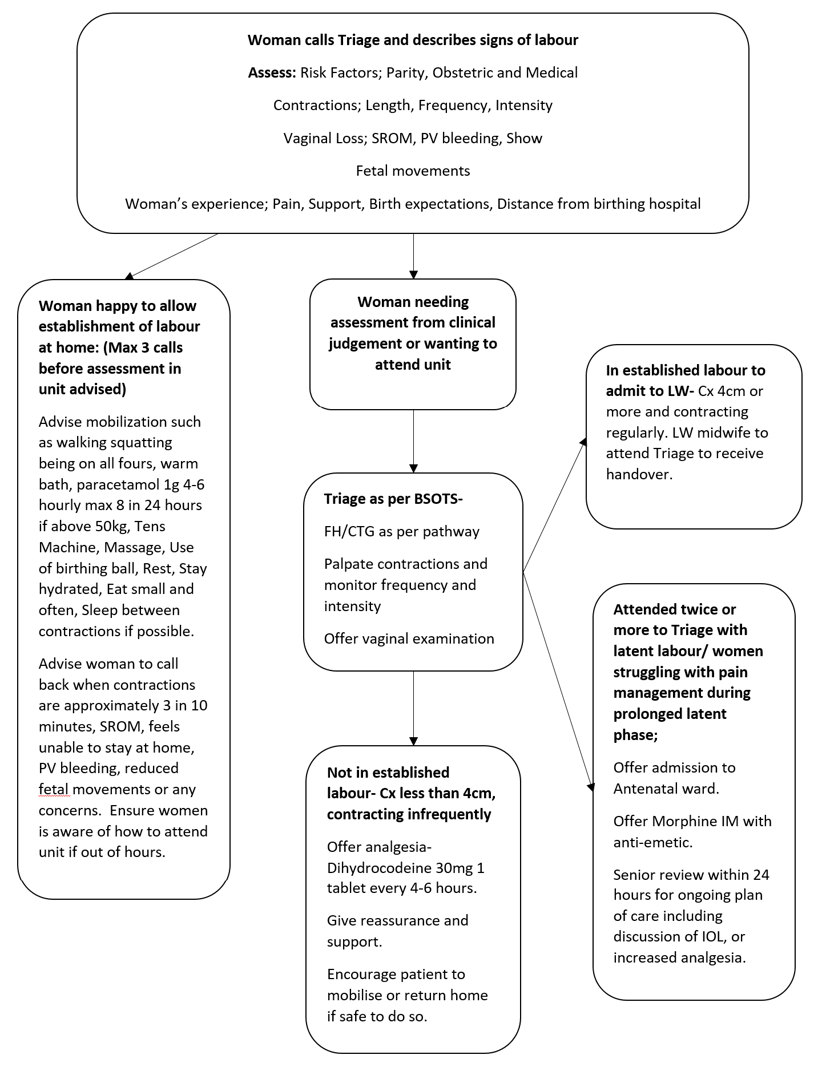
NICE (2023) recommends that if a woman contacts maternity triage for labour advice, the midwife should carry out an assessment on the telephone to determine if a face-to-face assessment is required.
The telephone triage midwife should ensure they have looked at all previous communications to allow for full oversight of the clinical situation. This will allow the midwife to identify women who have phoned multiple times that may need a face-to-face review.
The midwife should ensure appropriate professional telephone interpretation is in place to enable a full discussion with a woman who does not have English as a first language.
The midwife should ensure the call duration allows a full assessment of the woman’s uterine activity and allows time for the midwife to fully obtain the woman’s account of her pregnancy up until now considering any risk factors or concerns the woman may have.
Women who call twice within 24 hours may be offered a face-to-face assessment if the midwife taking the call has any concerns that the symptoms being described are out with what is expected of the latent phase of labour. Women who have experienced a prolonged latent phase of labour and have contacted triage multiple times should be considered for a face-to-face assessment by their third call.
Any woman who is not coping at home, regardless of how many phone calls they have made, or has any concerns with their health or the wellbeing of their baby should be offered immediate face to face review.
The following information should be included in a triage assessment of labour:
- ask the woman how she is, and about her wishes, expectations and any concerns she has
- ask the woman about the baby's movements, including any changes
- give information about what the woman can expect in the latent first stage of labour and how to work with any pain she experiences
- give information about what to expect when she accesses care
- agree a plan of care with the woman, including guidance about who she should contact next and when
- Provide guidance and support to the woman's birth companion(s).
The midwife should be able to confidently give advice on latent phase of labour coping strategies over the phone, for example:
- Performing activities as normal
- To go for a walk
- The use of water (warm shower/baths)
- Distractions through listening to music, watching television
- Using a TENS machine when the contractions become uncomfortable
- Using breathing and relaxation techniques such as hypnobirthing
- To try different positions and the use of a birthing ball
- To try massage. Women with babies in the occipito posterior position often experience increased back pain; massage and back rubbing may help this.
- To try to sleep/rest/nap when able too
- To keep well hydrated and eat light snacks to maintain energy levels
- To continue to monitor fetal movements
In addition, midwives must establish that they have appropriate social support and give advice on when to call back.
When inviting a woman in for a hospital review, the midwife should identify if the woman has access to appropriate transport to attend. Where a woman states that she does not have means to pay for taxi or public transport, the midwife should assess whether an ambulance is required or whether a hospital taxi could be arranged.