Prevention and Management of Iron Deficiency Anaemia in Pregnancy and the Puerperium (1195)

Warning

Objectives

This guideline covers the prevention and management of iron deficiency anaemia during pregnancy and puerperium. It aims to ensure

  • Recognition of low iron states
  • Early intervention to prevent iron deficiency anaemia
  • The diagnosis of iron deficiency anaemia
  • Treatment of iron deficiency anaemia

Audience

This guideline is for use by midwives, obstetricians, and other members of the multidisciplinary team in Maternity. It is also of relevance to Primary Care – GPs, community pharmacists, and practice nurses who may be involved in the wider health care of pregnant women.

Iron deficiency is the most common cause of anaemia in pregnancy. Maternal anaemia can result in maternal fatigue, an increased risk of postpartum haemorrhage, and an increased risk of postpartum depression. It is associated with an increased risk of stillbirth, preterm birth and neonatal low ferritin levels.

Oral iron supplements can effectively treat iron deficiency anaemia. Supplements also have a role in treating low iron states and preventing the development of iron deficiency anaemia.
1. Definition of anaemia in pregnancy

Maternal anaemia is defined as: 

  • Haemoglobin concentration (Hb) <110g/l 1st trimester
  • Hb <105g/l 2nd & 3rd trimesters
  • Hb <100g/l postpartum

2. Screening for anaemia

All women should be offered screening for iron deficiency anaemia during pregnancy. At a minimum a full blood count (FBC) and serum ferritin should be obtained at

  • Booking appointment
  • 28 weeks
  • 34-38 weeks

3. Responsibility for the review of results

It is the responsibility of the healthcare professional requesting and obtaining blood tests to ensure the results are reviewed and appropriate action taken.

  • Blood tests taken in the community should be followed up by the community midwife
  • Blood tests taken in the hospital should be followed up by the person requesting the test

Results of tests ordered through Trakcare will appear in the list of electronic results awaiting sign off. When results are signed off they should be actioned at the same time.

Blood tests taken, the results and actions should be documented in the electronic patient record (BadgerNet) using Blood Tests, Results and Actions.

Interpretation of results and treatments

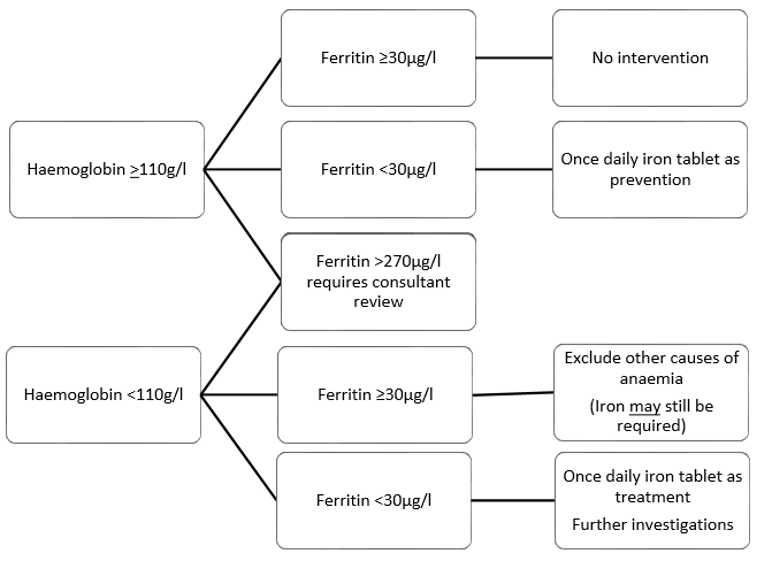
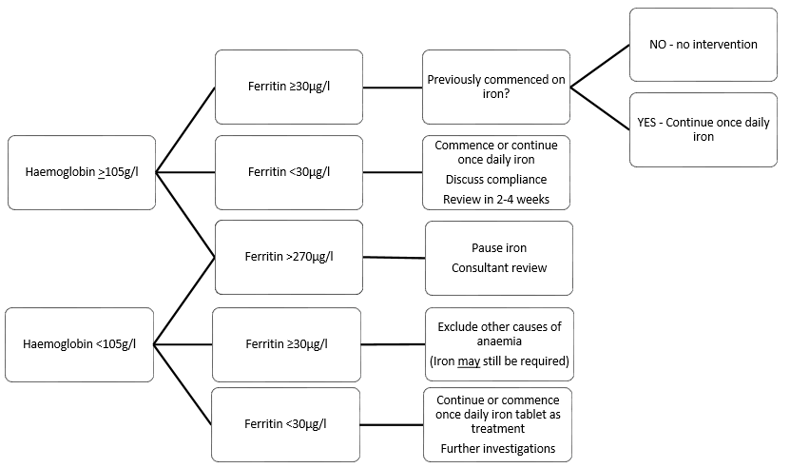
The flow charts below detail the interpretation of blood test results and actions to either prevent or treat iron deficiency anaemia. Where further investigations are indicated refer to section 7.

4. First trimester

5. Second and third trimester

6. Further investigation and management of anaemia during pregnancy

7. Normal ranges in pregnancy and interpretation of further investigation results

Normal ranges in pregnancy are:

Ferritin  >30µg/l
Mean Cell Volume (MCV) 88-109fl
Transferrin   2-4g/l


Ferritin

<30

<30

>30

>30

MCV

Low

Normal

Normal/Low

Normal

Transferrin

High/ Normal/ Low

High /Normal/ Low

High

Normal/ Low

Cause

Iron deficiency anaemia

Iron deficiency anaemia

Iron deficiency anaemia is likely

Anaemia NOT likely to be due to iron deficiency. Look for other causes.

A raised ferritin result can be a transient inflammatory marker. If a serum ferritin result is >270 µg/l, repeat bloods and consultant review are indicated. If oral iron has previously been prescribed, treatment should be paused until further blood results are reviewed, and an individualised plan agreed.

8. Contraindications to iron therapy

Anaemias that present with a low haemoglobin but a normal or high ferritin (>30µg/l) need careful review. There are other causes of anaemia and iron therapy may not be the appropriate treatment.

Consider other causes of anaemia e.g. folate or Vitamin B12 deficiency and check levels. If there is a strong clinical suspicion of iron deficiency anaemia, consider checking transferrin (request “iron studies” on Trakcare).

These conditions

  • Thalassemia trait
  • Sickle cell disease (HbSS or HbSC)
  • Haemolytic anaemias (e.g. Hereditary spherocytosis)

can be associated with iron overload and therefore iron replacement is relatively contraindicated. Patients are likely to know they have these conditions.

Always consider the Hb result in conjunction with the serum ferritin result to confirm iron deficiency and exclude iron overload.

Discussion with a haematologist should take place before giving iron to women with these conditions.

9. Iron therapy

A. First Line: Oral Iron

The first line iron therapy for both prevention and treatment of anaemia is one tablet of oral iron once daily. Recent evidence shows once daily dosing is as effective as twice or three times a day but has fewer side effects, so compliance is increased. Alternate day dosing is possible for women unable to tolerate daily dosing.

Ferrous fumarate or ferrous sulphate are suitable oral iron preparations. Sodium feredetate 5-10ml daily is a liquid alternative.

Women should be offered advice on how to take iron

  • In the morning
  • On an empty stomach
  • With orange juice (or other source of vitamin C)
  • Avoid tea or coffee and milk for two hours as they can reduce absorption of iron.
  • Some medications, including antacids, Thyroxine, calcium tablets and others interact with iron and should be taken at different times. If further advice is needed discuss with a pharmacist.

All women commenced on oral iron should continue on oral iron throughout the pregnancy, and for three months postpartum. For women commencing iron in the postnatal period oral iron should continue for at least three months.

Prescription requests to GPs should ideally be made through Clinical Portal. Local alternative arrangements may be in place in some areas. Women can be notified of results and prescription requests through the Badger App. Midwives can use the Midwifery Formulary to supply oral iron NMC | Practising as a Midwife in the UK.


B. Monitoring for a response to oral iron therapy

When oral iron is commenced as treatment for iron deficiency anaemia the effectiveness of the treatment should be monitored.

  • Check Hb and reticulocyte count 2-4 weeks after starting oral iron as treatment for iron deficiency anaemia.
  • Blood tests may be delayed until the patient’s next appointment if treatment started before 20 weeks gestation unless Hb≤80g/l (early monitoring required).
  • Reticulocyte count will increase prior to rise in Hb and will indicate that red blood cell production is responding to therapy
  • If no response in reticulocyte count at 2 weeks, review the diagnosis / compliance.
  • Response will depend on the initial degree of iron deficiency, patient requirements e.g. multiple pregnancy, and compliance.

Discussion with the obstetric team for individualised management is essential when

  • Hb <70g/l
  • Significant symptoms of anaemia
  • Advanced gestation >34/40
  • No response to treatment after 2-3 weeks of correctly taken oral iron


C. Second Line: Intravenous Iron

Intravenous iron is an alternative to oral iron for the treatment of anaemia. Careful consideration should be given to the use of intravenous iron as a range of common to rare side effects can be experienced.

It is intended for the treatment of significant iron deficiency anaemia – low haemoglobin and low ferritin in consultation with the obstetric team.

Indications for intravenous iron include

  • Known malabsorption condition;
  • Late pregnancy >34/40 gestation if Hb < 80g/l and iron deficient;
  • Postpartum in stable patient to avoid blood transfusion.
Benefits: Intravenous iron can improve iron stores and haemoglobin. Its use should be limited, as oral iron taken reliably is equally effective.
Risks: Rarely hypersensitivity and anaphylactoid reactions can occur -between 1 in 1000 and 1 in 10,000 people may be affected [BNF). Extravasation can occur and cause permanent brown discoloration to the skin.
Alternatives: Iron rich diet, oral iron, blood transfusion.
Nothing: If untreated iron deficiency anaemia will not resolve.

If a woman is not taking oral iron as recommended, or reports poor tolerance of oral iron, intravenous iron is not indicated. The second line in this circumstance should instead be to discuss and offer (see section 10a)

  • alternative iron preparations
  • alternate day dosing
  • optimising absorption of oral iron
  • dietary sources of iron.

It is essential that ferritin levels are checked prior to intravenous iron.

Contraindications for intravenous iron

  • History of anaphylaxis or allergy to intravenous iron
  • First trimester (possibly teratogenicity)
  • Acute/chronic infection
  • Chronic liver disease.

Refer to the GGC guideline for Iron Deficiency Anaemia (IDA) in Adults: Oral and Intravenous Iron Therapy Treatment available on Right Decisions platform - Iron Deficiency Anaemia (IDA) in Adults: Oral and Intravenous Iron Therapy Treatment (662) | Right Decisions

Ferinject (ferric carboxymaltose) should be used in obstetrics - prescribing-and-administration-information-for-ferinject.pdf

Please note it is recommended that oral iron is stopped 48h prior to administration of intravenous iron and should be withheld for five days after, if ongoing oral treatment is required.  

10. Postnatal Management of anaemia

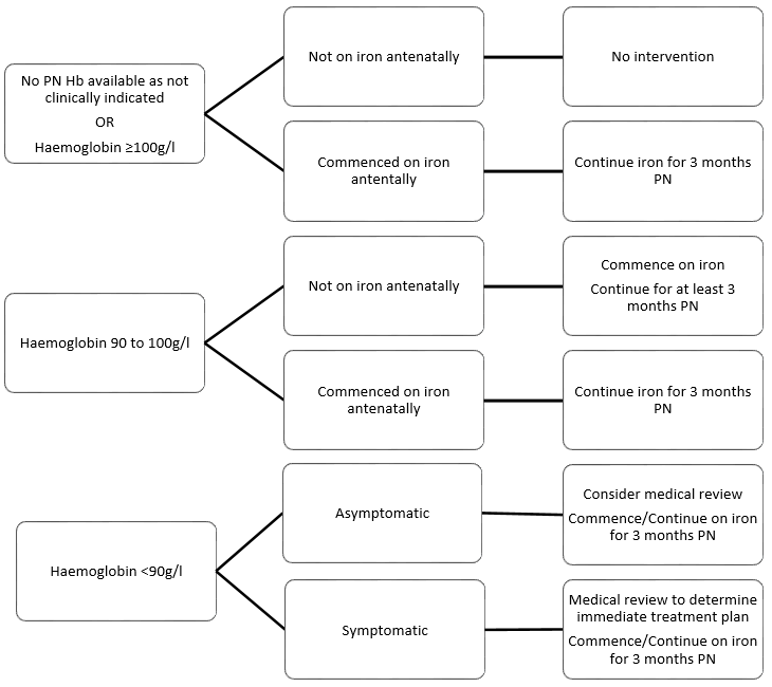
All women commenced on oral iron during pregnancy should continue on oral iron for three months postpartum.

The immediate postnatal management of anaemia will be determined by haemoglobin levels and a woman’s clinical condition. Refer to GGC Guideline Blood Transfusion in Stable Postpartum Patients

Postnatal
Intravenous iron can be used in a stable postpartum woman who is not actively bleeding or requiring immediate increase in Hb. An increase in haemoglobin of 30g/l can be expected in 14 days.

APPENDIX 2: Patient Information Leaflet on anaemia

APPENDIX 3: Patient Information Leaflet on IV Iron

APPENDIX 4: Letter to GP

Editorial Information

Last reviewed: 25/03/2025

Next review date: 31/03/2028

Author(s): Susan Kafka.

Version: 1

Approved By: Maternity Governance Group

Document Id: 1195

References
  1. Briley, A., Seed, P.T., Tydeman, G., et al. Reporting errors, incidence and risk factors for postpartum haemorrhage and progression to severe PPH: a prospective observational study. British Journal of Obstetrics and Gynaecology 2014;121: 876–888.
  2. Broche DE., Gay C., Armand-Branger S., et al. Severe anaemia in the immediate post-partum period. Clinical practice and value of intravenous iron. European Journal of Obstetrics & Gynecology and Reproductive Biology 2005; 123:S21-27 
  3. Daru J., Allotey J., Pena-Rosas JP.,et al. Serum ferritin thresholds for the diagnosis of iron deficiency in pregnancy: a systematic review. Transfusion Medicine, 2017, 27, 167–174.
  4. Haider, B.A., Olofin, I., Wang, M., et al. Anaemia, prenatal iron use, and risk of adverse pregnancy outcomes: systematic review and meta-analysis. British Medical Journal 2013;346, f3443.
  5. Moretti D., Goede JS., Zeder C., et al. Oral iron supplements increase hepcidin and decrease iron absorption from daily or twice-daily doses in iron-depleted young women. Blood. 2015; 126(17):1981-1989.
  6. Pavord S., Daru J., Prasannan N., et al. Uk Guidelines on the management of iron deficiency in pregnanacy. British Journal of Haematology 2019 doi: 10.1111/bjh.16221.
  7. Pena-Rosas, J.P., De-Regil, L.M., Malave, H.G., et al (2015) intermittent oral iron supplementation during pregnancy. Cochrane Database of Systematic Reviews, Issue 10, Art. No. CD009997.
  8. Royal College of Obstetricians and Gynaecologists, Blood Transfusion in Obstetrics: Green-top Guideline No.47. 2015.
  9. Reveiz L, Gyte GML, Cuervo LG, et al. Treatments for iron-deficiency anaemia in pregnancy. Cochrane Database of Systematic Reviews 2011, Issue 10. Art. No.: CD003094. DOI: 10.1002/14651858.CD003094.pub3.
  10. Schaap, C.C., Hendriks, J.C., Kortman, G.A., et al (2013) Diurnal rhythm rather than dietary iron mediates daily hepcidin variations. Clinical Chemistry, 59, 527–535.
  11. Shinar S., Skornick-Rapaport A., & Masiovitz S. Iron supplementation in singleton pregnancy: is there a benefit to doubling the dose of elemental iron in iron-deficient pregnant women? A randomised controlled trial.  Journal of Perinatology 2017;37:782-786.
  12. Smith GA., Fisher SA., Doree C., et al Cochrane Database Systematic Reviews 2014; 7, CD009532.
  13. Tapiero H., Gate L., Tew KD. Iron: deficiencies and requirements. Biomedicine and Pharmacotherapy, 2001; 55: 324–332.
  14. van den Broek NR., Letsky EA., White SA., et al. Iron status in pregnant women: which measurements are valid? British Journal of Haematology 1998;103:817–824.