HIV in Pregnancy and Prevention of Vertical Transmission (441)

Warning

Please report any inaccuracies or issues with this guideline using our online form

Between 10 and 20 women living with HIV require maternity care within GG&C every year. With universal antenatal screening, treatment with antiretroviral therapy (ART), planned mode of birth and support for infant feeding, the vertical transmission rate is extremely low with reported UK rates now less than 0.3%1. As well as preventing vertical transmission, the multidisciplinary team (MDT) aims to provide comprehensive obstetric and sexual & reproductive health care to women living with HIV in NHS GGC.

This guideline was written with reference to the BHIVA guidelines for the management of HIV in pregnancy and postpartum 2018 (2020 interim update).

Antenatal Screening

All women should be offered screening for HIV (along with syphilis and Hepatitis B) at booking. If testing is declined it should be clearly documented in Badgernet and re-offered at 20wks. If needle phobia is the reason for declining then dry blood spot testing (can also include Hep B and Hep C testing) should be made available if more acceptable to the woman.

For those declining screening the baby should be tested at delivery using cord bloods and the mother should be informed of this.

Potential Exposure to HIV during Pregnancy

Vertical transmission is more likely to occur when the woman acquires HIV during her pregnancy.

Frequent HIV testing (at least once every trimester) is recommended if there are any risk factors for HIV acquisition, including a change in sexual partner. Any woman who reports a risk of HIV exposure or is at higher risk of HIV exposure, such as those with a partner living with HIV, victims of sexual exploitation including trafficked women, and women who inject drugs, should be offered repeat screening at 28wks and 36wks.

Women who have a HIV negative test at booking but whose partners are living with HIV

  • Gain consent from person living with HIV (PLWH) to discuss the couple with HIV team. Explain the aim of this is to provide accurate clinical advice to the women on prevention of HIV during the pregnancy.
  • Consent given – email the woman and partner details to BBV CNS team at brownleecns@ggc.scot.nhs.uk and CNS will bring case to MDT for discussion and outcome, including specific advice on HIV testing frequency, prevention and if HIV PrEP is recommended, will be documented in notes.
  • Consent not given - Explore reasons for this and offer other options e.g. PLWH informs HIV team of pregnancy themselves to gain prevention advice for partner. Advise Obs team will seek generic advice on HIV prevention for the woman. 
  • If partner not present to give permission, gain permission for HIV team to contact the woman for a more in depth discussion and send women’s details to email above

Newly Diagnosed Antenatal Women

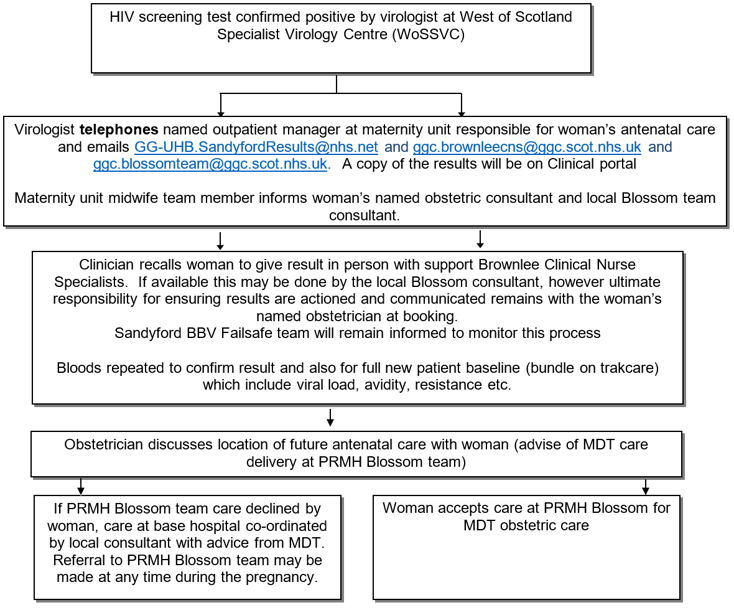
If a woman is found to be HIV positive on antenatal screening, the virology lab will contact the named outpatient manager at responsible maternity unit to inform them. Also, a copy of the result is sent to the Brownlee CNS team, Blossom team and the Sandyford Failsafe team.

Ideally, a multidisciplinary team consisting of obstetric and BBV staff will arrange to meet the woman together to discuss the diagnosis and plan care.

Disclosure of the woman’s HIV status to any sexual partners should be handled sensitively.

Contact tracing and management of sexual partners will be managed by the Brownlee HIV team. Advice should be given on barrier methods to reduce the risk of onward transmission. Women should be offered access to specialist counselling which is provided by the HIV team at the Brownlee Centre.

Newly diagnosed antenatal women flowchart

Antenatal Care

All women living with HIV, who are pregnant or breastfeeding, are discussed at a monthly MDT virtual meeting.  Antenatal care is managed by the Blossom team at PRMH unless the woman prefers to remain under her local obstetric team. Antenatal care is shared with the HIV team who will review her regularly via the joint MDT monthly clinic which is held at PRMH on a Wednesday morning.

The MDT consists of multidisciplinary staff from the Brownlee HIV service, Maternity & Neonatal at PRMH, GGC infant feeding team and GGC virology.

MDT discussions should be documented on Clinical Portal by HIV team member and significant MDT outcome affecting careplan should be updated on Badgernet.

Antiretroviral therapy (ART)

  • Treatment with ART will be managed by the HIV service.
  • Women on dolutegravir should be commenced on 5mg folic acid until at least 12 weeks.
  • All women should be commenced on 400mcg folic acid and vitamin D.
  • Other commonly used medications prescribed in pregnancy such as antiemetics, antibiotics, iron supplements and antacids may interact with ART. These can be checked here https://www.hiv-druginteractions.org/ or discussed with the specialist HIV pharmacy team on 0141 211 3383 or brownleepharmacy@ggc.scot.nhs.uk

Sexual health screening

  • Women who are at risk of other STI exposure should be offered vulvovaginal NAAT for chlamydia and gonorrhoea PCR at booking and again at 32wks.
  • Offer cervical screening if routine annual repeat due during pregnancy.

Fetal Monitoring and Screening

  • Offer women screening for chromosomal abnormalities with first trimester combined biochemical and ultrasound If this is not possible then second trimester quadruple test will be offered but advise women that use of ART can increase the false positive rate.
  • Women who screen positive for chromosomal abnormality will be offered non-invasive prenatal testing.
  • If amniocentesis is indicated then this is considered safe for women on ART with a supressed viral load although limited data exists. If not yet on ART and invasive testing cannot be delayed then liaise with HIV team to commence ART to include Raltegravir or Dolutegravir and give a single dose Nevirapine 200mg 2-4hrs prior to the procedure.
  • No additional fetal ultrasound scans are required unless other obstetric indications are present.

Laboratory Monitoring

  • Viral load and LFTs will be checked as per individual requirements but at least once per trimester, at 36wks and at delivery.
  • Therapeutic drug monitoring and CD4 count will be performed by the HIV team where appropriate

Planning for birth

Mode of birth should be discussed at each visit. The woman should be aware of the options available to her depending upon her obstetric history and viral load. All women should be advised to birth in a unit with immediate access to obstetric and neonatal support, and in GGC this would normally be at PRMH unless the woman chooses otherwise. 

HIV viral load should be reviewed at 36wks for a final decision to be made regarding mode of birth.

Birth plan should be clearly documented using the intrapartum management plan on Badgernet.

  • For women with a viral load <50 HIV RNA copies/ml at 36wks and in the absence of obstetric contraindications, a planned vaginal birth is recommended
  • For women with a viral load ≥50 HIV RNA copies/ml at 36wks a planned Caesarean birth (PCB) should be recommended between 38 and 39wks.

If Caesarean birth is planned for obstetric reasons alone then this can be planned for 39wks. In the case of breech presentation, external cephalic version can be offered to women with viral load <50 HIV RNA copies/ml from 36wks, in the absence of obstetric contraindications. No additional ART cover is required.

HIV infection alone is not a contraindication to trial of vaginal birth after caesarean.

Planning for postnatal care

  • Infant feeding and postnatal contraception should be discussed prior to birth (see more detail below) and the woman’s preference clearly documented in Badgernet, with a plan to administer post-partum.

Intrapartum Care

  • Follow most recent intrapartum management plan documented on Badgernet.
  • Inform neonatal team on admission if baby expected to be on high risk pathway (as documented on Badgernet).
  • Send sample for HIV PCR on admission.
  • Women with viral suppression and no obstetric risk factors can be offered Alongside Midwifery Unit (AMU) care. HIV infection is not a contraindication to a pool birth.
  • HIV infection alone is not an indication for continuous electronic fetal monitoring in labour.
  • The woman should continue to take her ART as normal throughout labour with timings documented on drug chart. If the woman is unable to take orally then consider need for IV Zidovudine (see below).
  • Amniotomy is considered safe but attention should be paid to timing to reduce length of ruptured membranes. In the case of induction of labour where the cervix is unfavourable then additional vaginal prostaglandins may be preferable to an early ARM. Birth should occur within 24hrs of rupture of membranes.
  • Current evidence does not confirm the safety of fetal scalp electrodes or fetal blood sampling in labour and therefore these should be avoided due to the potential risk of vertical transmission.
  • Intrapartum pyrexia should be treated with immediate intravenous antibiotics and consideration should be given to expediting birth.
  • Instrumental birth is not contraindicated and instrument used (ventouse or forceps) can be as per practitioner preference.
  • Optimal cord clamping (ie deferred for at least 60 seconds) is recommended for all women.
  • Baby’s face and eyes should be cleaned at delivery and then immediate skin to skin contact.
  • Bathing should happen as soon as is practical, taking care to avoid hypothermia. Bathing can wait until after the first hour of skin to skin/feeding.
  • Paediatricians should be informed of the time of delivery as post exposure prophylaxis (PEP) for the neonate should be commenced within 4hrs.
  • There are no contraindications to Vitamin K.
  • Mother’s should continue ART regimen post natal.

Spontaneous rupture of membranes (SROM)

  • Timing of rupture of membranes should be clearly documented and progress recorded on the partogram.
  • Women presenting with pre-labour spontaneous rupture of membranes >34 weeks should be offered immediate induction of labour or caesarean birth.
    • Aim for delivery within 24hrs of rupture of membranes if last VL<50
    • Offer immediate caesarean birth if last VL>50
  • Administer antenatal steroids if appropriate but do not delay birth beyond the above.
  • Follow usual guidance for antibiotics in SROM.
  • If <34 weeks, decision regarding timing and mode of birth will be made following MDT discussion, taking into account gestation, viral load, presence of comorbidities and other factors. HIV advice out of hours via ID consultant call (via GGC switchboard)


Intrapartum Intravenous Zidovudine

IV Zidovudine is indicated for women presenting in labour or with SROM in the following circumstances:

  • Known HIV viral load ≥50 RNA copies/ml
  • Viral load not known
  • Mother poorly compliant with ART since last viral load estimation
  • No antenatal treatment for HIV (see below).

In these cases delivery by CB is usually indicated. Delivery should not be delayed to allow completion of IV Zidovudine regime. 

IV Zidovudine is indicated for women presenting for planned Caesarean birth in the following circumstances:

  • Known HIV viral load ≥50 RNA copies/ml
  • Viral load not known
  • Mother poorly compliant with ART since last viral load estimation.

IV Zidovudine should run for at least four hours prior to planned caesarean birth. A loading dose of 2mg/kg is given over 1hr. This should be followed immediately with a maintenance dose of 1mg/kg/hr until the cord is clamped. If there is a gap of greater than 15mins between the loading and maintenance dose then the loading dose should be repeated. 

For women poorly compliant with ART they should receive their prescribed regimen as soon as possible in addition to IV Zidovudine as above.

Women presenting in labour who are not known to be on effective ART

Women living with HIV who are not on ART presenting in labour is a rare event in NHS GGC.

For women presenting not on ART they should receive a STAT dose of Nevirapine 200mg and a regular oral regime of Combivir 1 tablet (Zidovudine 300mg and Lamivudine 150mg) BD and Raltegravir 400mg BD to preload the baby, and IV Zidovudine (regimen as above).

In women not on ART presenting in preterm labour at <37+0 weeks commence treatment as above with the addition of a STAT dose of tenofovir 490mg to preload the baby as they may be unable to tolerate oral medication. Optimum timing is 2hrs prior to delivery.

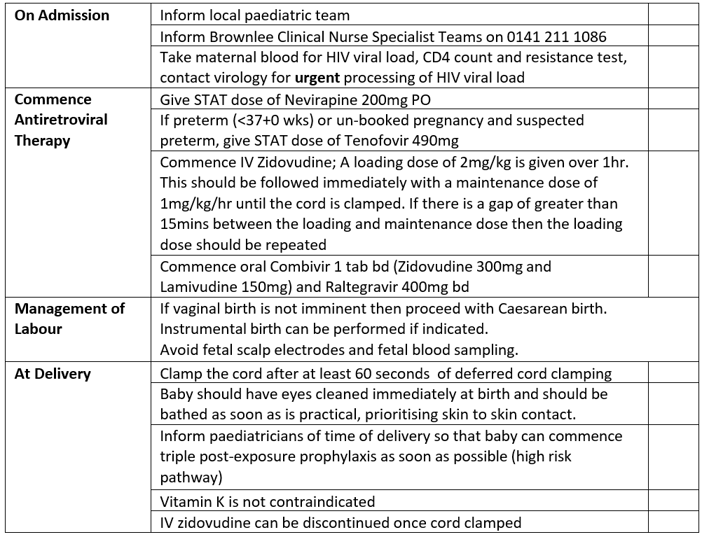
Checklist for managing women presenting in labour when HIV viral load is not suppressed

Checklist for managing women presenting in labour when HIV viral load is not suppressed

Postnatal Care

Antiretroviral Treatment

  • If on IV Zidovudine this can be stopped after cord clamping.
  • Check HIV viral load sample was sent during admission for birth and document result.
  • Neonatal team to review result and confirm ongoing PEP plan (see below).
  • Usual ART regimen for women should be continued postnatally

Neonatal PEP

  • All babies will commence HIV Post Exposure Prophylaxis (PEP) however the choice of medication and duration will vary depending on the clinical scenario / maternal blood results.
  • A neonatal PEP plan will be made by the MDT during pregnancy and documented in Badgernet
  • Commence medication as documented as soon as possible after birth, within 4 hours of delivery
  • In circumstances where HIV is newly diagnosed in labour, the viral load is unknown or the woman had not been taking ART regularly – discuss urgently with paediatric infectious diseases team to determine the neonatal PEP plan
  • See https://perinatalnetwork.scot/wp-content/uploads/2024/05/Management-of-Infants-exposed-to-HIV-in-pregnancy-Guideline-2024.pdf

Infant feeding

  • Breastfeeding can be supported by the MDT in those adherent to ART with viral suppression and regular monitoring for mother and baby. A guideline is currently in development and link will be added when available.
  • Women choosing to breastfeed should be advised to exclusively breastfeed for no longer than 6 months and specific guidance is available for cracked nipples, mastitis, and gastroenteritis in the mother or baby.
  • When women are supported to breastfeed, this can be commenced immediately after birth.
  • Mixed feeding with formula is not recommended and breastfeeding can be supported with donor breast milk
  • Women who choose to formula feed can access formula milk free of charge, funded by NHS GGC. Currently in NHS GGC this provision is facilitated by Waverley Care.
  • Women who choose to formula feed can be offered lactation suppression with Cabergoline 1mg STAT oral
  • Further information is provided in the NHS GGC infant feeding guideline - RHCG - Breastfeeding your baby (nhsggc.org.uk) - and the BHIVA parent information leaflet on infant feeding

Contraception

  • All women should be offered a reliable form of contraception prior to discharge home from the postnatal ward. This will also be re-visited when they are seen 6wks postnatally by the MDT.
  • Check drug drug interactions via https://www.hiv-org/
  • Check UKMEC guidelines for any contraindications to contraceptive methods 


Appendix: Management of HIV viral load in woman living with HIV who are breastfeeding

Objective & Scope

This document outlines the pathway for interpreting and managing ‘detectable’ HIV RNA viral loads in mothers who are breastfeeding.

The BHIVA guidance states that women who choose to breastfeed should be advised of the small on-going risk of HIV transmission. They should be fully supported in their decision, if they have a fully suppressed viral load, a good adherence history to antiretroviral therapy (ART), engagement with the perinatal MDT, are able to attend for monthly clinic review for HIV viral load for themselves and their baby during and for two months after stopping breastfeeding. Women who don’t meet all of these criteria should be counselled against breastfeeding.

A suppressed viral load is defined as a viral load <50 HIV RNA copies/ml. In NHS GGC, a HIV RNC <20 copies/ml is reported as ‘undetectable’.

Women should be provided with written information – HIV and feeding your newborn baby (1).

HIV viral load test results during breast feeding

Infant HIV viral load

If an infant has a detectable viral load, please contact Paediatric Infectious Disease (PID) on call team urgently.

Maternal HIV viral load

‘Undetectable’ maternal viral load

<20copies/ml

Continue to monitor HIV RNA PCR monthly whilst breast feeding.

‘Detectable’ maternal viral load

50 or >50copies/ml

  1. Mother should be contacted urgently for clinical consultation about ART adherence by the adult HIV team. Mother & partner should be counselled regarding the risk of transmission of HIV if breastfeeding, of national recommendations to stop breastfeeding, as viral load is not fully suppressed.
  2. Adult HIV team to host an MDT conference call with the HIV feeding team, the Paediatric Infectious Diseases team and Lead Neonatologist for HIV (PRMH).
  3. Urgent clinical review of the infant with the Paediatric Infectious Diseases team, with repeat infant viral load, consideration of post-exposure prophylaxis (see below) and planning for follow-up testing of the infant (2).
  4. HIV feeding team to support transition to formula feeding.

20-50copies/ml

  1. Mother should be contacted urgently for clinical consultation about adherence to ART by the adult HIV team. Mother & partner should be counselled that the risk of transmission of HIV if breastfeeding are unknown. The maternal viral load should be repeated urgently.
  2. Adult HIV team to host an MDT conference call with the HIV feeding team, and the Lead Neonatologist for HIV (PRMH). During the conference call a plan is to be made for breastfeeding assessment and urgent repeat infant viral load.
    • If there are features that may increase the risk of transmission of HIV (concerns regarding maternal adherence, mixed breast and formula feeding, breast health issues such as cracked nipples or mastitis or gastrointestinal symptoms in the mother or infant) the mother should be encouraged to stop breastfeeding and commence formula feeding whilst awaiting the result of an urgent repeat maternal viral load. In this case, if the repeat maternal viral load falls, and factors affecting the risk of HIV transmission resolve, they can be supported to continue breastfeeding.
    • If there are no features that increase the risk of transmission of HIV, the mother & partner should be counselled regarding the unknown risk of HIV transmission. If they wish to stop breastfeeding, they will be supported to do so by the HIV feeding team. If the mother & partner are accepting of the possible risk of transmission and wish to continue to breastfeed, they will be supported to do so while awaiting the result of an urgent repeat maternal viral load.

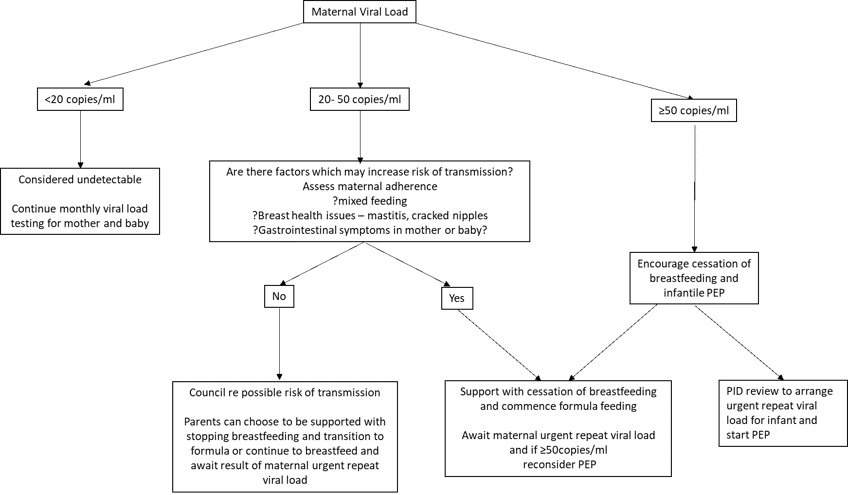
Summary flowchart
Contact details

Team

Link clinician(s)

Contact details

HIV infant feeding

Ruth Bland

Janice Moodie

Via RHC switchboard

Paediatric infectious Diseases

On call team

84939 or Consultant on call via RHC switchboard

Neonatal

Karen Walsh

If unavailable on call PRM neonatal consultant

Via PRMH switchboard

0141 956 0771 (internally 60771)

Adult HIV

Generic Email

Ggc.brownleecns@nhs.scot

BBV paediatric Pharmacy

Fiona Mara

Fiona.Marra3@nhs.scot

The process will be reviewed annually. Matters arising will be reviewed via the HIV pregnancy MDT in real time.  

Appendix 1 - Infant post-exposure prophylaxis (PEP)

If PEP is required (≥50copies/ml) this will be arranged by the paediatric infectious diseases team.  

First line preferred options in the absence of known maternal resistance are shown in the table below based on recommendations in WHO, EACS and BHIVA guidelines 2025.  

Check HLAB5701 status in all infants starting PEP.

Age of child

NRTI Backbone*

Anchor drug

Term to < 4 weeks (+ >3kg)

Lamivudine + Zidovudine

Lamivudine Liquid: 10mg/ml
<4 weeks 2mg/kg BD

Zidovudine Liquid: 10mg/ml
< 4 weeks 4mg/kg BD

Dolutegravir dispersible tablets for oral suspension: 5mg tabs

0-2 weeks: 5mg every 48 hours

2-4 weeks: 5mg daily


> 4 weeks (+ >3kg) – 6 years

Lamivudine + Zidovudine

Lamivudine Liquid: 10mg/ml
1-2 months  4mg/kg BD
≥3 months   5mg/kg BD or 10mg/kg OD 
Max dose 300mg/day

Zidovudine Liquid: 10mg/ml
4-8kg          12mg/kg BD
≥9-30kg      9mg/kg BD   
Max dose     300mg BD

Dolutegravir dispersible tablets for oral suspension: 5mg tabs

3-5kg          5mg OD
6-9kg          15mg OD
10-13kg      20mg OD
14-19kg      25mg OD 
≥20kg         30mg OD

  • Consider Abacavir in place of Zidovudine if HLAB5701 negative in line with WHO guidelines

Drug interactions: Take a full drug history and discuss any other medications with a pharmacist or use the Liverpool HIV drug interactions checker to identify risks (https://www.hiv-druginteractions.org/ )

Note: Oral divalent cations may reduce the absorption of dolutegravir and raltegravir i.e. iron, calcium, magnesium, aluminium Please seek pharmacy advice on drug spacing of doses.

Appendix 2 – Urgent HIV testing

Email west.ssvc2@nhs.scot to inform.

Request on Trakcare.

For HIV PCR testing need a minimum of 1ml blood in an EDTA sample bottle.

Arrange for the sample to be couriered to the lab (West of Scotland Specialist Virology Centre, Lew Lister Building, Glasgow Royal Infirmary, G31 2ER).

After 5pm the sample can be left in the ‘out of hours box’ at the Princess Royal Maternity Hospital emergency entrance and drop off (Princess Royal Maternity Hospital, Glasgow Royal Infirmary, Wishart Street, G31 2HT).

For couriers from the RHC – contact the transport helpdesk, open 24-7. Main desk 0141 414 6711, for sample transport - 0141 2113734 or 0141 2113674.

References

  1. Tosswill J. British HIV Association guidelines for the management of HIV in pregnancy and postpartum period 2025
  2. Foster C, Lees EA, Lyall EGH, Tudor-Williams G, Tickner N BA. DDIPost-Exposure Prophylaxis (PEP) Guidelines for infants, children and adolescents potentially exposed to blood-borne viruses. 2023 

Editorial Information

Last reviewed: 10/09/2024

Next review date: 30/09/2029

Author(s): Anna Clark.

Version: 4

Approved By: Maternity Governance Group

Document Id: 441