Neonatology
|
Name |
Role |
|
Dr Andrew MacLaren (chair) |
Consultant Neonatologist - RHC Glasgow, RAH Paisley & ScotSTAR Neonatal Transport Team |
|
Dr Hilary Conetta |
Consultant Neonatologist – RHC Glasgow, RAH Paisley |
|
Lisa Milner-Smith |
Practice Development Midwife – RAH Paisley |
|
Claire Rowan |
Practice Development Midwife – RAH Paisley |
|
Gillian Jamieson |
Clinical Risk Midwife – RAH Midwife |
|
Denise McColl |
Designated Senior Charge Midwife – RAH Paisley |
|
Laura Flynn |
Lead Midwife – RAH Paisley |
|
Mary Ross-Davie |
Director of Midwifery – NHS GG&C |
|
Ashley McNamee |
ANNP, RHC Glasgow & RAH Paisley |
|
Katrina Armstrong |
ANNP, RHC Glasgow & RAH Paisley |
|
Dr Mairi Wilson |
Clinical Fellow, RAH Paisley |
SOP for Implementation of Neonatal Early Warning Track & Trigger (NEWTT2) in RAH

Warning
Background
Historically, maternity units in GG&C have used the Neonatal Early Warning Score (NEWS) to identify the deteriorating baby. In response to recent SAER recommendations, it was felt that a revised early warning score was necessary for use in the postnatal setting in the Royal Alexandra Hospital to incorporate parental concerns. The NEWTT2 system was produced by the British Association of Perinatal Medicine (BAPM) and published in January 2023 and includes parental concerns as part of its scoring system
Every newborn infant should be provided with the environment and healthcare professional support required to enable the transition of their physiology following delivery, the establishment of infant feeding, and the early development of the family. Additionally, they should be protected to prevent avoidable morbidity and mortality during this phase of adaptation. While the majority of newborn infants require only short-term surveillance there are groups at risk of developing complications particular to the perinatal period. By planning and preparing for these at risk newborn infants we aspire to prevent morbidity that could have life-long consequences for their health and wellbeing. There is no clear evidence of the effectiveness of any specific system or set of observations in the newborn. The National Reporting and Learning System (NRLS) does however identify delays in response to deteriorating observations as contributory to the morbidity of hospitalised patients. This framework is designed for use in postnatal care settings including the delivery suite, postnatal ward and transitional care unit. In the rare event that a baby is deteriorating or at risk of deterioration in a community setting (home or midwifery-led unit (MLU)) the NEWTT2 chart can be used to support monitoring of the baby while transfer to the consultant unit is undertaken without delay. The NEWTT2 working group advise immediate contact with the neonatal team and urgent transfer into the consultant unit from community settings for infants with any observations outside the acceptable normal range. NEWTT2 is not designed to be used for patients being cared for on a paediatric ward.
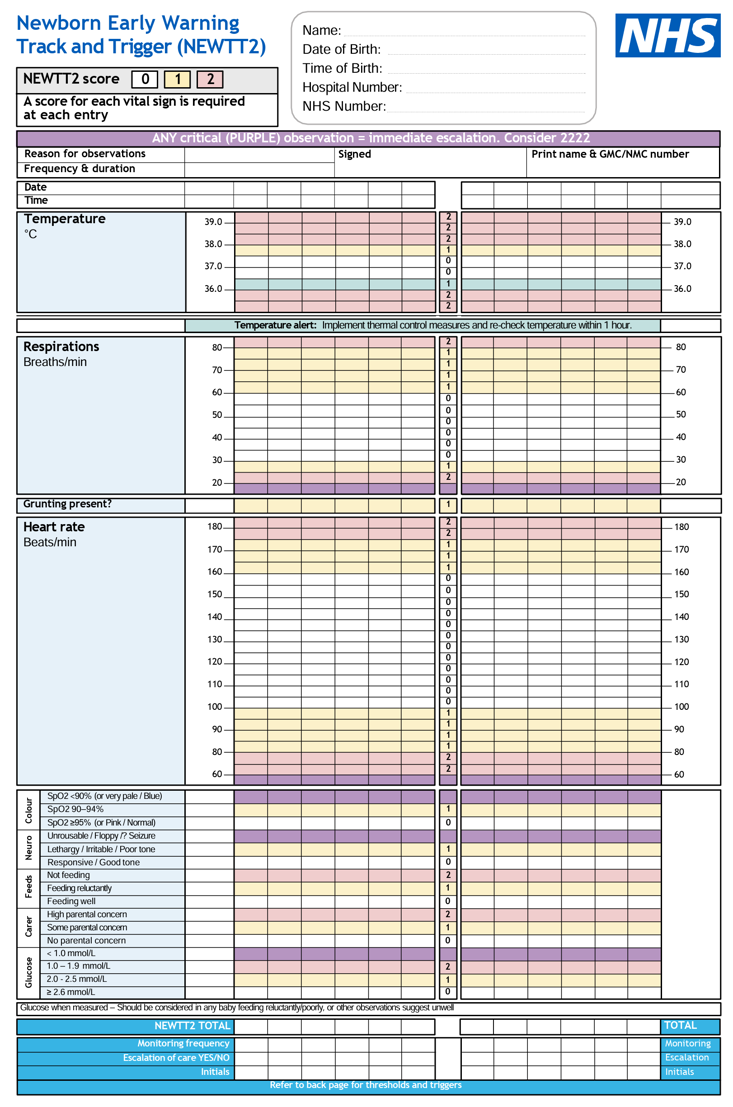
All observations should be recorded on the NEWTT2 Observation Chart (see below).
Observations in the yellow or blue areas of the chart, generate a score of 1. Observations in the pink area of the chart generate a score of 2. The score should be totalled and acted upon as outlined below. Any observations in the purple area of the chart indicate an unwell child and should generate an immediate review by the neonatal team.
Charts should be kept in the white Maternity Record. Post-discharge, these should be scanned onto Clinical Portal.
All reviews of babies should be documented under ‘Specialist Review’ on Maternity Badger (as is currently done).
Figure 1: The NEWTT2 Chart