Warning

Generalised, convulsive status epilepticus refers to five or more minutes of continuous seizures, or two or more discrete seizures between which there is incomplete recovery of consciousness.2

Evidence suggests that achieving seizure control quickly is a major determinant of good outcome.3

The priority in status epilepticus management is to achieve rapid termination of seizures, regardless of the agent used

This page is a breakdown of the NHS Lothian Status Epilepticus quick reference guide

Links to full protocol

The neurology status epilepticus protocol can be found on the intranet here: http://intranet.lothian.scot.nhs.uk/Directory/neurology/Protocols/Status%20Epilepticus%20in%20Adults-full%20guideline.docx

In case of backup you can also access the Full Guideline and Quick Reference Guideline on this app.

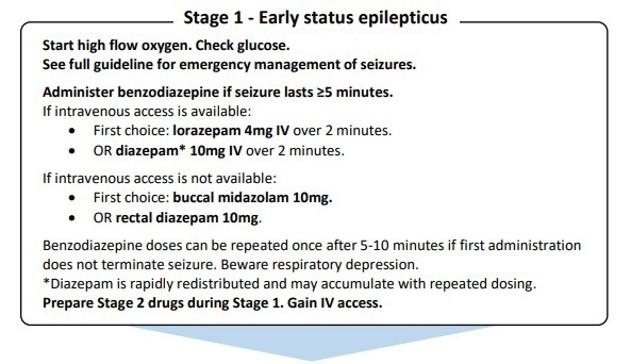
Stage 1 - early status epilepticus

Early status epilepticus pathway

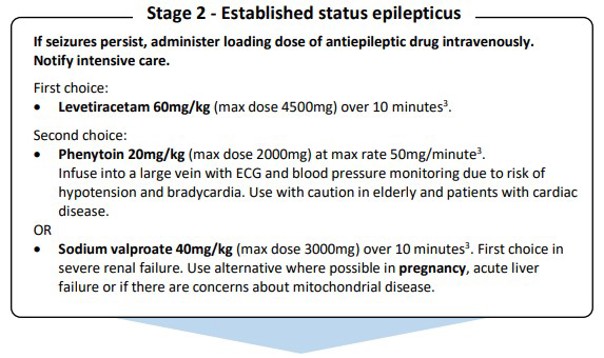
Stage 2 - established status epilepticus

Established status epilepticus pathway


Loading dose administration

  • Levetiracetam: administer in 100ml of 0.9% sodium chloride or 5% glucose over 10 minutes.
  • Phenytoin: administer in 50-250ml of 0.9% sodium chloride (concentration not to exceed 10mg/ml) at a
    rate not exceeding 50mg/minute through an in-line filter (0.22-0.5 micron). Ensure working cannula in
    large vein prior to infusion due to risks associated with extravasation (see NHS Lothian IV guide).
  • Sodium valproate: administer in 50ml of 0.9% sodium chloride or 5% glucose over 10 minutes.

Note: levetiracetam and sodium valproate doses are based on the ESETT trial4 and differ from those in
NHS Lothian IV monographs.

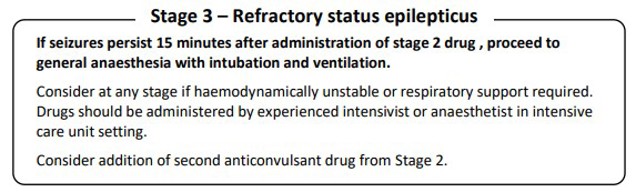
Stage 3 - refractory status epilepticus

Refractory status epilepticus pathway


Special circumstances

1. Patient already prescribed levetiracetam: Levetiracetam can be used as the first choice anticonvulsant drug during Stage 2 at full dose, even if the patient was already prescribed levetiracetam prior to admission. Levetiracetam levels are not available acutely, and supratherapeutic doses of levetiracetam are unlikely to be harmful. If there is concern about administering levetiracetam in this context, sodium valproate or phenytoin can be given instead.

2. Pregnancy: Levetiracetam is the preferred Stage 2 drug in pregnancy. Avoid sodium valproate where possible (risk of teratogenicity).

3. Known severe renal failure: Where eGFR is known to be less than 30 mL/min/1.73m2, then sodium valproate should be used as first choice Stage 2 drug. No dose adjustment is required. Do not delay treatment to wait for blood results. Levetiracetam is an appropriate second-line option (no dose adjustment), but the maintenance dose should be reduced (see QRG guide).


Maintenance doses of anticonvulsant drugs

Levetiracetam: 1000-1500mg IV, oral or NG twice daily. Start 10-12 hours after loading dose. Aim for
reasonable dosing times 12 hours apart. For maintenance doses of levetiracetam in renal impairment, please see the quick reference guide.

Phenytoin: 300mg IV once daily, or 100mg IV three times per day, or 300mg oral capsules once daily. Prescribe 270mg once daily if using oral liquid. Start 6-8 hours after loading dose. Check phenytoin trough level 24-48 hours after starting maintenance dose. If phenytoin is to be administered down a feeding tube contact pharmacy for advice.

Sodium valproate: 1000-1200mg IV, oral or NG twice daily. Start at least 6 hours after loading dose. Maintenance doses of sodium valproate must not be started in women of childbearing age unless a Pregnancy Prevention Programme is in place – contact neurology for advice.

Causes to think about

Potential causes include:

  • Patients with epilepsy
    • omission of therapy
    • anything which might provoke seizures in non-epileptics (see below)
  • Patients without epilepsy
    • encephalitis or meningitis
    • cerebral abscess
    • head injury
    • hypoglycaemia
    • CVA
    • Poisoning or alcohol withdrawal
    • severe infection
    • use of convulsant such as an antidepressant or alcohol

Editorial Information

Last reviewed: 07/06/2024

Next review date: 07/06/2026

Author(s): Deepankar Datta.

Co-Author(s): Adapted to RDS app from NHS Lothian guideline (see references).

Approved By: DTC NHS Lothian

Reviewer name(s): Deepankar Datta.

References
  1. Wilkinson T. et al. "Guideline for the in-hospital drug treatment of convulsive status epilepticus in adults", NHS Lothian, 2022-08
  2. Trinka E, Cock H, Hesdorffer D, Rossetti AO, Scheffer IE, Shinnar S, et al. A definition and classification of status epilepticus--Report of the ILAE Task Force on Classification of Status Epilepticus. Epilepsia. 2015 Oct;56(10):1515–23.
  3. Neligan A, Shorvon SD. Prognostic factors, morbidity and mortality in tonic–clonic status epilepticus: A review. Epilepsy Res. 2011 Jan 1;93(1):1–10.
  4. Kapur J, Elm J, Chamberlain JM, Barsan W, Cloyd J, Lowenstein D, et al. Randomized Trial of Three Anticonvulsant Medications for Status Epilepticus. N Engl J Med. 2019 28;381(22):2103–13.
  5. CRC Press Taylor & Francis Group. The Renal Drug Database. [Accessed 2020 Apr 27]. Available from: https://renaldrugdatabase.com