Warning

Scope

This guideline, whilst similar to management at RHCYP, contains some changes which are relevant to the population that presents to SJH ED

Limping children are very common presentations to the Emergency Department (ED).

It is important to approach any limping child in a systematic way and to positively seek out a history of trauma, acknowledging that very minor trauma may unmask unexpected pathology. Always consider hip pathology in patients presenting with atraumatic knee pain.

Differentials

The following table summarises the more common differential diagnoses at given ages in the limping child:

Toddler (1-4 years)

Child (4 – 10 years)

Adolescent (>10 years)


  • Toddlers fracture
  • Transient synovitis of hip
  • Developmental dysplasia of hip (DDH)
  • Septic arthritis
  • Osteomyelitis
  • Non accidental injury (NAI)


  • Transient synovitis of hip
  • Perthes Disease
  • Fractures
  • Soft tissue injuries


  • Consider slipper upper femoral epiphysis (SUFE) if >8 years


  • Slipped upper femoral epiphysis (SUFE)
  • Perthes Disease
  • Overuse/stress fractures
  • Soft tissue injuries particularly sport related (i.e Osgood Schlatter, Severs)

Of these, transient synovitis is most common. In a retrospective analysis of all patients with atraumatic limp presenting over 12 months to RHCYP ED, 67% had transient synovitis. The numbers of patients with infective pathology was extremely low (1.2%) as were diagnoses of Perthes (0.8%) and SUFE (0.2%).

Consideration must also be given to the following rarer conditions in ALL ages of patient:

  • Infection: osteomyelitis, septic arthritis, viral myositis, cellulitis, discitis
  • Malignancy
  • Haematological conditions such as sickle cell or leukaemia
  • Reactive arthritis or other rheumatological disorders
  • Intra-abdominal pathology such as appendicitis or ovarian torsion
  • Inguinal pathology such as hernias or testicular torsion
  • Metabolic bone problems such as Vitamin D deficiency
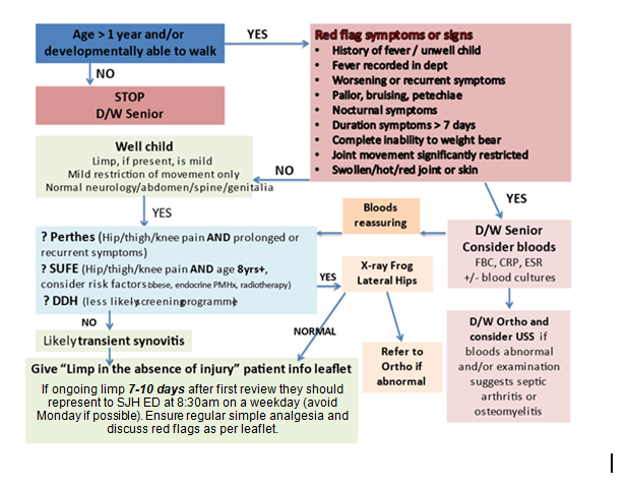
Atraumatic Limp Flowchart

The flowchart below seeks to safely limit initial investigations in children with atraumatic limp without “red flag” symptoms or signs, whilst ensuring adequate safety netting.

This includes:

  • Discussing/examining patients of whom you are uncertain with a Consultant/Senior ED doctor.
  • Giving all parent/carers the “Limp in the absence of Injury” information leaflet on discharge
  • Ensure that parents/carers know to represent to the Emergency Dept with significant worsening (encourage morning presentation i.e. 8:30am).

If there is a history of trauma which is judged to be significant then the child should follow appropriate trauma pathways. Be cautious of attributing a limp to an injury if the limp developed 24-48hrs after apparent injury and not immediately. They may need both traumatic and atraumatic limp investigation.

The following flow chart is for those without a history of trauma, or a very trivial history which is not judged by the clinician as being significant to cause the presenting symptoms:

Atraumatic limp flowchart

Transient Synovitis of the hip

This is a condition of unknown aetiology, usually affecting one hip, but occasionally may be bilateral. There may well be a history of preceding viral illness but this is not always the case. Classic findings are of the child who suddenly wakes up one morning limping, is clearly in pain, but is apyrexial. Very often, referred knee pain is present.

Physical exam will reveal an absence of temperature. There will be limitation of abduction in the flexed position and internal rotation/external rotation will be limited, again with the hip flexed.

Treatment is rest and NSAIDs. If the patient still has symptoms 7-10 days after the initial ED presentation parents are instructed to reattend the ED at 8:30am on a weekday. Approx 10% will have another reason for their symptoms and require further investigation or specialist team referral after 2 weeks of symptoms.

Bone and Joint Sepsis

Children with bone and joint sepsis are typically in a great deal of pain, cannot weight bear at all and there will be extremely limited movement at the affected joint. The affected bone area will be tender, perhaps with visible inflammation. Children may be toxic or unwell or just have a history of fever or record a fever in the department. Children with osteomyelitis can present well and afebrile (and may even have normal baseline blood parameters). Clinical caution and suspicion is needed.

Full blood count may be normal but inflammatory markers (ESR and CRP) are usually elevated. A blood culture should be obtained. Plain radiology is usually of little use - ultrasound or MRI may help. Discuss with senior clinicians / Orthopaedics.

Perthes disease

Perthes disease is avascular necrosis of the hip. This is a disease of unknown aetiology that often presents with atraumatic limp. Occasionally it will present in a similar fashion to transient synovitis. However, children with Perthes Disease usually present with a longer history of intermittent limping. Children with an intermittent or prolonged limp should be discussed with seniors as to whether a plain film (frog lateral) of the pelvis is warranted. Positive x-rays should be discussed with Orthopaedics.

Slipped Upper Femoral Epiphysis

"SUFE" can present insidiously in children over the age of 8 and up to the age of 15 years. Most will present with some degree of pain outwith the hip region very often in the knee. Occasionally there may be precipitating trauma but this is rare. There will be limitation of movement in the hip as described for transient synovitis. There may be localised hip tenderness but this can be difficult to elicit. A plain frog-lateral x-ray should be done. Subtle slips may be present and if there is any doubt these should be discussed early with seniors.

Discharge

If patients are generally well, and there has been no significant acute abnormality identified (as per the flowchart above), you can safety net the patient and parents, and give them the atraumatic limp patient information leaflet.

Editorial Information

Last reviewed: 24/06/2025

Next review date: 24/06/2027

Author(s): Beth Walsh.

Author email(s): Elizabeth.Walsh@nhs.scot.

Reviewer name(s): Deepankar Datta, Beth Walsh.