Warning

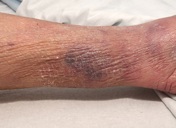
A haematoma can be described as a swelling caused by bleeding into the tissues usually as the result of injury1. Although most lower leg haematomas are caused by trauma, some will form spontaneously2.

First aid for a new non bleeding haematoma


Non bleeding haematoma

  • Rest the injured part.
  • Ice it with a cold pack or ice wrapped in a cloth, 20 minutes on and 20 minutes off.
  • Compress the area with a bandage which is firm, but not tight.
  • Elevate the injured part.

Bruises on dark skin develop the same way as on light skin. The colour can appear different depending on the skin tone.


First aid for a new bleeding haematoma   


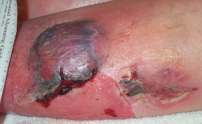
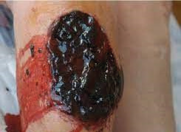
Bleeding haematoma

  • Stop any bleeding.
  • Apply an alginate dressing, absorbent secondary dressing and a double layer of tubular bandage or a crepe bandage applied in a figure of eight.
  • Elevate limb.


Down arrow   Down arrow

Assessment

 Holistic wound assessment:

Location, tissue type, exudate levels and type of exudate (complete a wound chart)

Patient assessment:

  • Cause, co-morbidities, bloods (INR), pain management, medications, regular observations to monitor for signs of sepsis.
  • Check the patient's coagulation status/any reason for bleed other than trauma.
  • Check for signs of compartment syndrome e.g. faint pulse, pain, numbness, swelling and tightness.
  • Obtain images as per local policy.
Arrow left  

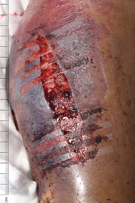
Do not apply steristrips or sutures

Sutures

If any sutures or strips are in place, please remove them (unless they are ligature sutures to stop bleeding)


   Down arrow                                                Arrow down
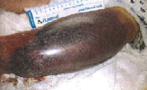
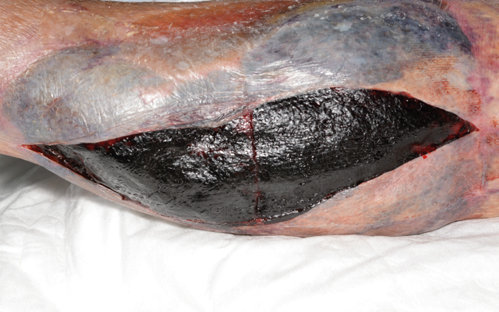
Closed haematoma

Closed haematoma

Surgical management

Refer to appropriate specialist services for
evacuation (Orthopaedics/Plastics or Vascular)
for opinion and surgical evacuation/debridement.


  Open bleeding haematoma

Open bleeding haematoma

Stop bleeding

  • Apply alginate dressing and a suitable absorbent secondary dressing and a double layer of tubular bandage.
  • Regularly monitor dressing for active bleeding.


    Open non-bleeding

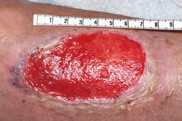
Open non bleeding haematoma

Debridement (if safe to do) of devitalised tissue to reduce the risk of infection, minimise tissue damage, and encourage healing.

  • Sharp debridement
  • Mechanical debridement (monofilament debridement pad or cloth)
  • Larvae therapy
  • Autolytic debridement (hydrogels, honey etc).
 

Continuing management


Undertake a lower limb assessment after two weeks as per local policy or before if haematoma removed.


Continuing management


References

  1. Smith B, Williams T (2004) Operating Department Practice A-Z. Greenwich Medical Media Ltd, London.
  2. Pagan M, Hunter J (2011) Lower leg haematomas: potential for complications in older people. Wound Practice and Research 19(1): 21–8.

Editorial Information

Next review date: 01/12/2026

Author(s): National Association of Tissue Viability Nurse Specialists Scotland.