Warning

The following sections illustrate wound types and characteristics. This includes a brief description, and treatment aims based on best practice guidance.

If using on a smartphone, this visual guide is best viewed in landscape.

Wound bed

Epithelialising

  Definition Aims
Epithelialising

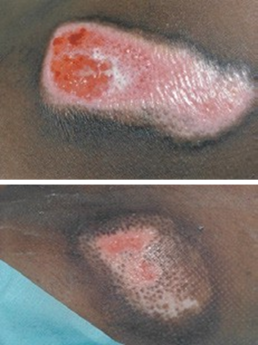
New skin cells (epithelial cells) migrate across the wound surface creating a new, delicate layer of skin.

This usually happens from the edges but can develop from the middle as small islands.
  • Promote and protect new tissue growth.
  • Consider exudate levels and apply appropriate dressing to optimise epithelialisation.


Granulating

  Definition Aims
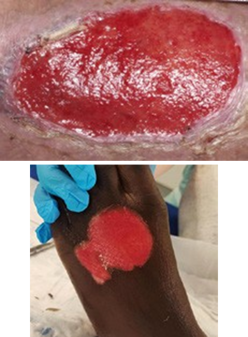
Granulating The development of new tissue from the wound base, which typically appears bright red in colour, and has a rough or irregular surface. Encourage growth of granulation tissue and support moist wound healing
Management considerations
  • Presence of biofilm and alternative cleansing methods as discussed in cleansing section.
  • Exudate levels and selection of dressing to optimise moisture balance. (Refer to local guidance/ formulary)


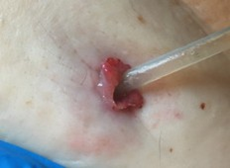
Hypergranulating (overgranulating)

  Definition Aims
Hypergranulating An overgrowth of granulating tissue, which appears ‘proud’ of the wound, preventing epithelialisation. Reduce the cause for inflammation which is causing the overgrowth of tissue.
Management considerations
Hypergranulating
  • Consider any irritants at the wound bed (e.g. friction from tubing) and examine ways to manage cause.
  • Consider bacterial load on the wound bed and if there is requirement for antimicrobial product.
  • Refer to relevant local guidelines.
  • Seek advice from appropriate healthcare professional.


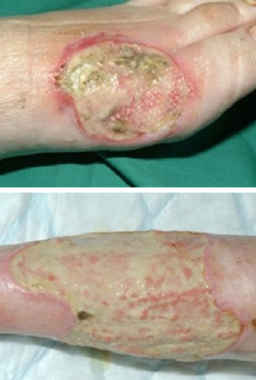
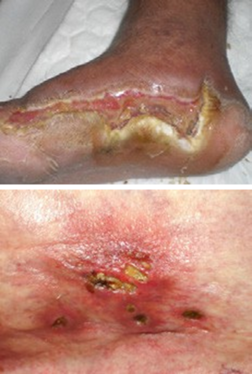
Sloughy

  Definition Aims
Sloughy

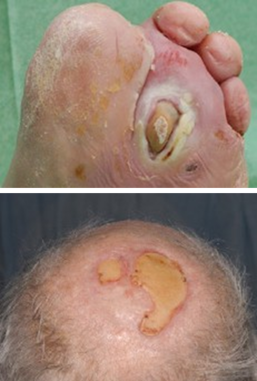
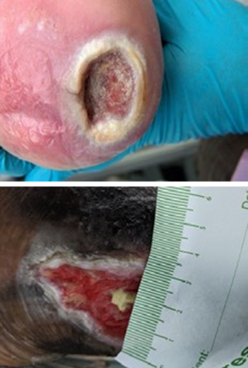
Slough is a layer of dead tissue, which can be yellow or green in colour, and may be dry or wet on the surface.

It can be of varying depth and may produce an offensive smell.
Remove all debris from the wound using appropriate wound debridement method e.g. mechanical.
Management considerations
  • Consider the presence of a biofilm and the use of a surfactant solution.
  • Exudate level- hydrate if dry, absorb if wet.
  • Protection of skin surrounding wound if exudate levels high.
  • Requirement for antimicrobial as per local guidance.


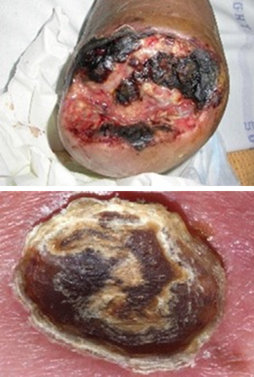
Necrotic

  Definition Aims
Necrotic

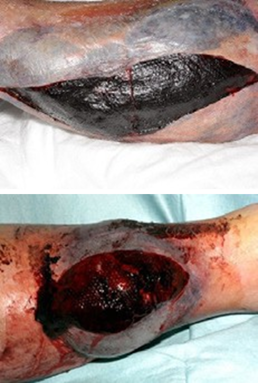
Necrotic tissue is a layer of dead tissue which can be brown or black in colour and is caused by inadequate blood supply or infection.

It may be soft or hard on the surface, can be of varying depth and may produce an offensive smell.
  • Establish if the patient is for conservative or progressive management (see debridement section above and refer to local guidance)
  • Where debridement is not indicated keep the wound environment dry.
  • Where debridement is indicated, consider rehydration and use of appropriate debridement technique (as discussed in debridement section)
Management considerations
  • Monitor for signs of infection as per local guidance.
  • Consider malodour and management using appropriate dressings as per local formulary.


Undermining/tracking

  Definition Aims
Undermining

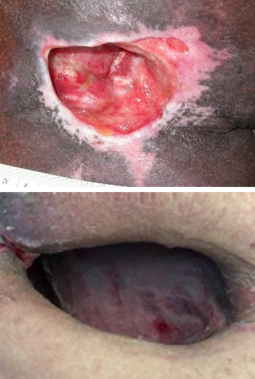
A pocket or tunnelling which extends under the edge of the wound.

Extension of the wound bed into adjacent tissue (under the skin), also known as a sinus tract.
Aid healing by secondary intention (from the base of the wound upwards)
Management considerations
  • Consider dressing regime to support healing.
  • If packing is used, please refer to local guidance and documentation.
  • Seek advice from appropriate healthcare professional.


Bone

  Definition Aims
Bone Bone appears as a pale hard mass that is hard when palpated.
  • Maintain a moist environment to encourage new granulation tissue.
  • Reduce the risk of infection.
  • Seek advice from appropriate healthcare professional.


Tendon

  Definition Aims
Tendon

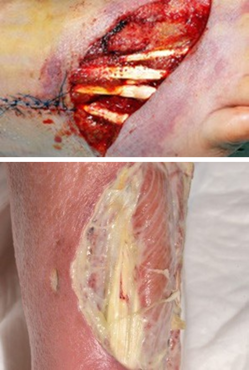
Tendons are creamy white in colour. They will present as stringy and cord like and can move as the limb or joint flexes.

(Can be mis-diagnosed as slough)
  • Maintain a moist environment to prevent the tendon drying out.
  • Seek advice from appropriate healthcare professional.


Haematoma

  Definition Aims
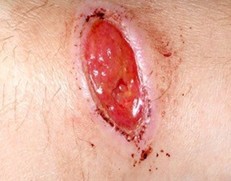
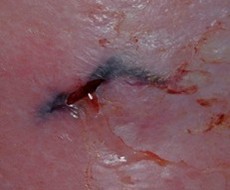
Haematoma Haematoma is a collection of congealed blood from a leaking blood vessel, which appears like a blood-filled blister.
  • To support appropriate and safe management refer to haematoma pathway (local or NATVNS)
  • Seek advice from appropriate healthcare professional.

Skin surrounding wound

Erythema

  Definition Aims
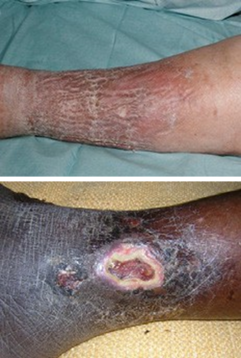
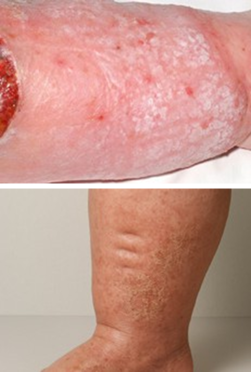
Dry/scaly Scaly skin which appears hard and dry. Promote healthy skin.
Management considerations
  • Consider emollient therapy.
  • Encourage hydration through good fluid intake.
  • Consider mechanical debridement of skin plaques.


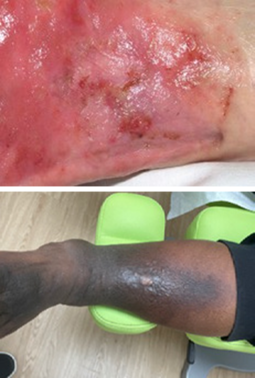
Erythema

  Definition Aims
Erythema Abnormal redness or change in skin tone from the surrounding area, resulting from enlarged blood vessels under the skin.
  • Understand the underlying cause and treat appropriately.
  • Prevent deterioration of the surrounding tissues.
Management considerations
  • Refer to local wound infection pathways/guidance.
  • Seek advice from appropriate healthcare professional.


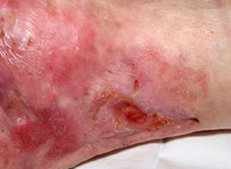
Excoriation

  Definition Aims
Excoriation Trauma to the skin surface layer caused by excessive moisture with or without abrasion. It can vary in colour depending on the individuals normal skin tone. Identify and manage underlying cause.
Management considerations
  • Manage moisture levels and protect the skin.
  • Refer to Skin Excoriation Tool (local or NATVNS)
  • Seek advice from appropriate healthcare professional.


Fragile

  Definition Aims
Fragile

Skin which is friable and may appear ‘paper thin’. More vulnerable to damage.

N.B. Fragile skin is more common at the extremes of age e.g. neonates and older adults
  • Protect the skin and reduce the risk of harm.
  • Maintain good skin hydration.
Management considerations
  • Consider use of full-length, soft clothing and bedding to protect skin.
  • Keep nails short.
  • Use approved manual handling techniques and equipment.
  • Consider low adherent atraumatic dressing if appropriate.
  • Consider use of adhesive removers when removing adhesive dressings and tapes.


Infection

  Definition Aims
Infection When the quantity of microorganisms in a wound becomes imbalanced and the individual’s response becomes overwhelmed, resulting in impairment of the normal wound healing process.
  • Confirm that the wound is infected prior to commencing treatment regime.
  • Reduce bacterial load and consider the presence of a biofilm.
Management considerations
  • Consider the use of an appropriate topical anti-microbial wound product in line with local formulary/guidance.
  • Consider if systemic treatment is required in conjunction with topical products (e.g. antibiotics or antifungals)
  • Use Scottish Ropper Ladder for Infected Wounds or local infection guideline/pathway for full guidance.


Oedematous

  Definition Aims
Oedematus Acute or chronic, soft tissue swelling.
  • Consider and manage the underlying cause for the oedema.
  • Protect skin surrounding the wounds using barrier products.
Management considerations
  • Manage exudate using appropriately non-adherent, absorbent products.
  • Consider elevating the limb when at rest.
  • Assess suitability for compression therapy (where appropriate)
  • Refer to local policy/guidelines.
  • Seek advice from appropriate healthcare professional.
  • Consider referral to chronic oedema/ lymphoedema service if available.


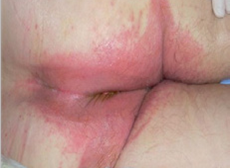
Macerated

  Definition Aims
Macerated

Softening and breakdown of the skin as a result of prolonged exposure to moisture (urine, sweat, wound exudate, faeces etc.)

Establish the underlying cause and manage excess moisture level.
Management considerations
  • Consider barrier products in line with local formulary/ guidelines.
  • Where appropriate, ensure correct continence products are in use.
  • Refer to local pathway/guidance on moisture associated skin damage (MASD) and
  • Refer to local pathway/guidance on suitably absorbent wound management products.
N.B. Macerated skin is at higher risk of infection or further breakdown.

Exudate

Haemoserous/serous (serosanguineous)

  Definition Aims
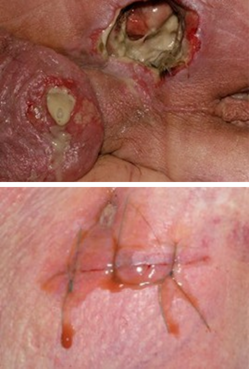
Haemoserous/serous Haemoserous is thin and watery fluid which is blood tinged in appearance. Serous is thin and watery fluid which is pale yellow in appearance
  • Manage wound moisture balance utilising appropriately absorbent dressings as per local formulary/guidelines.
  • Protect surrounding skin from moisture associated skin damage using appropriate barrier products in line with local formulary/ guidelines.


Haemopurulent/purulent/fibrinous

  Definition Aims
Haemopurulent An opaque, cloudy or milky exudate which can be yellow, brown, green or red in colour and can be thick viscosity.
  • Manage wound moisture balance utilising appropriately absorbent dressings as per local formulary/guidelines.
  • Protect surrounding skin from moisture associated skin damage using appropriate barrier products in line with local formulary/guidelines.
Management considerations
Consider investigations for signs of systemic infection. Ensure appropriate treatment plan is embedded to manage infection in line with local policy/guidelines.

References

Anderson, K. N. (1998) Mosby’s Medical Nursing and Allied Health Dictionary. St Louis: Mosby- Year Book Inc.

Beldon, P. (2012) The causes, presentation and management of chronic oedema. Wound Essentials, 2, pp: 41-45. Available at: https://wounds-uk.com/wound-essentials/wound-essentials-72-the-causes- presentation-and-management-of-chronic-oedema/ [Accessed 25 Jun 25].

Iwasaki, M., Shimomura, M. and Li, T. (2021) Negative-pressure wound therapy in combination with bronchial occlusion to treat bronchopleural fistula: a case report. Surgical Case Reports. 7(1), pp. 61. Available at: https://doi.org/10.1186/s40792-021-01144-4.

Keast, D., Angel, D., Weir, D., Haesier, E., Ousey, K., Carville, K., Waters, N., Idensohn, P., Swanson, T. and Bjarnsholt, B. (2022) International Wound Infection Institute. Wound Infection In Clinical Practice: Principles of best practice. London: Wounds International. Available at: https://woundsinternational.com/wp-content/uploads/2023/05/IWII-CD-2022-web.pdf [Accessed 25 Jun 2025].

Mayer, D. O., Tettelbach, W. H., Ciprandi, G., Downie, F., Hampton, J., Hodgson, H., Lazaro-Martinez, J. L., Probst, A., Schultz, G., Sturmer, E. K., et al. (2024) Best practice for wound debridement. Journal of Wound Care, 33 (Sup 6b), pp. S1-S32.

NHS National Services Scotland (2012) National Infection Prevention and Control Manual. Available at: https://www.nipcm.scot.nhs.uk/ [ Accessed 25 Jun 2025].

Nichols, E. (2015) Describing a wound: from presentation to healing. Wound Essentials, 10 (1), pp. 56-61. Accessible at: https://wounds-uk.com/wp-content/uploads/2023/02/content_11582.pdf [Accessed 25 Jun 2025].

Schultz, G., Tariq, G., Harding, K., Carville, K., Romanelli, M., Chadwick, P., Percival, S. and Moore, Z. (2019) World Union of Wound Healing Societies (WUWHS) Consensus Document. Wound exudate: effective assessment and management. London: Wounds International. Available at: https://woundsinternational.com/world-union-resources/wuwhs-consensus-document-wound-exudate-effective- assessment-and-management/. [Accessed 25 Jun 2025].

Editorial Information

Last reviewed: 01/10/2025

Next review date: 01/10/2028

Author(s): National Association of Tissue Viability Nurse Specialists Scotland.

Version: 02.0