Warning

Pre-hospital trauma triage

A robust pre-alert and handover system ensures that the receiving hospital is optimally prepared for incoming trauma patients. Clear, concise information allows the Trauma Team Leader (TTL) to active the appropriate trauma team response and allocate resources promptly.

Scottish Ambulance Service (SAS) or equivalent providers use major trauma triage tools (adult and paediatric) at the scene.

The ambulance crew determines if the patient meets major trauma criteria and selects the appropriate receiving facility. Child protection triage must be considered for any child with high-risk injuries or safeguarding concerns.

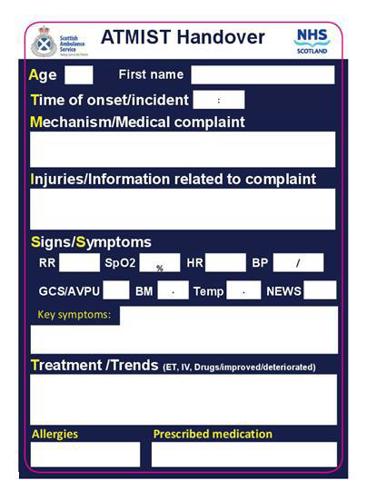
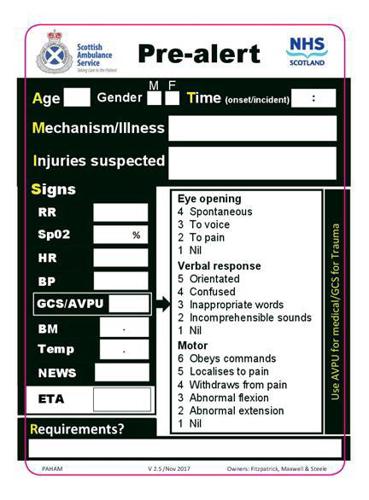
The ambulance will provide an ATMIST handover using the form below over the airwaves radio system to the receiving hospital.
The pre-alert form and the ambulance PRF must be placed in the patients notes.


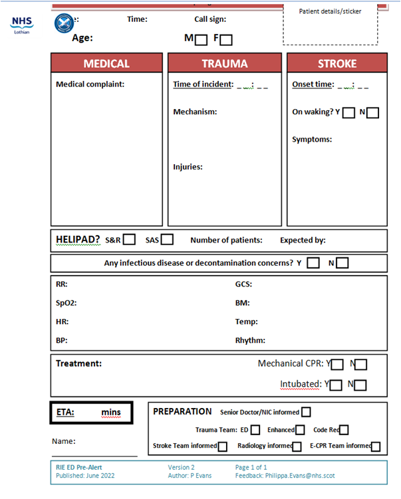
An SAS/NHS Scotland ambulance pre-alert form.

Handover sheet

Trauma Triage Tools (Adults and Paediatrics)

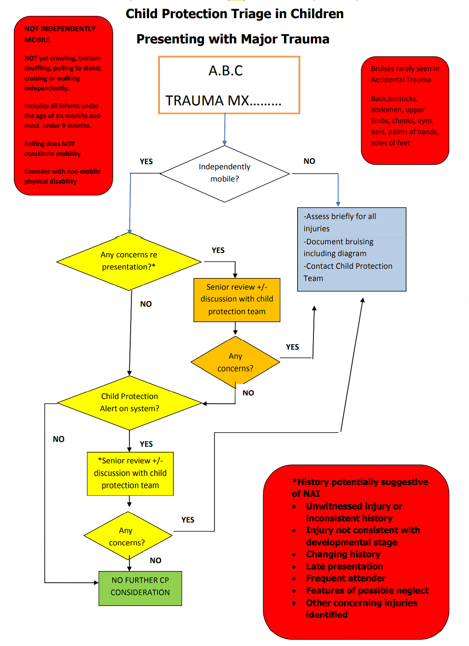
Child protection triage in children presenting with major trauma

Child protection triage in Children Presenting with Major Trauma Algorithm

Pre-alert Information

Record the following information during the pre alert from the Scottish Ambulance Service (SAS):

  • Age and sex of the injured person.
  • Time of incident.
  • Mechanism of injury.
  • Injuries suspected.
  • Signs, including vital signs, and GCS.
  • Treatment so far.
  • Estimated time of arrival (ETA).
  • Special requirements.
  • Ambulance call sign.
  • Name of person taking the call.
  • Time of the call.

Pass the pre-alert form to the Trauma Team Leader (TTL) or Senior Nurse who will determine the level of trauma team response according to the trauma team activation. 

Trauma Team Activation

  • The TTL or Senior nurse reviews the pre-alert information and makes a decision on the level of trauma team activation. Please see the trauma team activation protocol for the agreed criteria.
    • ED trauma
    • Enhanced trauma
    • Code Red Trauma
  • Once the appropriate trauma team type is determined, assign one person to dial 2222 and formally activate the trauma response
  • The caller must state:
    • Exact location (e.g. “RIE ED Resus 1C”)
    • ETA of the patient
    • Type of trauma team required (ED, Enhanced or Code Red)
    • If the trauma call is Code Red, stay on the line to be connected to Blood Bank, who will ask what products you require.
  • Not all specialties are included in the trauma team activation (e.g. Cardiothoracics, Neurosurgery, Vascular etc). If needed, contact these specialties individually to ensure they respond.
  • The TTL or designated individual should also alert Radiology.

Trauma team activation protocol for Royal Infirmary of Edinburgh.

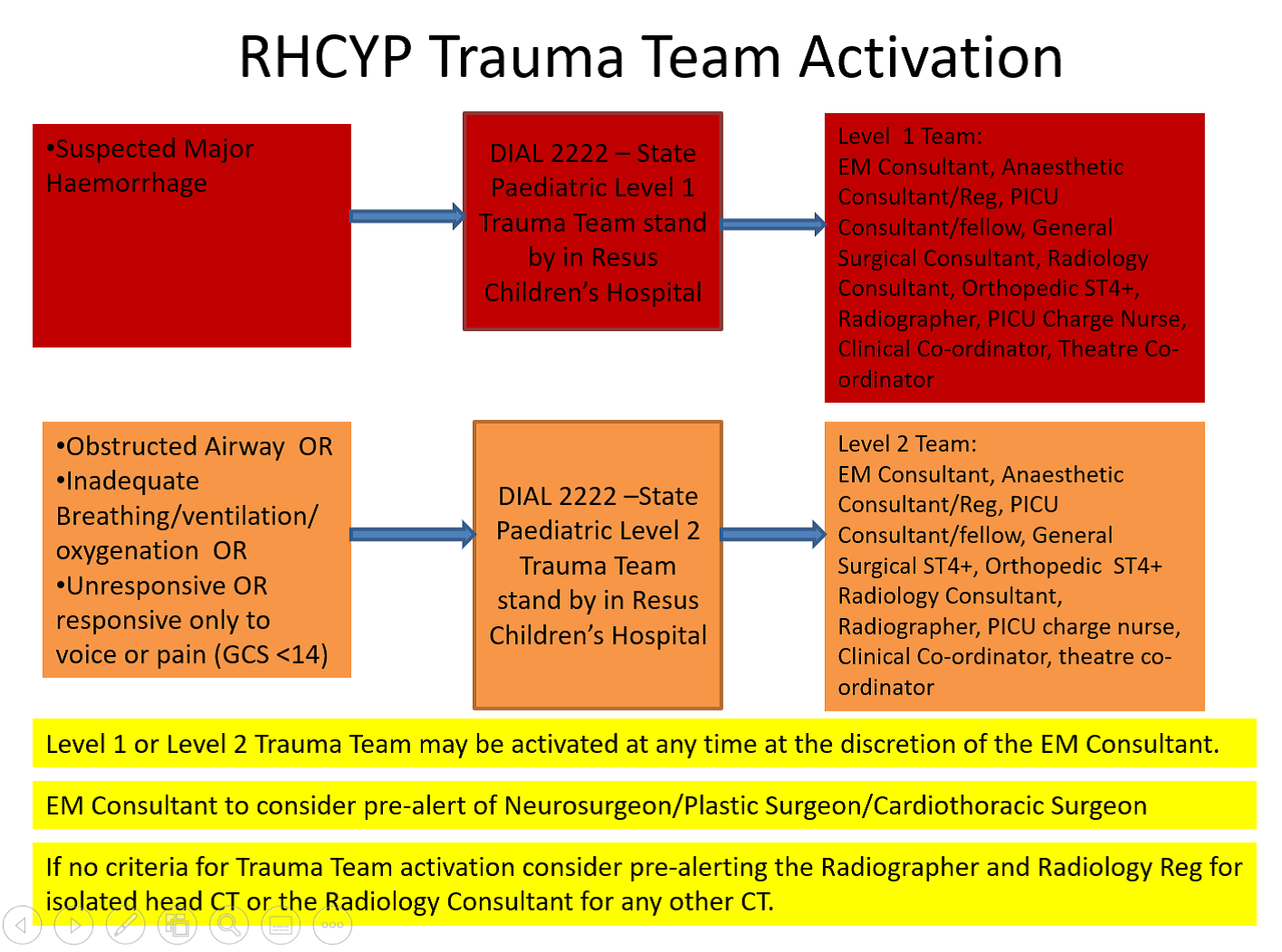
Trauma team activation protocol for the Royal Hospital for Children & Young People.

Handover in the ED

  • TTL should be clearly identifiable and ready to receive the handover.
  • Address immediate life threats before a formal handover if needed.
  • ATMIST handover at the bedside
    • Should take no more than 30 seconds
    • Use repeated or extended handover if new critical info arises
  • Further relevant info can be discussed with the TTL or designated scribe after the initial concise handover.

Child Protection Triage

  • For paediatric major trauma, a child protection triage algorithm should be applied in parallel
  • Any suspicion of non-accidental injury, inconsistent history, or safeguarding concern must prompt immediate senior review and possible social services involvement.

Documentation

The Pre-alert form and SAS PRF must be scanned or inserted into the patients records.

Code Red Response

Who Can Activate

A Code Red Trauma Call can be activated by any of the following:

  • A pre-hospital critical care team (e.g. EMRS or equivalent)
  • An advanced practitioner in critical care
  • The trauma team leader

Criteria for Code Red

  • Activate a Code Red Trauma call if ALL of the following criteria apply:Systolic blood pressure (BP) <90mmHg.
  • Suspected or confirmed active haemorrhage.
  • Unresponsive to volume resuscitation

Note: A code red trauma call has significant implications for the wider hospital (e.g. it interrupts emergency theatre). Use it only when indicated by the above criteria.

Process: Step-by-Step

  1. Phone 2222. State Code Red trauma call, Royal Infirmary of Edinburgh and state your current location and patient ETA. Stay on the line to be connected with the Blood Bank
  2. Tell Blood Bank
    • A contact number so they can reach the team
    • Patients gender and pregnancy status if known
    • Patients exact location and planned moves
    • Request TRAUMA PACK A components to be sent to the ED. By default, you’ll receive 4 units of red cells (O+ if male or female >51, O- if female <51) and 4 units of FFP
    • Red cells are likely to come down first followed by other components as they become available.
    • Blood porter will automatically be notified of code red and will attend blood bank
    • Note: The ED routinely holds 4 units of universal red cells and 2 units of FFP for immediate use in actively bleeding patients. If the ED’s FFP is already being used or expected to be used, Blood Bank may reduce the FFP in Trauma Pack A from 4 units to 2 units.
  3. Confirm activation of Code Red with the TTL
    • Confirm blood available in ED emergency satellite blood fridge (4 x O- red cells) and FFP in credo box (2 x FFP)
    • If on arrival of the patient/ after resuscitation the TTL wants further blood components then phone 27501 and request TRAUMA PACK B.
    • You do not need to state what you specifically require. You will automatically be issued with 6 units of red cells (O+/O- or type specific if BTS have a tube), 6 units of universal (or type specific) FFP, 1 unit of universal (or type specific) platelets and 2 units of cryoprecipitate.
  4. TTL should assign a team member to act as the named link with the emergency blood porter. That team member:
    • Receives or tracks arriving blood components
    • Passes any urgent lab samples (e.g. crossmatch) to the porter for immediate transfer
    • Performs ROTEM
  5. Remember to give TXA as per protocol
  6. Remember Calcium replacement
  7. At the end of the Code Red the TTL should ensure that blood bank are informed the Code Red is ending and ensure that all transfusion labels, tages and documentation is completed and returned.

Royal Infirmary of Edinburgh.

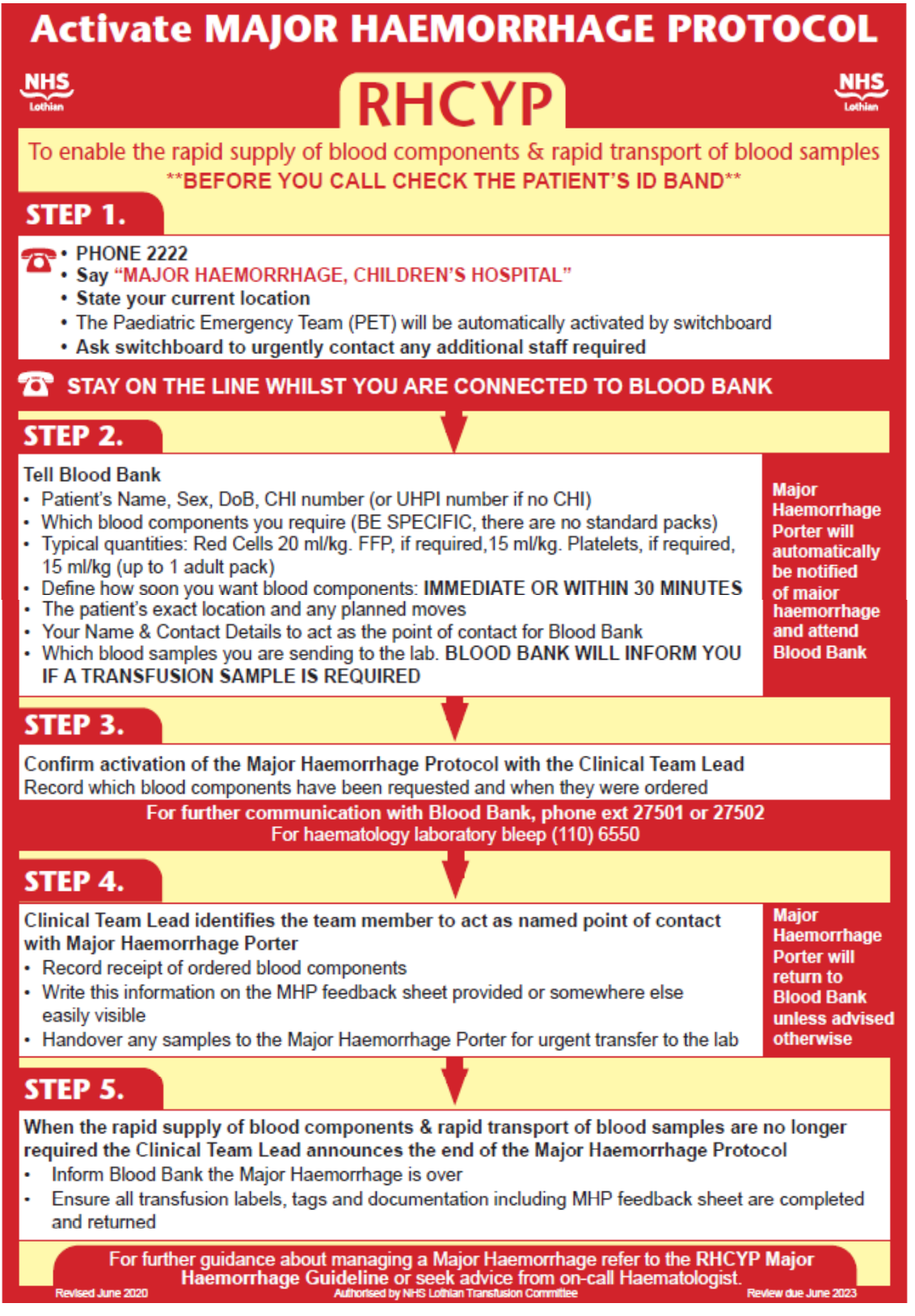
Royal Hospital for Children & Young People

Paediatric Guidelines logo

Management of trauma induced coagulopathy

INITIAL PHASE

  • Pack A: 4 x PRBC + 4 x FFP followed by Pack B empiric transfusion.
  • Tranexamic Acid 2 x 1g bolus
    • May have been given in pre-hospital phase
  • Maintain Temp > 35°C.
  • Maintain Calcium > 1mmol/l.
  • Expedite definitive haemorrhage control.
  • Anticipate Transfusion Requirements.

CLOTPro ALGORITHIM

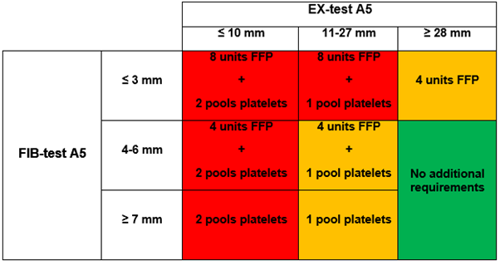
ClotPro repeatable 15min after blood products to assess response and guide further therapy.

ClotPro guided therapy is in addition to the empiric transfusion strategy until definitive haemorrhage control has been achieved.

Thrombin Generation/Fibrinogen/Platelets

Thrombin Generation/Fibrinogen/Platelets

Fibrinolysis

Fibrinolysis

SAS handover to hospital

ATMIST Handoversheet

Editorial Information

Last reviewed: 01/04/2025

Next review date: 01/04/2028

Version: 2.0