Warning

Paediatrics

Please also refer to the Paediatric trauma team document.

The Royal Infirmary of Edinburgh (RIE) operates a three-tiered trauma response system:

  • ED Trauma team
  • Enhanced Trauma Team
  • Code Red Trauma Team

Each tier aligns the correct level of response to the patient’s needs. The aim is to provide consultant-led care quickly, minimise delays, and ensure all major trauma patients have the right personnel present.

Clear roles, responsibilities and timely activation are crucial.

Three Tiers of Trauma Activation

ED trauma team

Activated for trauma that does not meet Enhanced or Code Red criteria but still has concerning mechanism or risk factors. 

Team composition is typically:

  • ED Consultant/ST4+ (TTL) or delegated ED senior
  • 1 or 2 ED care providers
  • Major Trauma Clinical Fellow or ANP
  • ED nurses


Enhanced trauma team

For patients who meet certain physiologicall or anatomical triggers.

Team composition is typically:

  • ED Consultant (TTL)
  • ST4+ Doctor
  • 1 or 2 ED care providers
  • Anaesthesia (Consultant/Registrar) & ODP
  • Orthopaedic registrar
  • Surgical registrar
  • Major Trauma Consultant
  • Major trauma Clinical Fellow or ANP
  • Radiographer present
  • ED nurses: 2+ including a level 2 trained nurse, 1 scribe


Code Red Trauma Team

For shocked patients with suspected haemorrhage who are unresponsive to fluids.

Team composition is typically:

  • ED consultant (TTL)
  • ST4+ Doctor
  • 1 or 2 ED care providers
  • Anaesthesia (Consultant/Registrar) & ODP
  • Orthopaedic registrar
  • Surgical Consultant/Registrar
  • Major Trauma Consultant
  • Major Trauma Clinical Fellow or ANP
  • Radiographer present
  • ICU Registrar/Consultant
  • Blood bank porter
  • ED nurses: 2+ including a level 2 trained nurse, 1 scribe

Not all specialties are included automatically in the trauma team activation (e.g. Cardiothoracics, Neurosurgery, Vascular, ENT). If needed, additional specialties will need to be contacted individually to request a response.
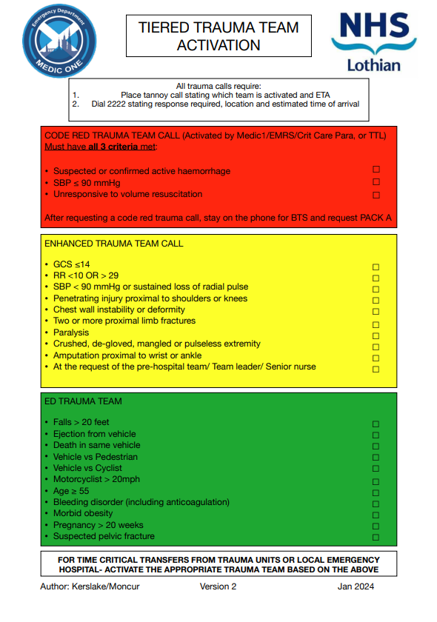
Tiered Trauma Team Activation

Trauma team leader

Designation

  • Typically an ED consultant, who will be present in advance for Enhanced and Code Red trauma calls
  • For ED trauma calls, an ST4+ doctor can be TTL
  • The TTL should utilise the leadership and trauma experience of other specialty and ED consultants if present.

Key Responsibilities

  • Pre-arrival Preparation: Assign roles, confirm thoracotomy capability, prepare equipment as required
  • Hands-off Coordination: Oversee the resuscitation, prioritise interventions, provide expert management of the trauma patient
  • Communicate clearly to the team
  • Decide if immediate CT or theatre is required, ensure safe transfer.
  • Ensure accurate documentation in the medical record.
  • Protect the safety of the trauma team.

The TTL ensures thoracotomy availability (consultant or trained operator) for every enhanced and code red trauma call. This will be documented in the trauma booklet.

Trauma team leader training

All TTL must maintain TTL competencies and must be comfortable with advanced trauma decision making (Please refer to this document).

Emergency department nurse training

  • All nurses who participate in trauma teams must have completed level one trauma training.
  • There must be a level two trained nurse present for all Enhanced trauma teams and Code Red trauma teams.

Trauma team standard operating procedure

The following document describes the roles and responsibilities of the trauma team, please click here to access the document.

Team Principles and Conduct

  • Arrive before the patient if possible, or within 10 minutes of activation
  • Introduce yourself by name and role, wear a name sticker or appropriate ID
  • Minimise noise during handover and the resuscitation
  • No one leaves the trauma team without TTL approval

Pre-arrival checklist

Trauma team leader checklist

  • Prepare trauma mattress, warm blankets, monitors and airway trolley
  • Prepare cannulation and blood taking equipment
  • Prepare under patient Bair Hugger for enhanced and code red trauma activations
  • Prepare additional equipment as required (Belmont, chest drain etc)
  • Complete whiteboard with pre-alert information

Immediate Patient arrival

  • Address immediate life threats before formal handover if needed
  • Entire team silent for a 30-second hands-off handover from pre-hospital teamRemove clothing: cut carefully, protect patient dignity, store valuables
  • Attach monitoring within 2 minutes of handver
  • Primary survey by Doctor 1
  • TTL outlines next steps

Trauma team document

The scribe should complete the Trauma team document.  Including times of arrival of team members.

Ensure that the ambulance PRF remains with the patients notes.

Each specialty involved should document a plan on TRAK following discussion with TTL.

Editorial Information

Last reviewed: 01/04/2025

Next review date: 01/04/2028

Version: 2.0