

Diabetic Foot Infection (Antimicrobial)
 TAM (Treatments and Medicines) NHS Highland

What's new / Latest updates
NICE guidance 2015 (updated 2019)
WIFi scoring 2014
Good practice guidance:
Diabetic foot infection can be complex and management should be comprehensive including optimising blood sugar control, surgical and vascular assessment, offloading of wound (see TAMS Diabetic foot infections (Guidelines)).
Infection is a pathological state caused by invasion of bacteria in host tissues that induces an inflammatory response.
If clinical evidence of infection (see WIfI grading below) then take a sample - ideally tissue or bone from base of debrided wound. If not possible then deep swab from base of debrided wound. This should ideally be taken before starting antibiotics.
Colonisation is the presence of bacteria on the wound surface and is a constant phenomenon, therefore DO NOT SWAB THE SURFACE OF WOUNDS to determine if infection is present
Grading of presence of infection, use Society for Vascular Surgery Wound Ischaemia Foot infection (WIFi) classification score : Mills JL Sr, Conte MS, Armstrong DG, et al. The Society for Vascular Surgery lower extremity threatened limb classification system: risk stratification based on wound, ischemia, and foot infection (WIfI). J Vasc Surg 2014; 59:220–34.e2.
| foot Infection (fI) | 0 | Uninfected |
| 1 | Mild local infection, involving only the skin and subcutaneous tissue, erythema >0.5 to ≤2cm | |
| 2 | Moderate local infection, with erythema >2cm or involving deeper structures | |
| 3 | Severe local infection with signs of SIRS |
When to be concerned about osteomyelitis
- Wound is
- Present for several weeks
- Wide, deep, located over bony prominence
- Visible bone
- Erythematous swollen (“sausage”) toe
- For diagnosis of osteomyelitis use a combination of:
- Probe to bone test (user dependent; helpful for diagnosis if positive in high risk patient or negative in low risk patient)
- Plain X-ray (sequential may be helpful)
- Bloods (CRP, WCC)
- If remains unclear despite the above then consider MRI
Empirical treatment when culture results are awaited are below.
Antibiotic treatment should be based on microbiology results in context of clinical evidence of infection.
When to discuss with Microbiology/ Infectious diseases
- Empirical antibiotics aren’t suitable
- Allergy/ Interactions/ Contraindications
- Recurrence of infection
- Infection not improving on current therapy (eg after 48hrs IV, or after 7 days oral)
- Consideration of OPAT/ COPAT particularly for osteomyelitis and complex infection
For glossary of terms see Glossary.
Drug details
Mild soft tissue infection
Oral flucloxacillin 1g 4 times daily
7 days and review
Full resolution of symptoms at 7 days is not expected, but if concerns at clinical assessment (eg if peripheral vascular disease and/or extensive infection continuing to resolve but slower than expected) then continue for a further 7 days.
Mild soft tissue infection:
Penicillin allergy or flucloxacillin in previous 2 months
Oral doxycycline 100mg 2 times daily
OR
Oral co-trimoxazole 960mg 2 times daily
7 days and review
Full resolution of symptoms at 7 days is not expected, but if concerns at clinical assessment (eg if peripheral vascular disease and/or extensive infection continuing to resolve but slower than expected) then continue for a further 7 days.
Moderate soft tissue infection
OR
Oral switch at 48hrs in severe soft tissue infection if no positive microbiology
If an antibiotic has been given recently then choose an alternative from the list. Check side effects and interactions to decide on antibiotic choice.
Oral doxycycline 100mg 2 times daily PLUS oral metronidazole 400mg 3 times daily
OR
Oral co-trimoxazole 960mg 2 times daily PLUS oral metronidazole 400mg 3 times daily
OR
Oral flucloxacillin 1g 4 times daily PLUS oral metronidazole 400mg 3 times daily
7 days and review
Full resolution of symptoms at 7 days is not expected, but if concerns at clinical assessment (eg if peripheral vascular disease and/or extensive infection continuing to resolve but slower than expected) then continue for a further 7 days.
Severe soft tissue infection (ie evidence of sepsis)
IV aztreonam 1g 3 times daily PLUS IV flucloxacillin 1g 4 times daily PLUS oral metronidazole 400mg 3 times daily
48 hours and review with a view to oral switch to review at 7 days total
If evidence of sepsis then start with 48 hours of IV antibiotics; then IV to oral switch at 48 hours. If not improving at 48 hour review then discuss with infection specialist.
Severe soft tissue infection (ie evidence of sepsis)- penicillin allergy and/or MRSA colonised
IV aztreonam 1g 3 times daily PLUS IV vancomycin PLUS oral metronidazole 500mg 3 times daily
48 hours and review with a view to oral switch to review at 7 days total
If evidence of sepsis then start with 48 hours of IV antibiotics; then IV to oral switch at 48 hours. If not improving at 48 hour review then discuss with infection specialist.
Osteomyelitis- no surgical resection
As above depending if moderate/severe BUT not oral flucloxacillin as it has suboptimal oral absorption
Up to 6 weeks
Osteomyelitis - minor amputation but growth of bacteria at margins of resection
Base antibiotics on culture results - discuss with Microbiology
3 weeks
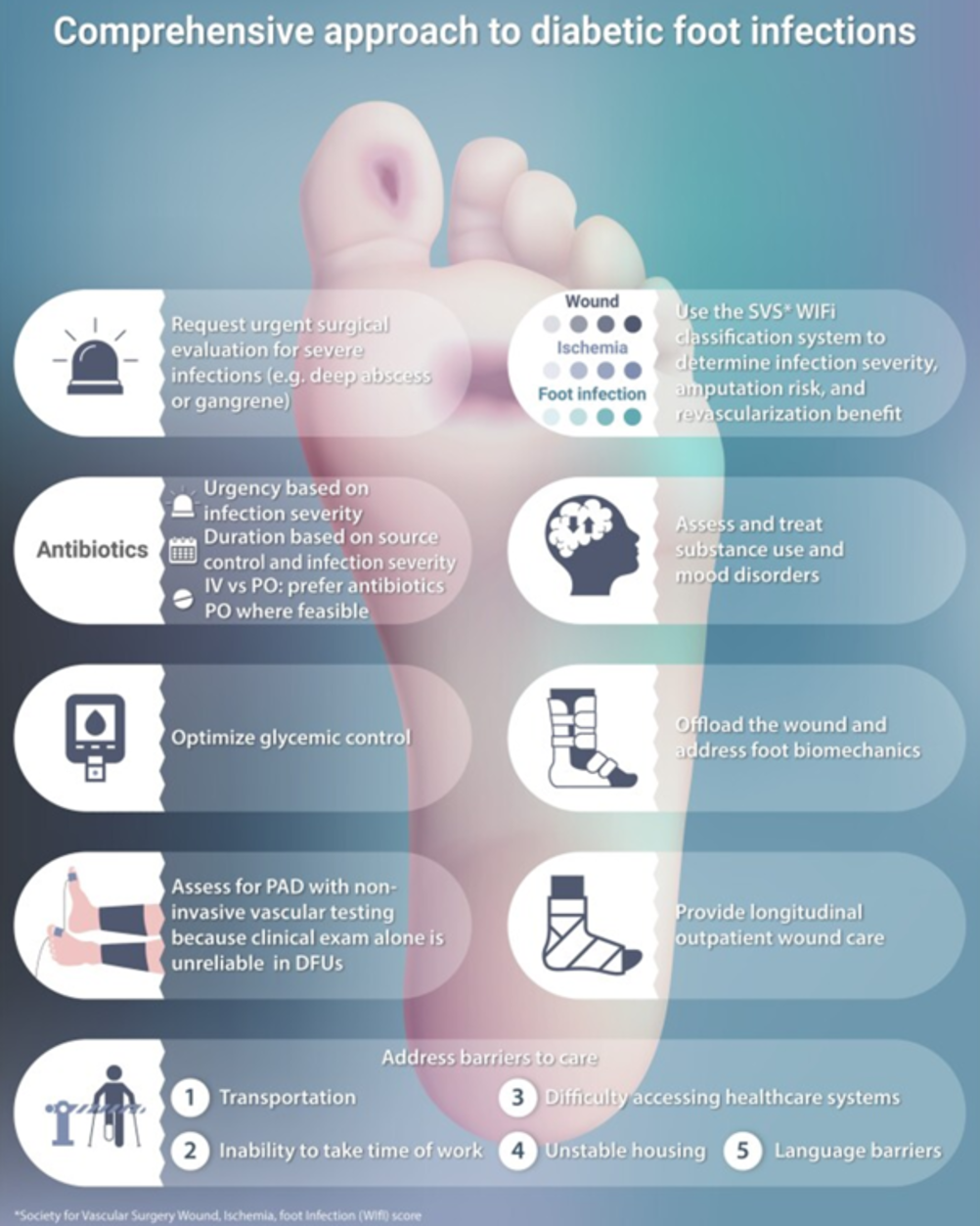
Evaluation and Management of Diabetes-related Foot Infections. CID 2023:77 (1 August). Cortes-Penfield et al