

 TAM (Treatments and Medicines) NHS Highland
Embolism prophylaxis for patients with non-valvular, persistent or permanent atrial fibrillation (Guidelines)

Warning
What's new / Latest updates
17/03/2026 V3:
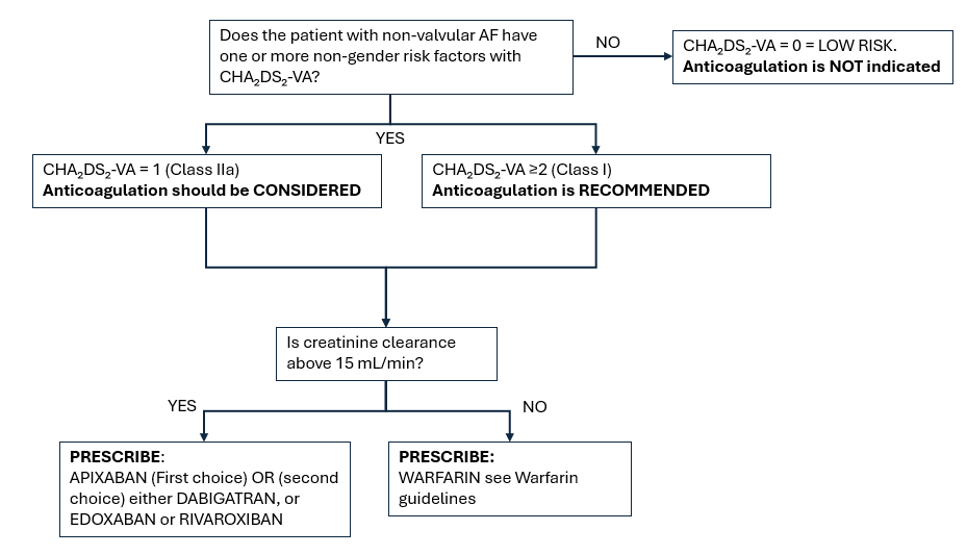
- CHA₂DS₂-VASc scoring is now CHA₂DS₂-VA Score with the removal of the line about patient sex.
- Definition: CHA₂DS₂-VA score calculates stroke risk for patients with atrial fibrillation; similar to the CHA₂DS₂-VASc score but without considering sex.
- Explanation from 2024 ESC Guidelines for the management of atrial fibrillation developed in collaboration with the European Association for Cardio-Thoracic Surgery (EACTS) | European Heart Journal | Oxford Academic: 'Female sex is an age-dependent stroke risk modifier rather than a risk factor per se. The inclusion of gender complicates clinical practice both for healthcare professionals and patients. It also omits individuals who identify as non-binary, transgender, or are undergoing sex hormone therapy. This task force proposes, in the absence of other locally validated alternatives, that clinicians and patients should use the CHA2DS2-VA score to assist in decisions on OAC therapy (i.e. without a criterion for birth sex or gender).'
- The link to the online calculators have been removed.
Audience
- North NHS Highland
- Adults only
- Primary and Secondary Care
Non-valvular AF applies to all patients with AF except those with significant mitral stenosis or metal valve replacements.
- AF: atrial fibrillation
- BNF: British National Formulary
- CHA₂DS₂-VA: clinical scoring system for stroke risk in AF
- CHF: congestive heart failure
- DOAC: direct oral anticoagulant
- ECG: electrocardiogram
- FBC: full blood count
- LMWH: low molecular weight heparin
- LVD: left ventricular dysfunction
- MDS: monitored dosage system
- MI: myocardial infarction
- PAD: peripheral arterial disease
- SPC: Summary of Product Characteristics
- TIA: transient ischemic attack