Warning

Audience

  • All NHSH 
  • Primary Care only 
  • Adults only 
Long covid is the term preferred by patients for "Post Covid Syndrome".
It is a condition where symptoms last beyond 12 weeks following a SARS-COV-2 infection, and the symptoms are not explained by an alternative diagnosis.

Highland COVID Recovery Service

NHS Highland’s long covid pathway includes medical vetting, followed by the rehabilitation and coordination for people with long covid. The rehabilitation pathway signposts to self-management resources as a first option and can be stepped up to supported self-management including one-to-one or group support. The service is virtual.

The Highland COVID Recovery Service rehabilitation team consist of Occupational Therapy, Physiotherapy and Psychology. This service works as part of a multidisciplinary team and has been established to help signpost and co-ordinate care for those patients who are severely impacted by long covid and struggling to recover. Interventions are discussed and planned appropriately and with cross learning and professional support. Once medical assessment, appropriate testing, contraindications identified and diagnosis of long covid made by appropriate physician, rehabilitation intervention is requested as appropriate.

NHS Highland's Covid Recovery Service (CRS) is closing by 31st March 2026, following the end of time-limited Scottish Government funding. Clinical care of long covid patients will be transitioned into mainstream care.
This planned change aligns with the national approach, as similar services across Scotland, England and Wales have already integrated care of long covid patients into mainstream services.

What This Means for Your Practice

The CRS accepted new referrals until 15th August 2025, maintaining the current single access point you're familiar with. After this date, new referrals will no longer be taken in order to manage the existing waitlist effectively. All patients currently referred or on the waiting list will receive care as usual through to March 2026.

Next Steps

After 15th Aug 2025, we ask that you follow the assessment and management guidelines as below. Upcoming guidance with training opportunities to support long covid management will be provided once stakeholder engagement is completed.
Assessment

Whilst long covid is a new condition, assessment and management of symptoms is not new and should be familiar to those working in primary care. Assess as you would normally for any other patient.

In the context of long covid patients, the clinical presentation extends beyond mere tiredness. Patients commonly present with a spectrum of symptoms, including but not limited to fatigue, breathlessness, myalgia, arthralgia, and insomnia. It is imperative that each symptom receives thorough investigation, consistent with routine practice.

This guideline builds upon the NICE CKS: How should I assess an adult with tiredness / fatigue 2021

Long covid is a diagnosis of exclusion

  • It is vital that other conditions are excluded prior to making a positive diagnosis of long covid.
  • A deterioration in a long-term condition is red flag and should not be attributed to long covid without thorough assessment.
  • Common alternative diagnoses seen in long covid clinics are ischaemic heart disease, arrhythmias, COPD, anaemia. More unusual diagnoses include obstructive sleep apnoea, destructive arthropathies, Addison's disease and myasthenia gravis.
  • Because it is a diagnosis by exclusion, it is unreasonable to expect primary care colleagues who have not had the length and breadth of training as a GP to make a positive diagnosis without any GP input in such complex cases.

Consider long covid

  • In your differential diagnosis of fatigue.
  • Whilst most patients have (correctly or incorrectly) diagnosed themselves with long covid at presentation, there are an increasing proportion of patients who present with fatigue or other symptoms in whom we should remember to consider long covid as a possible cause.

Postural tachycardia syndrome (PoTS)

  • This very common in long covid. It is useful to consider this when taking a history.
  • Whilst the history remains the most important part of the assessment of PoTS, some GPs may wish to carry out a NASA Lean Test. Instructions on how to carry out a NASA lean test (pdf, November 2023)
  • Symptoms can be alleviated by non-pharmacological measures, which can be started in primary care; and pharmacological measures, which are usually started by clinicians with a special interest in long covid.
A full assessment may take multiple appointments.

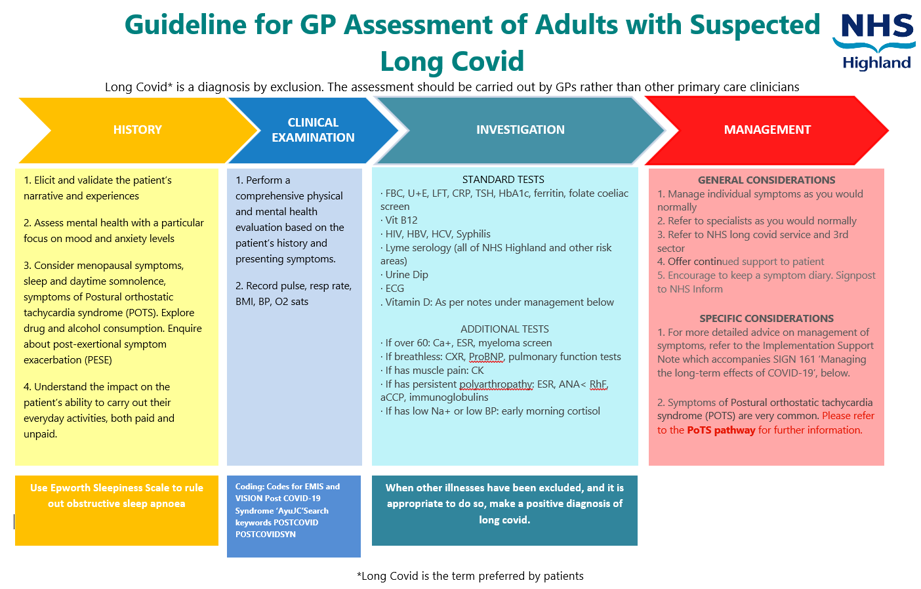
History

  • Elicit and validate the patient’s narrative and experiences
  • Assess mental health with a particular focus on mood and anxiety levels
  • Consider menopausal symptoms, sleep and daytime somnolence, symptoms of postural orthostatic tachycardia syndrome (POTS). Explore drug and alcohol consumption. Enquire about post-exertional symptom exacerbation (PESE)
  • Understand the impact on the patient’s ability to carry out their everyday activities, both paid and unpaid
  • Use Epworth Sleepiness Scale to rule out obstructive sleep apnoea

Clinical examination

  • Perform a comprehensive physical and mental health evaluation based on the patient’s history and presenting symptoms.
  • Record: pulse, respiratory rate, BMI, BP, O2 sats

Codes for EMIS and Vision:

  • Post COVID-19 Syndrome: AyuJC
  • Search keywords: POSTCOVID POSTCOVIDSYN

Investigation:

  • Standard tests
  • FBC, U+E, LFT, CRP, TSH, HbA1c, ferritin, folate, coeliac screen
  • Vitamin B12
  • HIV, HBV, HCV, Syphilis
  • Lyme serology (all of NHS Highland and other risk areas)
  • Urine Dip
  • ECG
  • Vitamin D: See notes under management below.
    • For those long covid patients who remain symptomatic, they should be tested in accordance with NHS Highland: Vitamin D deficiency (Guidelines)
    • Please note that the prevalence of pain, myalgia and proximal muscle weakness in long covid patients is high.
    • Subsequent prescription adjustments of Vitamin D and Calcium should be made as necessary.

Additional tests:

  • If over 60: Ca+, ESR, myeloma screen
  • If breathless: CXR, ProBNP, pulmonary function tests
  • If has muscle pain: CK
  • If has persistent polyarthropathy: ESR, ANA< RhF, aCCP, immunoglobulins
  • If has low Na+ or low BP: early morning cortisol

When other illnesses have been excluded, and it is appropriate to do so, make a positive diagnosis of long covid.

Quick reference guide

Management

Vitamin D

  • Prescribe 400 units (10 micrograms) of Vitamin D supplementation to all long covid patients between September and March.
  • For individuals deemed at high risk of Vitamin D deficiency - such as those who are frail, housebound, or have darker skin tones - this supplementation should continue year-round.
  • Additionally, as above, under investigations, long covid patients who remain symptomatic should be tested in accordance with NHS Highland: Vitamin D deficiency (Guidelines)
  • Please note that the prevalence of pain, myalgia and proximal muscle weakness in long covid patients is high.
  • Subsequent prescription adjustments of Vitamin D and Calcium should be made as necessary.

General considerations

Specific considerations

Abbreviations

  • aCCP: Anti-Cyclic Citrullinated Peptide Antibodies
  • ANA: Antinuclear Antibodies
  • BMI: Body Mass Index
  • BP: Blood Pressure
  • Ca+: Calcium
  • CK: Creatine Kinase
  • COPD: Chronic Obstructive Pulmonary Disease
  • CRP: C-Reactive Protein
  • CRS: Covid Recovery Service
  • CXR: Chest X-Ray
  • ECG: Electrocardiogram
  • ESR: Erythrocyte Sedimentation Rate
  • FBC: Full Blood Count
  • HbA1c: Glycated Hemoglobin (Hemoglobin A1c)
  • HBV: Hepatitis B Virus
  • HCV: Hepatitis C Virus
  • HIV: Human Immunodeficiency Virus
  • LFT: Liver Function Test
  • IgA: Immunoglobulin A
  • IgG: Immunoglobulin G
  • IgM: Immunoglobulin M
  • O2 sats: Oxygen Saturation
  • PESE: post-exertional symptom exacerbation
  • PoTS: Postural tachycardia syndrome
  • ProBNP: Pro B-type Natriuretic Peptide
  • RhF: Rheumatoid Factor
  • SARS-COV-2: Severe acute respiratory syndrome coronavirus 2
  • TSH: Thyroid Stimulating Hormone
  • U+E: Urea and Electrolytes

Editorial Information

Last reviewed: 28/08/2025

Next review date: 31/08/2028

Author(s): Highland COVID Recovery Service.

Version: 3

Approved By: TAM subgroup of the ADTC

Reviewer name(s): Dr J Scott, CRS Physician , Dr C Forsyth, CRS Physician , Dr C Milne, Clinical Lead for Long COVID .

Document Id: COVID104

References

Self-management information