Warning

Audience

  • Highland HSCP only
  • Secondary Care only
    • Including: General adult wards
    • Excluding: Critical Care areas (ICU, HDU). Discuss with Registrar or above first. 
    • Excluding: Women who are pregnant
  • Adults only

Fluids are essential and lifesaving in many hospital patients. However, they are drugs, which come with established side effects. These range from direct side effects such as hypervolaemia and electrolyte derangement from inappropriate fluid choice, to indirect effects such as bacteraemia from cannulation.

NB ALL fluids should go through a pump, with the exception of stat fluids in resuscitation scenarios.

This updated guidance aims to allow HCSPs to better understand what fluid they are giving, when fluids are necessary, and to give a structured option to choose oral rather than IV replacement and maintenance therapy.

Fluid therapy algorithms

Fluids are prescribed for three generic scenarios:

  1. Resuscitation
  2. Replacement
  3. Maintenance

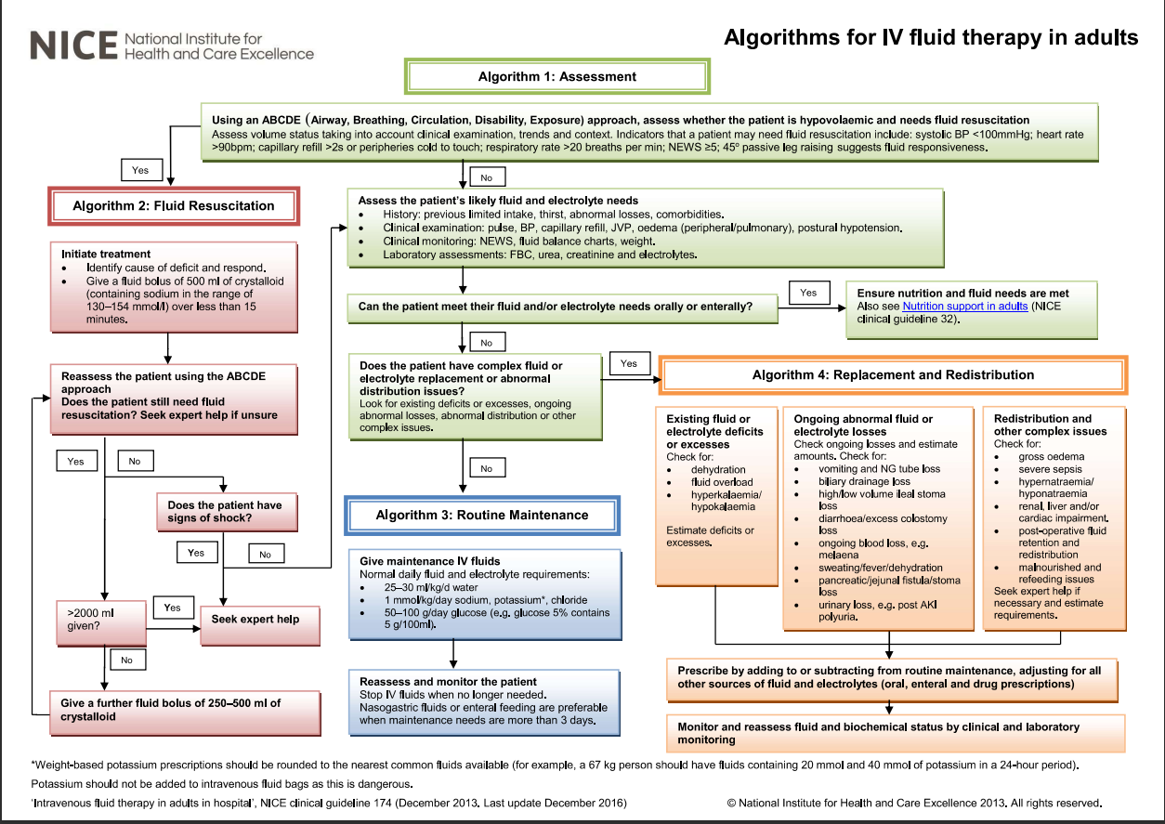
See: NICE Algorithms for IV fluid therapy in adults-poster-set-pdf-191627821. Page 1 copied below: 

Resuscitation

  • If your patient is haemodynamically unstable, follow the resuscitation guidelines in the NICE algorithm 
  • Make seniors aware urgently.
  • Make note of fluid volumes used, if approaching 2L IV fluid, ensure referral has been made for HDU/ITU and consideration of inotropes if BP remains low.

Replacement

Patients in this category have had fluid / electrolyte loss and have been unable to replace this themselves OR have ongoing fluid and/or electrolyte loss but are haemodynamically stable on assessment.
  • A full set of bloods including levels of sodium, potassium, magnesium, phosphate, calcium should be taken.
  • You should also gain a VBG/ABG to assess blood glucose and pH to ensure you are not missing a DKA.
    • This is not an exhaustive list of investigations; ensure you have taken an adequate history and examination and investigate as appropriate.
  • First assess whether the patient can replace fluid and/or electrolytes orally.
    • If able and safe levels to do so, oral replacement should be the preferred option (see NICE algorithm).
  • If electrolytes are deranged, treat according to the following guidelines: 
  • In complex patients with multiple electrolyte disturbances, the above IV guidance will put them at high risk of fluid overload. In this scenario, discuss with senior clinician +/- registrar on call for SHDU or MHDU for consideration of CVC placement and concentrated electrolyte replacement.
  • Please consider diluting electrolytes in 5% glucose in preference to 0.9% saline IF THIS IS A LISTED OPTION. This is to reduce use of 0.9% saline hospital-wide due to side effect of hyperchloraemic metabolic acidosis.

Maintenance

Maintenance fluids are required in patients who are clinically stable but cannot meet their basic daily intake needs due to poor swallow / reduced consciousness / background disease process. They are also required for patients who are temporarily NBM, eg, prior to surgery or intervention.

A full set of bloods, including sodium, potassium, magnesium, phosphate and calcium levels should be taken.

If there are any abnormalities, your patient should be managed as REPLACEMENT patients and NOT maintenance.

Daily baseline fluid/electrolyte needs

Daily baseline fluid/electrolyte needs:

  • 25 to 30mL/kg/day water
  • 1mmol/kg/day of sodium, potassium and chloride
  • 50 to 100g/day glucose

Fluids designed for resuscitation and replacement (such as Hartmann’s or Plasmalyte)

  • DO NOT CONTAIN GLUCOSE
  • AND have INADEQUATE POTASSIUM
  • therefore are INAPPROPRIATE as maintenance fluids.

Maintenance fluids contain a lower volume of sodium, and are calculated based on patient body weight.

As such, patients MUST have an accurate weight prior to commencing IV fluids, and fluid rate must be prescribed as per the table below (should also be on updated Fluid Prescription charts).

Weight (kg) Maintenance rate (mL/hr) Replacement of losses 2% of body weight over 24hrs (mL/hr)
35 to 44 50 80
45 to 54 65 95
55 to 64 75 120
65 to 74 85 140
>75 100 max 160
  • Prescribing maintenance fluids faster than advised puts patients at risk of dilutional hyponatremia.
  • It is both the prescriber's and the administrator’s responsibility to ensure maintenance fluid is given at the appropriate rate.
  • It is important, therefore, for the correct maintenance fluid to be selected and for both prescribers and administrators to be aware of available fluid preparations.
  • Repeat blood tests should be performed as per the relevant replacement guidelines once treatment has been commenced, or at least daily to monitor response if on ANY form of IV fluid (including maintenance).

Fluid calculator

Caution before using calculator: Administer IV fluids with caution or seek specialist advice for patients with following conditions:

  • Frail elderly: be cautious giving fluids to frail elderly, consult senior for advice
  • Cardiac failure: be cautious giving fluids to patients with cardiac failure, consult senior for advice
  • Diabetes: refer to local guidance for management of diabetic ketoacidosis / hyperosmolar hyperglycaemic state and variable rate intravenous insulin infusion
  • Head injury: avoid fluids containing glucose
  • Renal and hepatic failure: consult senior doctor
  • Obstetrics: consult senior for complex cases
  • Burns: consult specific guidelines and seek advice
  • Patients with electrolyte abnormalities: see resuscitation section and refer to specific guidance under: FLUID AND ELECTROLYTES

Aseptic No Touch Technique is to be used.

For fluid replacement, resuscitation and maintenance (excluding circumstances listed under caution above) NHS Highland recommends following the Scottish IV fluids prescribing calculator and guidance.

To access the calculator click on the link: IV fluids prescribing - calculator and guidance | Right Decisions (scot.nhs.uk) or use the QR code:

QR code RDS Fluid calculator

This is a national calculator and lists fluids that are NOT used in NHS Highland.

  • The aim of this calculator is to ascertain the volume and rate of fluid advised.
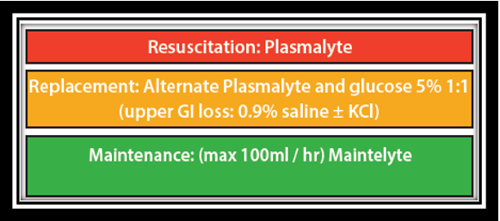
  • Within NHS Highland our advised replacement fluid is Plasmalyte (can be used as a direct replacement for Hartmann’s)
  • And maintenance fluid is Maintelyte (can be used as a direct replacement for other maintenance fluid). Daily blood tests are advised to monitor for hypokalaemia, however this is not an anticipated effect based on use elsewhere.
  • The calculator is is based on the NICE CG174: Intravenous fluid therapy in adults in hospital | Guidance | NICE 
  • This calculator is to support clinicians in the safe prescribing and intravenous administration of IV fluids for adult hospital inpatients, aged sixteen and over. It is to mitigate risks of clinical error in prescribing of IV fluids and consequent harm to patients.
  • The calculator uses patient parameters (weight, presence of frailty, potassium and sodium values, source and volume of previous 24h losses, anticipated 24h fluid intake) to calculate the volume and rate of administration of IV fluid. Based on the sources of 24h losses it will prompt the user to select an IV fluid.

Recommended fluids and their composition

Commonly available IV fluids in NHS Highland are: 

  • Crystalloids for replacement or resuscitation:
    • Plasma-lyte (previously Hartmann's and now switched life-for-like)

OR 0.9% sodium chloride (for specific protocols such as hypercalcaemia and DKA pathways only). 

  • Crystalloids for maintenance: 
    • Sodium chloride 0.18%/ Glucose 4%/ Potassium chloride 0.15% (20mmol K in 1 Litre)
    • Sodium chloride 0.18%/ Glucose 4% / Potassium chloride 0.3% (40mmol K in 1 Litre)
    • Maintelyte: also contains glucose and 20mmol K in 1 Litre 

OR 0.9% sodium chloride (ONLY under specialist use for SC infusions: this should NEVER be used for IV maintenance fluid).

For comparison, the composition of some fluids are given below. More detail can be seen at: Composition of commonly used crystalloids table-191662813 (nice.org.uk)

Fluid for replacement or resuscitation
Electrolyte content per Litre

Plasma-lyte 148
Solution for infusion

Hartmann's solution
Compound sodium lactate BP

Na+ 140mmol
K+ 5mmol
Mg2+ 1.5mmol
Cl- 98mmol
CH3COO- (Acetate) 27mmol
C6H11O7- (Gluconate) 23mmol

Na+ 131mmol
K+ 5mmol
Ca2+ 2mmol
HCO3- (Bicarbonate) 29mmol
Cl- 111mmol

Maintenance fluid
Electrolyte content per Litre

Maintelyte
Solution for infusion
NaCl 0.18%/ Glucose 4%/ KCl 0.15%
Solution for infusion BP

NaCl 0.18%/ Glucose 4%/ KCl 0.3%
Solution for infusion BP

NaCl 0.9%

Na+ 40mmol
K+ 20mmol
Mg2+ 1.5mmol
CH3COO- (Acetate) 23mmol
Cl- 40mmol

NB: Contains glucose

Na+ 30mmol
K+ 20mmol
Cl- 50mmol

NB: Contains glucose

Na+ 30mmol
K+ 40mmol
Cl- 70mmol

NB: Contains glucose

Na+ 154mmol
Cl- 154mmol

Fluid balance and prescription charts

Wards and outpatient areas have been supplied with new Fluid Balance charts. 
  • These MUST be started and completed for any patient commenced on IV fluids and, where possible, used to first assess 24 hour fluid intake prior to IV fluids being commenced.
  • These charts have a review section at 2 to 3pm, giving adequate time for nursing staff to raise concerns of poor oral intake to medical staff prior to changeover. In this scenario, a fluid review of the patient MUST be undertaken in person (if haemodynamically stable) prior to commencing IV fluids, and the Fluid Calculator should be used to formally assess fluid need.
  • ADULT Fluid balance charts can be ordered via PECOS: Code WRT119
  • ADULT Fluid prescription chart can be ordered via PECOS: Code WRT007

Please note that these charts have been updated. See 'What's new' section for details. 

  • (NB PAEDIATRIC Fluid prescription charts can be ordered via PECOS: Code WMH013)

Abbreviations

  • ABG: Arterial blood gas
  • CVC: Central venous catheter
  • DKA: Diabetic ketoacidosis
  • NBM: Nil by mouth
  • SC: Subcutaneous
  • VBG: Venous blood gas

Editorial Information

Last reviewed: 02/04/2025

Next review date: 01/04/2026

Author(s): Renal Department.

Version: 2

Approved By: Acute Services Clinical Validation Group

Reviewer name(s): Dr S Lambie, Consultant Nephrologist, S Sutherland, Clinical Educator, Surgical & Anaesthetics.

Document Id: TAM542