Warning

Audience

  • North NHS Highland only
  • Primary and Secondary care
  • Adults only 

See COVID-19: Long covid (Guidelines) for specific advice on POTS (Postural Tachycardia Syndrome)

Definition of orthostatic hypotension:

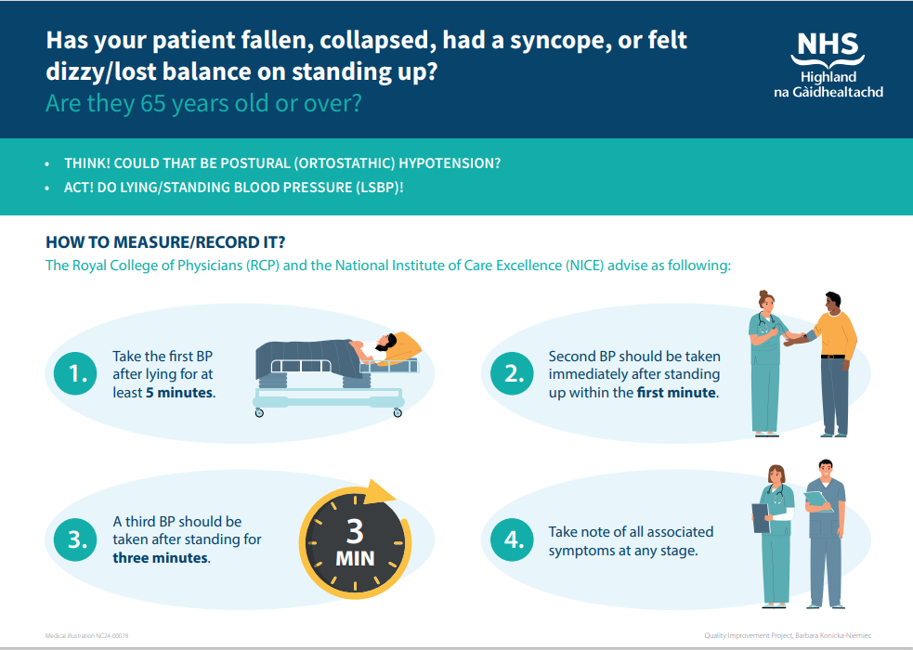
  • A drop in systolic blood pressure of more than 20mmHg when the patient moves from the lying or sitting position to standing, or a diastolic drop of greater than 10mmHg (measure at 1, 3 and 5 minutes).
  • Any drop in systolic blood pressure to below 90mmHg, can also be defined as orthostatic hypotension.
  • The drop can be delayed for longer than these arbitrary test times, and, if symptoms are suspicious of orthostatic hypotension, then Tilt Table testing (Gold standard test), which takes place over 40 minutes with beat-to-beat blood pressure and ECG monitoring can be undertaken, see below.

Relevance

Orthostatic hypotension is associated with an increased risk of injury, mortality, cognitive impairment, heart failure, atrial fibrillation, syncope, anxiety/ depression, loss of function and decreased quality of life.

Symptoms

  • Light headedness
  • aching shoulders and neck
  • anxiety
  • unsteadiness
  • leaning/ falling to the side
  • double or blurred vision
  • nausea
  • headache
  • ‘might black out’ or has blacked out
  • pale or sweaty
  • palpitations
  • dyspnoea.
Asymptomatic orthostatic hypotension is linked to an increased risk of unexplained falls so checking for this in any older adult with falls is essential.

Unfortunately the history in syncope can be unreliable, with amnesia of the event and with limited symptoms, even with severe orthostatic hypotension.

Diagnostic criteria by history in syncope:

  • Vasovagal syncope: is highly probable if syncope is precipitated by pain or fear or standing, and is associated with typical progressive prodrome ie pallor, sweating, nausea
  • Situational Syncope: also known as reflex syncope, is highly probable if syncope occurs during or immediately after specific triggers ie during or immediately after urination, defaecation, cough or swallowing
  • Orthostatic Hypotension: confirmed when syncope occurs while standing and there is concomitant significant orthostatic hypotension

Differential diagnosis

When the symptom occurs

Differential diagnosis

Always in the morning on rising from supine position?

Orthostatic hypotension

After standing from sitting?

Orthostatic hypotension

Turning over in bed? 

More likely vestibular

Associated with diplopia/ nausea/ feeling of motion?

More likely vestibular

After meals? (Splanchnic pooling)

Orthostatic hypotension

In a warm environment? (Vasodilation)

Orthostatic hypotension

After alcohol? (Vasodilation)

Orthostatic hypotension

Cough or micturition can trigger syncope

NOT related to orthostatic hypotension in this context

Linked to activity or exercise 

Potential for cardiac cause (RED FLAG)

Linked to chest pain or palpitations/arrhythmia 

Potential for cardiac cause (RED FLAG)

With a family history of Sudden Cardiac Death

Potential congenital cardiac disorder (RED FLAG)
If acute onset or RED FLAGS, then URGENT assessment for a new medical condition is required. 
Causes

Orthostatic hypotension is the result of baroreflex failure (autonomic failure), end-organ dysfunction, or volume depletion. Injury to any limb of the baroreflex causes neurogenic orthostatic hypotension. Although, with afferent lesions alone, the hypotension tends to be modest and accompanied by wide fluctuations in blood pressure, including severe hypertension.

Drugs can produce orthostatic hypotension by interfering with the autonomic pathways or their target end-organs or by affecting intravascular volume.

Brain hypoperfusion, resulting from orthostatic hypotension from any cause, can lead to symptoms of orthostatic intolerance (for example, light-headedness imbalance and falls) and, if the hypotension is severe, to syncope. It may be asymptomatic however, up until the point of syncope.

It is important to establish if the presentation is acute or chronic.

  • Eg: is it an indicator of acute hypovolaemia, or chronic and potentially related to other medical conditions, including diabetes or Parkinson’s.

Related conditions

Causes of autonomic dysfunction are adrenal insufficiency, diabetes, Parkinson’s and the atypical Parkinson’s conditions, spinal injury, primary autonomic failure, paraneoplastic disease. Orthostatic hypotension and POTS are recognised as symptoms of long covid. 

Medication

Drugs can contribute to orthostatic hypotension, in particular antihypertensives and some antidepressants. Refer to the list of medicines which can contribute to falls: Post-fall medication review (Guidelines)

Assessment

Examination:

  • Consider other factors related to falls in general: Observe mobility/ balance/ level of anxiety (related to fear of falling or symptoms).
  • Lying and standing blood pressure. Preferably daily if an inpatient. Sit to stand if realistically the only viable option.

Investigations to consider:

  • U&Es, FBC, Blood glucose
  • TFTs, B12 can be considered if diagnosis is uncertain
  • Morning (9am) cortisol, if suspicion of adrenal insufficiency
  • ECG

Other investigations: 

  • Echo, if clinical evidence of structural heart disease (eg heart failure or valvular pathology)
  • Ambulatory ECG monitoring for patients with suspected cardiac arrhythmia (eg sudden loss of consciousness with prompt recovery, unrelated to posture and especially if occurring when supine.
    See: ESC Guidelines on Syncope (Diagnosis and Management of)
  • Consider use of Tilt table +/- CSM, if ongoing, unexplained, recurrent syncope of uncertain cause that is refractory to initial medical management, with a suspected reflex or delayed OH aetiology and where the result would alter management. Consider
    CSM as part of the protocol

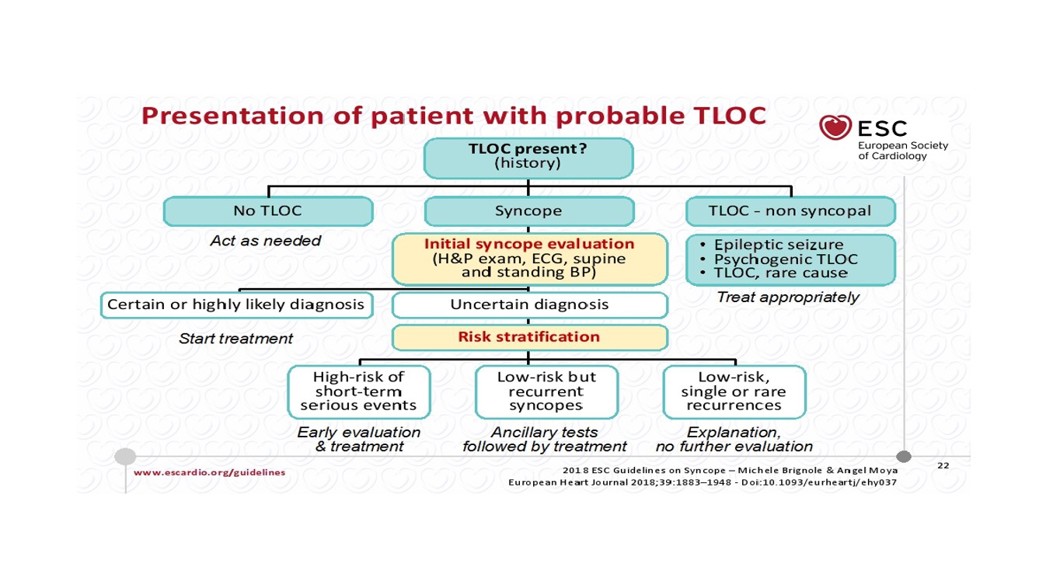
Risk stratification at the initial evaluation

Adapted from: ESC Guidelines on Syncope (Diagnosis and Management of)

Low-risk

High-risk (RED FLAG)

Syncopal event

  1. Associated with prodrome typical of reflex syncope (e.g. light-headedness, feeling of warmth, sweating, nausea, vomiting)
  2. After sudden unexpected unpleasant sight, sound smell or pain
  3. After prolonged standing or crowded, hot places
  4. During a meal or postprandial
  5. Triggered by cough, defaecation, or micturition
  6. With head rotation or pressure on carotid sinus (e.g. tumour, shaving, tight collars)
  7. Standing from supine/ sitting position

Major: 

  1. New onset of chest discomfort, breathlessness, abdominal pain, or headache
  2. Syncope during exertion or when supine.
  3. Sudden onset palpitation immediately followed by syncope

Minor: (high risk only if associated with structural heart disease or abnormal ECG)

  1. No warning symptoms or short (<10 s) prodrome
  2. Family history of sudden cardiac death at young age
  3. Syncope in the sitting position

Past medical history


  1. Long history (years) of recurrent syncope with low-risk features with the same characteristics of the current episode.
  2. Absence of structural heart disease.

Major:

  1. Severe structural or coronary artery disease (heart failure, low LVEF or previous myocardial infarction)

Physical examination

  1. Normal examination

Major: 

  1. Unexplained systolic BP in the ED <90 mmHg.
  2. Suggestion of gastrointestinal bleed on rectal examination.
  3. Persistent bradycardia (<40 b.p.m.) in awake state and in absence of physical training.
  4. Undiagnosed systolic murmur.

Transient loss of consciousness (TLOC)

Blanket copyright permission from: ESC Guidelines on Syncope (Diagnosis and Management of)

Non-pharmacological management

When orthostatic hypotension is confirmed as definite or highly likely (other possibilities excluded)

First consider how significant the issue of orthostatic hypotension is

  • If mild and patient can understand the situation and use non-pharmacological measures to manage the symptoms, then no further action may be necessary.
  • Provide reassurance and explanation, with focus on managing symptoms more than absolute numbers.

Volume expansion

  • Fluids: glass of water to take prior to rising (leave at bedside the night before).
  • Slow to rise and rising in stages first thing in morning.
  • Increased salt (dietician advice on real measures to achieve this).

Postural manoeuvres

  • Head up tilt in bed, 15 to 20% elevation of head of bed.
  • Clenching hands, tensing leg muscles prior to standing, leg crossing when standing.
  • Avoid manoeuvres which may replicate valsalva, eg, straining at stool.

Compression

  • Full length compression stockings.
  • Counter pressure manoeuvres.
  • Compression ‘garments’, if suitable.

Environmental/ lifestyle

  • Maintain activity levels.
  • Avoid alcohol.
  • Avoid large meals in warm rooms (due to vasodilation and splanchnic pooling), drink water 15 minutes before or with meals and delay rising immediately after meals.
  • Avoid hot showers & baths, and being outdoors on warm days.

Supine hypertension

This is sometimes a concern. General advice is to avoid lying supine in the day time, to eat a large carbohydrate snack before bed and consider applying a wheat bag/hot water bottle to the abdomen (ensure suitable clothing / padding to avoid burns).

There is some evidence supporting prescribing low dose anti-hypertensives at bed time.

The balance of symptomatic orthostatic hypotension versus supine hypertension is a complex and should be considered on an individual basis. Often, avoiding falls and injury which is the most immediate concern.

Medical management

Medication review

Review the patient's medications following the Polypharmacy guidance: 7 Steps | Right Decisions medication review. rescribed to avoid iatrogenic cause and as part of good pharmacological management. Specifically for antihypertensive medication: see the DANTE study

Consider if there is a potential to temporarily withhold medication and observe response, or can it be discontinued more permanently? Care may be required to avoid withdrawal reactions for some medication.

Be alert to ACE inhibitors and ARBs, alpha blockers, β Blockers, antidepressants, antipsychotics, benzodiazepines, diuretics, opiates, calcium channel blockers, Parkinson’s medication, sildenafil.


There are two licensed medicines for orthostatic hypotension: 

Midodrine:

See: Midodrine hydrochloride | Drugs | BNF | NICE and Vasoconstrictor sympathomimetics (Formulary)

  • Alpha adrenergic agonist, and sympathomimetic.
  • Indication: Severe orthostatic hypotension when other factors excluded.
  • Significant contraindications and cautions with use (see BNF).
  • Dose: Initiate at 2.5mg and increase gradually. Last dose: 5pm to prevent supine hypertension.

Fludrocortisone:

See: Fludrocortisone acetate | Drugs | BNF | NICE and Mineralocorticoid therapy (Formulary)

  • Indication: Orthostatic hypotension
  • Off label indication
  • Adverse effects: hypertension, oedema, cardiac enlargement, congestive heart failure
  • Risks: potassium loss and hypokalaemic alkalosis. Therefore monitoring of BP, weight, clinical signs of fluid retention and electrolytes is required.
  • Dose: 100 to 400 micrograms in neurogenic orthostatic hypotension. Increase dose gradually over weeks and months.

The BNF states that fludrocortisone has insignificant glucocorticoid activity. Local Endocrinology consultant advice is that it is not appropriate to provide steroid cards or advise to increase the dose in acute illness.


Other pharmacological treatments can be tried, but have limited evidence to support their use:

Pyridostigmine:

  • Side effects of abdominal cramps, diarrhoea, tearing, salivation, Nausea and vomiting.

Erythropoietin

  • Has been used when anaemia of chronic disease is associated.

Domperidone

  • Potential use in managing orthostatic hypotension in the treatment for Parkinson's disease (most specifically when introducing the dopamine agonist apomorphine).

Metoclopramide

  • Low evidence.

Patient information

Abbreviation

  • ACEi: Angiotensin-converting-enzyme inhibitors 
  • AF: Atrial fibrillation
  • ARBs: Angiotensin receptor blocker
  • BP: Blood pressure
  • CSM: Carotid sinus massage
  • ECG: Electrocardiogram
  • POTS: Postural tachycardia syndrome

Editorial Information

Last reviewed: 28/08/2025

Next review date: 28/08/2028

Author(s): Care of the Elderly.

Version: 1

Approved By: TAM subgroup of the ADTC

Reviewer name(s): Dr D Gray, Associate Specialist, Medicine for the Elderly, A Warren, Pharmacist, Care of the Elderly, Dr L Cormie, Consultant, Medicine for the Elderly, H McCloughlin, Senior Advanced Nurse Practioner.

Document Id: TAM703

References
  • BMJ best practice 2022 https://bestpractice.bmj.com/topics/en-gb/972
  • European Society of Cardiology guidelines on Syncope
  • orthostatic hypotension - UpToDate
  • Scottish polypharmacy guide