Warning

Audience

  • North NHS Highland only
  • Secondary Care only
  • Adults and Children

There are a significant number of patients taking anticoagulants, such as warfarin, and, increasingly, direct oral anticoagulants (DOACs). When we see patients on these medications, with uncontrolled haemorrhage, management may include the reversal of the anticoagulants, especially in major haemorrhage. There are general principles that should be applied to all patients, irrespective of the anticoagulant:

General principles

  • Haemorrhage control: pressure, haemostatic dressing, tourniquet, etc.
  • Lab samples: FBC, Coag screen, renal function
  • NB: specify name of anticoagulant on request form
  • Identify time of last anticoagulant dose, if possible
  • Consider tranexamic acid
  • Resuscitate as required, including with blood product transfusion

There are however specific antidotes for warfarin and some of the DOACs.

Specific antidotes: 

Anticoagulant reversal agents (Formulary: Cardiovascular)

Warfarin: vitamin K antagonist affecting factors II, VII, IX & X

Reversal with Prothrombin Complex Concentrate (PCC) (Prothromplex Total) and vitamin K

  • PCC (Prothomplex Total) is stored in the Resus blood fridge
  • See specific Prothomplex total infusion guide
  • Repeat Coag screen 30 mins post-administration

Apixiban & rivaroxaban: DOACs that inhibit factor Xa

Reversal with Andexanet Alpha (Ondexxya)

  • Haematologist approval required
  • Stored in Critical Care Department fridge
  • Filters and a second pump available in Critical Care Department
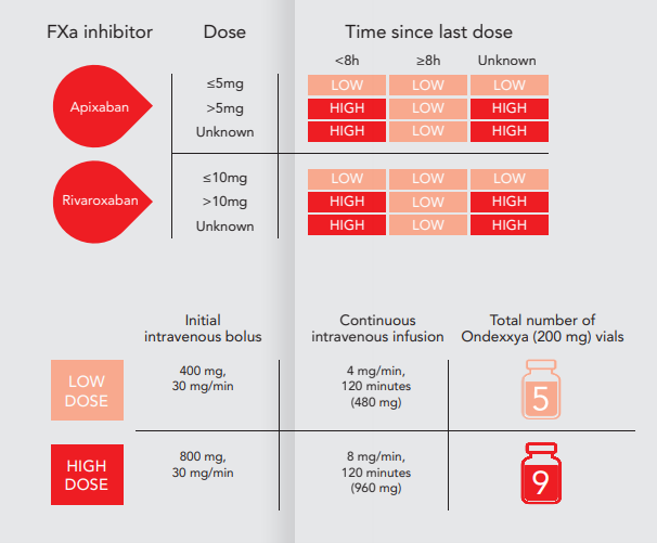
  • See dosing guide
  • Repeat Coag screen 30 mins post-administration

Dabigatran: DOAC that inhibits factor IIa

Reversal with Idarucizumab (Praxbind)

  • Haematologist approval required
  • Stored in the Resus fridge
  • Simple dosing: fixed, ready-to-use IV dose of 5g Praxbind
  • Repeat Coag screen 30 mins post-administration

Edoxaban: DOAC that inhibits factor Xa

NO specific reversal agent

  • Discuss with haematologist regarding potential reversal options

Prothromplex TOTAL Infusion

Prothrombin complex concentrate (PCC): combination of blood clotting factors II, VII, IX and X, as well as protein C. Prepared from human fresh frozen plasma

For the Emergency treatment of life-threatening haemorrhage in patients taking oral anticoagulants.

  • Eg. intracranial bleed, GI haemorrhage, major trauma
  • Primarily for: rapid reversal of warfarin coagulopathy.

May be administered PRIOR to consultation with haematologist, using supply in Resus blood fridge

Seek advice from a haematologist if there is any doubt regarding the use of PCC (Prothromplex TOTAL)
  • PCC provides SHORT-TERM reversal.
  • Vitamin K 10mg by slow IV injection should also be given to provide a longer lasting effect.
  • Vitamin K should be given via a different cannula

Prescribing details: 

For full information see: Prothromplex TOTAL 500 IU powder and solvent for solution for injection - Summary of Product Characteristics (SmPC) - (emc) | 15237

Contraindications

  • Known sensitivity to Prothromplex total or any of the excipients
  • Known history of heparin induced thrombocytopenia (HIT)
  • Patient currently in disseminated intravascular coagulation (DIC)

Risks

  • May induce a pro-thrombotic state in some patients. Therefore use in ED is limited to reversal of anticoagulation in life-threatening haemorrhage

Administration

  • Inform BTS that you are going to administer PCC (Prothromplex total), to ensure timely replacement of stock
  • This is a complex drug administration process and should be checked fully with another competent practitioner
  • Use both the reconstitution and dosing guides below.
    A video and other resources on administration are also available from: PROTHROMPLEX TOTAL® (human prothrombin complex) | Rare Disease Hub 2.0 
  • Prothromplex Total is administered by IV infusion at a maximum rate of 2mL/minute.
  • NO blood should be allowed to flow into the syringe of PCC during administration. This is to avoid clots forming in the syringe
Prothromplex reconstitution

Making up the Prothromplex TOTAL. Please also see video available from: PROTHROMPLEX TOTAL® (human prothrombin complex) | Rare Disease Hub 2.0 


Steps

Image

1
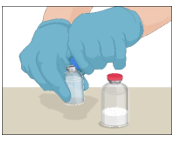
  • Remove protective caps from the powder vial and the solvent vial.
2
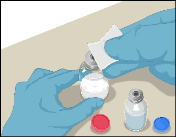
  • Disinfect each stopper with a separate sterile alcohol swab (or other suitable sterile solution) by wiping the stopper for several seconds.
  • Allow the rubber stopper to dry. Place the vials on a flat surface.
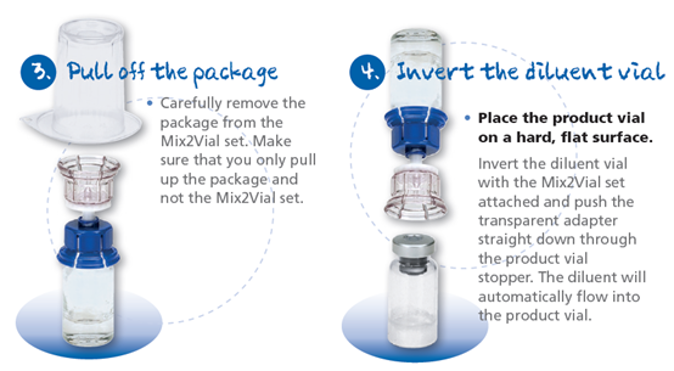
3
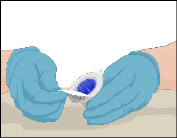
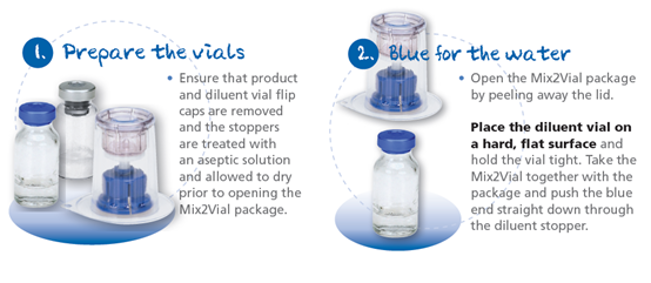
  • Open the Mix2Vial device package by completely peeling away the lid, without touching the inside of the package.
  • Do not remove the Mix2Vial device from the package.
4
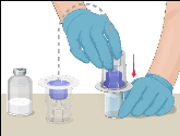
  • Turn the package with the Mix2Vial device upside down and place it over the top of the solvent vial.
  • Firmly insert the blue plastic spike of the device into the centre of the solvent vial stopper by pushing straight down. Grip the package at its edge and lift it off the Mix2Vial device.
  • Be careful not to touch the clear plastic spike.
  • The solvent vial now has the Mix2Vial device connected to it and is ready to be connected to the Prothromplex TOTAL vial.
5
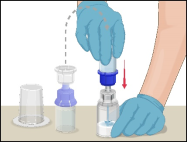
  • To connect the solvent vial to the Prothromplex TOTAL vial, turn the solvent vial over and place it on top of the vial containing Prothromplex TOTAL powder.
  • Fully insert the clear plastic spike into the Prothromplex TOTAL vial stopper by firmly pushing straight down. This should be done right away to keep the liquid free of germs.
  • The solvent will flow into the Prothromplex TOTAL vial by vacuum. Check that all the solvent has transferred.
  • Do not use if the vacuum has been lost and the solvent does not flow into the Prothromplex TOTAL vial.
6
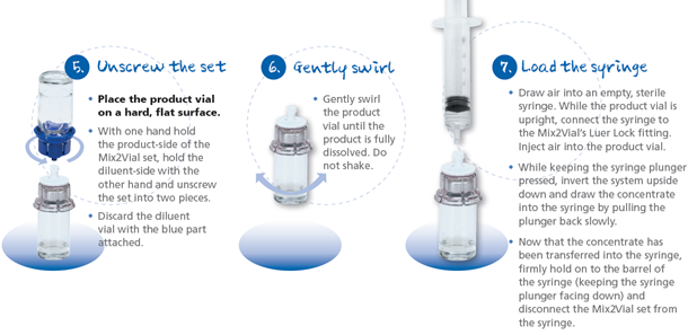
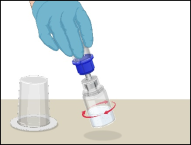
  • Gently and continuously swirl the connected vials until dissolved or allow the reconstituted product to stand for 5 minutes then gently swirl to ensure the powder is completely dissolved.
  • Do not shake. Shaking will adversely affect the product. Do not refrigerate after reconstitution.
7
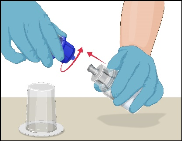
  • Disconnect the two sides of the Mix2Vial from each other by holding the clear plastic side of the Mix2Vial device attached to the Prothromplex TOTAL vial with one hand and the blue plastic side of the Mix2Vial device attached to the solvent vial with the other hand.
  • Turn the blue plastic side counterclockwise and gently pull the two vials apart.
  • Do not touch the end of the plastic connector attached to the Prothromplex TOTAL vial cotaining the dissolved product.
  • Place the Prothromplex TOTAL vial on a flat work surface. Discard the empty solvent vial.
8
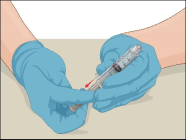
  • Draw air into an empty, sterile disposable plastic syringe by pulling back on the plunger.
  • The amount of air should equal the amount of reconstituted Prothromplex TOTAL that you will withdraw from the vial.
9
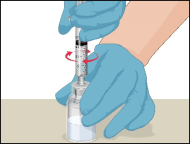
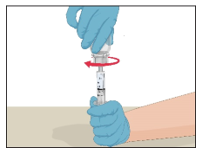
  • Leaving the Prothromplex TOTAL vial (containing the reconstituted product) on your flat work surface, connect the syringe to the clear plastic connector and turn the syringe clockwise.
10
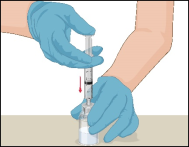
  • Hold the vial with one hand and use the other hand to push all the air from the syringe into the vial.
11
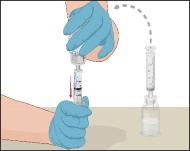
  • Flip connected syringe and Prothromplex TOTAL vial, so the vial is on top. Be sure to keep the syringe plunger pressed in. Draw the Prothromplex TOTAL into the syringe by pulling plunger back slowly.
  • Do not push and pull solution back and forth between syringe and vial. Doing so may harm the medicine.
12
  • When ready to infuse, disconnect the syringe by turning it counterclockwise. Inspect the syringe visually for particulate matter; the solution should be clear and slightly opalescent.
  • If the solution is cloudy or with deposits, do not use the solution.

Prothromplex administration

  1. Inspect the prepared solution in the syringe for particulate matter and discoloration prior to administration.
    • The solution should be clear, colourless and free from particles.
    • The filter included in the Mix2Vial device removes those particles completely.
    • Filtration does not influence dosage calculations.
    • The solution in the syringe should not be used if it is cloudy or contains flakes or particles after filtration.
  2. Attach the infusion needle to a syringe containing Prothromplex TOTAL solution.
    • Infuse the solution through an appropriate device e.g. cannula
    • Point the needle up and remove any air bubbles by gently tapping the syringe with your finger and slowly and carefully pushing air out of the syringe and needle.
  3. Apply a tourniquet and get the infusion site ready by wiping the skin well with a sterile alcohol swab (or other suitable sterile solution).
  4. Insert the needle into the vein and remove the tourniquet.
    • Slowly infuse Prothromplex TOTAL.
    • Do not infuse any faster than 2mL per minute.
    • Disconnect the empty syringe.
    • NOTE: Do NOT remove butterfly needle until all syringes have been infused and do NOT touch the Luer port that connects to the syringe.
  5. Take the needle out of the vein and use sterile gauze to put pressure on the infusion site for several minutes.
    • NOTE: Do NOT recap the needle. Place the needle, syringe, and empty Prothromplex TOTAL and solvent vial in a hard-walled sharps container for proper disposal.

Prothromplex dosing

Catastrophic haemorrhage on warfarin and no INR available

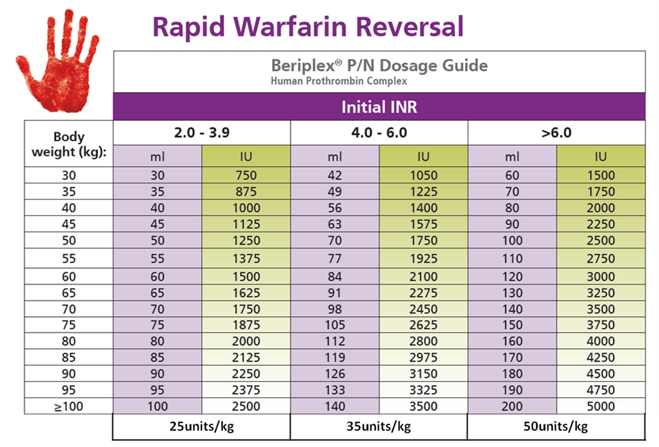
  • Dose at 35units/kg
  • Once results are available, more PCC could be given if pre-drug INR >4 or post drug INR >2. Discuss with haematologist

Uncontrolled haemorrhage and INR known

(Note this calculator is recommended for use by the Haematology Dept, however it is unvalidated, and is to be used with clinical judgement). Please read the ‘Assumptions and limitations’ section on the calculator for more information). 


Dose of Prothromplex® TOTAL to correct INR according to initial INR measurement

INR

2.0 to 3.9

4.0 to 6.0 >6.0
Dose (unit/kg) 25 35 50
Body weight (kg) Units mL Vials Units mL Vials Units mL Vials
40 1,000 34.0 2.0 1,400 47.6 3.0 2,000 68.0 4.0
41 1,025 34.9 3.0 1,435 48.8 3.0 2,050 69.7 5.0
42 1,050 35.7 3.0 1,470 50.0 3.0 2,100 71.4 5.0
43 1,075 36.6 3.0 1,505 51.2 4.0 2,150 73.1 5.0
44 1,100 37.4 3.0 1,540 52.4 4.0 2,200 74.8 5.0
45 1,125 38.3 3.0 1,575 53.6 4.0 2,250 76.5 5.0
46 1,150 39.1 3.0 1,610 54.7 4.0 2,300 78.2 5.0
47 1,175 40.0 3.0 1,645 55.9 4.0 2,350 79.9 5.0
48 1,200 40.8 3.0 1,680 57.1 4.0 2,400 81.6 5.0
49 1,225 41.7 3.0 1,715 58.3 4.0 2,450 83.3 5.0
50 1,250 42.5 3.0 1,750 59.5 4.0 2,500 85.0 5.0
51 1,275 43.4 3.0 1,785 60.7 4.0 2,550 86.7 6.0
52 1,300 44.2 3.0 1,820 61.9 4.0 2,600 88.4 6.0
53 1,325 45.1 3.0 1,855 63.1 4.0 2,650 90.1 6.0
54 1,350 45.9 3.0 1,890 64.3 4.0 2,700 91.8 6.0
55 1,275 46.8 3.0 1,925 65.5 4.0 2,750 93.5 6.0
56 1,400 47.6 3.0 1,960 66.6 4.0 2,800 95.2 6.0
57 1,425 48.5 3.0 1,995 67.8 4.0 2,850 96.9 6.0
58 1,450 49.3 3.0 2,030 69.0 5.0 2,900 98.6 6.0
59 1,475 50.2 3.0 2,065 70.2 5.0 2,950 100.3 6.0
60 1,500 51.0 3.0 2,100 71.4 5.0 3,000 102.0 6.0
61 1,525 51.9 4.0 2,135 72.6 5.0 3,050 103.7 7.0
62 1,550 52.7 4.0 2,170 73.8 5.0 3,100 105.4 7.0
63 1,575 53.6 4.0 2,205 75.0 5.0 3,150 107.1 7.0
64 1,600 54.5 4.0 2,240 76.2 5.0 3,200 108.8 7.0
65 1,625 55.3 4.0 2,275 77.4 5.0 3,250 110.5 7.0
66 1,650 56.1 4.0 2,310 78.5 5.0 3,300 112.2 7.0
67 1,675 57.0 4.0 2,345 79.7 5.0 3,350 113.9 7.0
68 1,700 57.8 4.0 2,380 80.9 5.0 3,400 115.6 7.0
69 1,725 58.7 4.0 2,415 82.1 5.0 3,450 117.3 7.0
70 1,750 59.5 4.0 2,450 83.3 5.0 3,500 119.0 7.0
71 1,775 60.4 4.0 2,485 84.5 5.0 3,550 120.7 8.0
72 1,800 61.2 4.0 2,520 85.7 6.0 3,600 122.4 8.0
73 1,825 62.1 4.0 2,555 86.9 6.0 3,650 124.1 8.0
74 1,850 62.9 4.0 2,590 88.1 6.0 3,700 125.8 8.0
75 1,875 63.8 4.0 2,625 89.3 6.0 3,750 127.5 8.0
76 1,900 64.6 4.0 2,660 90.4 6.0 3,800 129.2 8.0
77 1,925 65.5 4.0 2,695 91.6 6.0 3,850 130.9 8.0
78 1,950 66.3 4.0 2,730 92.8 6.0 3,900 132.6 8.0
79 1,975 67.2 4.0 2,765 94.0 6.0 3,950 134.3 8.0
80 2,000 68.0 4.0 2,800 95.2 6.0 4,000 136.0 8.0
81 2,025 68.9 5.0 2,835 96.4 6.0 4,050 137.7 9.0
82 2,050 69.7 5.0 2,870 97.6 6.0 4,100 139.4 9.0
83 2,075 70.6 5.0 2,905 98.8 6.0 4,150 141.1 9.0
84 2,100 71.4 5.0 2,940 100.0 6.0 4,200 142.8 9.0
85 2,125 72.3 5.0 2,975 101.2 6.0 4,250 144.5 9.0
86 2,150 73.1 5.0 3,010 102.3 7.0 4,300 146.2 9.0
87 2,175 74.0 5.0 3,045 103.5 7.0 4,350 147.9 9.0
88 2,200 74.8 5.0 3,080 104.7 7.0 4,400 149.6 9.0
89 2,225 75.7 5.0 3,115 105.9 7.0 4,450 151.3 9.0
90 2,250 76.5 5.0 3,150 107.1 7.0 4,500 153.0 9.0
91 2,275 77.4 5.0 3,185 108.3 7.0 4,550 154.7 10.0
92 2,300 78.2 5.0 3,220 109.5 7.0 4,600 156.4 10.0
93 2,325 79.1 5.0 3,255 110.7 7.0 4,650 158.1 10.0
94 2,350 79.9 5.0 3,290 111.9 7.0 4,700 159.8 10.0
95 2,375 80.8 5.0 3,325 113.1 7.0 4,750 161.5 10.0
96 2,400 81.6 5.0 3,360 114.2 7.0 4,800 163.2 10.0
97 2,425 82.5 5.0 3,395 115.4 7.0 4,850 164.9 10.0
98 2,450 83.3 5.0 3,430 116.6 7.0 4,900 166.6 10.0
99 2,475 84.2 5.0 3,465 117.8 7.0 4,950 168.3 10.0
100 2,500 85.0 5.0 3,500 119.0 7.0 5,000 170.0 10.0

Following administration

Monitoring

  • Full obs 10 minutes and 30 minutes after administration, as required thereafter
  • Repeat coagulation studies 30 mins after drug delivery

Batch number MUST be recorded in the patient notes.

This is a blood product and, due to the theoretical risk of viral transmission, the products need to be traceable

Andexanet apha dosing

We need to know both the dose of anticoagulant and the time since that dose in order to appropriately prescribe.

Reconstitute as per the documents within the product box

Also see: Andexanet alfa: administration quick reference guide (Guidelines)

Abbreviations

  • DIC: disseminated intravascular coagulation
  • DOAC: direct oral anticoagulants
  • HIT: heparin induced thrombocytopenia
  • INR: international normalised ratio
  • PCC: Prothrombin Complex Concentrate

Editorial Information

Last reviewed: 01/07/2025

Next review date: 07/08/2028

Author(s): Emergency Department.

Version: 2

Co-Author(s): Haematology Department, Pharmacy.

Approved By: TAM subgroup of the ADTC

Reviewer name(s): Dr M Rennie, Consultant ED, Dr J Craig, Consultant Haematology, A Mehta, Lead Pharmacist, Surgical and Women & Children Directorate.

Document Id: TAM699