Transmissible spongiform encephalopathies (TSEs), otherwise known as prion diseases, are rare, neurodegenerative diseases affecting the central nervous system (CNS), that occur in humans and certain other mammals.
Although TSEs are not contagious, they are experimentally transmissible by inoculation and in some cases by oral challenge. Transmission of TSEs to humans has occurred from both human and bovine sources, resulting in iatrogenic CJD and variant CJD respectively.
CJD (Creutzfeldt-Jakob disease) is the abbreviation used throughout this document as the other TSEs are very rare and the best practice principles will apply equally to these conditions.
CJD is a progressive, fatal neurological disease that belongs to a wider group of neurodegenerative disorders known as transmissible spongiform encephalopathies (TSEs) or prion diseases. TSEs affect humans and animals. Traditionally, there are three aetiological categories of CJD.
- Sporadic CJD (85 to 90% of cases) is of unknown aetiology. Sporadic CJD has a worldwide distribution, with a relatively uniform annual incidence of about 1 in 1 million people.
- Inherited CJD (10 to 15% of cases) is associated with coding mutations, insertions or deletions in the prion protein gene.
- Iatrogenic CJD (less than 1% of cases) arises from accidental exposure to human prions through surgical or medical procedures.
CJD patients typically present with rapidly progressive dementia, usually accompanied by myoclonus and cerebellar ataxia. Most patients die within 4 months of disease onset, in a mute and immobile state.
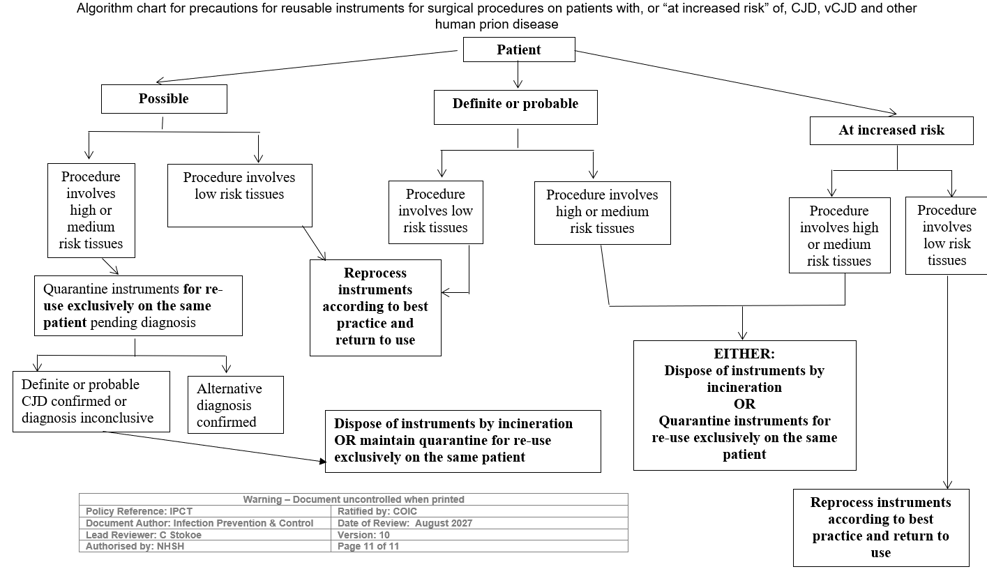
A variant form of CJD was identified in 1996, which was described as being identical to Bovine Spongiform Encephalopathy (BSE). It was thought to have been transmitted to humans by eating contaminated meat products. Other instances of transmission of CJD have been described via receiving blood products and occasionally through instruments contaminated with CJD. Unlike micro-organisms, prions are not destroyed by conventional methods of decontamination and sterilisation, therefore a risk assessment has to be undertaken before any clinical procedure where there is considered to be a risk of potential transmission.


 TAM (Treatments and Medicines) NHS Highland