

 TAM (Treatments and Medicines) NHS Highland
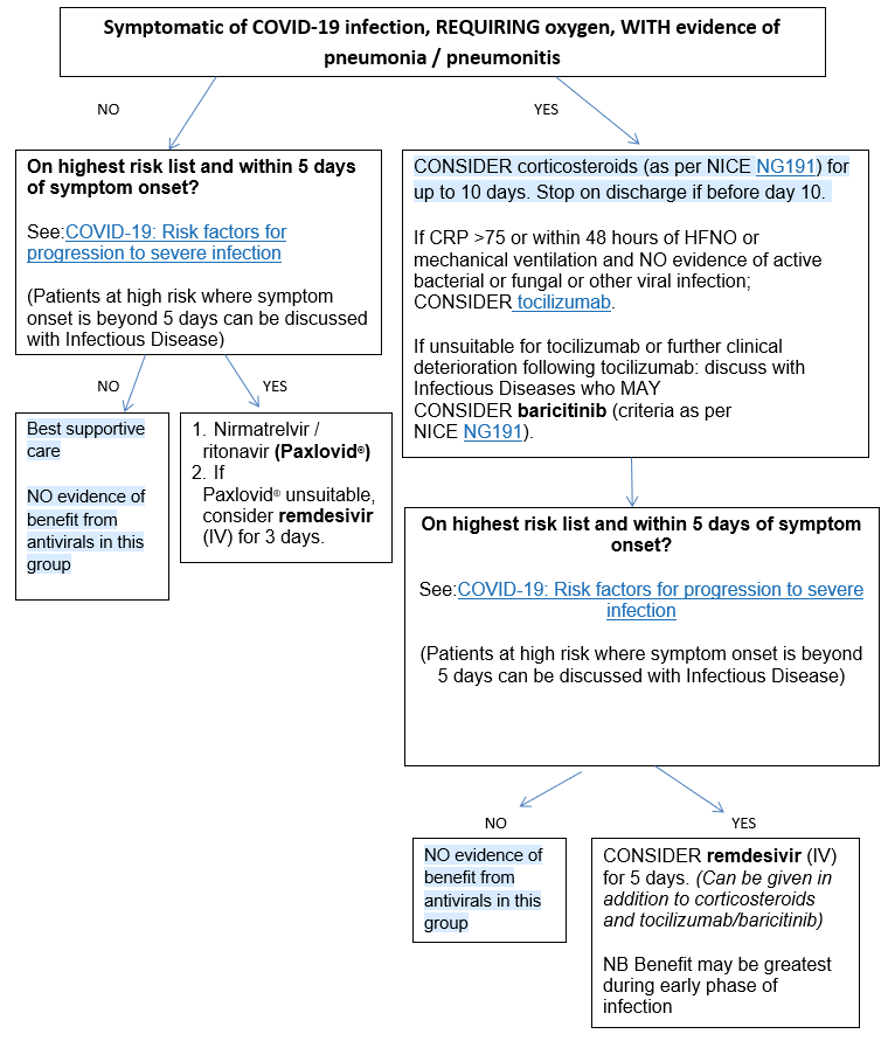
COVID-19: Adult in-patient: Drug management following POSITIVE LFT / PCR test (Guidelines)

Warning
What's new / Latest updates
26/03/26
Bold writing added: CONSIDER remdesivir (IV) for 5 days. (Can be given in addition to corticosteroids and tocilizumab/baricitinib)
26/02/26 V2:
- Guidance revised with updated NICE recommendations with information streamlined and links to prescribing information for licensed treatments provided.
13/11/24:
- Information represented as a flowchart
- Handover communication re tocilizumab added
Audience
- All NHS Highland
- Secondary Care only
- Adults only
- Patients aged between 12 and 17 years should be assessed by a paediatric multi-disciplinary team, with input from infectious diseases to determine clinical capacity to benefit from the treatment.
This guidance is based on:
- NICE NG 191: COVID-19 rapid guideline: managing COVID-19
- TCA971: Remdesivir and tixagevimab plus cilgavimab for treating COVID-19
See manufacturer’s information (emc) before prescribing tocilizumab, remdesivir and nirmatrelvir / ritonavir as these are all licensed treatments for COVID-19 infection.
Extract from NICE NG191, section 4.3, box 1
Dosage in adults:
- Continue corticosteroids for up to 10 days unless there is a clear indication to stop early, which includes discharge from hospital or a hospital-supervised virtual COVID ward.
- Dexamethasone (licensed indication)
For people able to swallow and in whom there are no significant concerns about enteral absorption, prescribe tablets.
ONLY use intravenous administration when tablets or oral solutions are inappropriate or unavailable.- 6 mg orally, once a day for 10 days (three 2 mg tablets or 15 mL of 2 mg/5 mL oral solution)
- OR 6 mg intravenously once a day for 10 days (1.8 mL of 3.3 mg/mL ampoules [5.94 mg]).
Suitable alternatives (currently unlicensed)
- Prednisolone: 40 mg orally once a day for 10 days.
- Hydrocortisone: 50 mg intravenously every 8 hours for 10 days (0.5 mL of 100 mg/mL solution; powder for solution for injection or infusion is also available); this may be continued for up to 28 days for people with septic shock.
Dosage in pregnancy
For more information on the management of children, follow the Royal College of Paediatrics and Child Health National guidance: the management of children in hospital with viral respiratory tract infections (2023).:
Nirmatrelvir / ritonavir (Paxlovid):
- Clinical evidence suggests that nirmatrelvir plus ritonavir is effective at treating mild COVID-19 compared with standard care.
Remdesivir:
- For adults in hospital, remdesivir can improve how long adults needing low-flow supplemental oxygen live compared with standard care, but the evidence is highly uncertain.
- NICE evaluation committee concluded that there was NO clinical trial evidence available for remdesivir in the context of the current endemic setting with a widely vaccinated and naturally immune population and the Omicron variant.
- The committee concluded that significant uncertainty remained in terms of generalisability of the trial evidence for remdesivir.
Drug interactions with nirmatrelvir / ritonavir
- MUST be checked before prescribing nirmatrelvir / ritonavir as these can be significant.
- See University of Liverpool Drug interaction checker.
- This has more detailed information on interactions and recommended actions to take than the manufacturer’s information (SPC).
- If the significance of the drug interaction needs clarification, please contact Pharmacy or Infectious Diseases
Renal disease and renal dialysis
Infectious Diseases & Renal Specialists in NHS Highland recommend using:
- For dose adjustment for nirmatrelvir / ritonavir, see Liverpool guidance: Dosing of Paxlovid in Renal Disease:
- PDF: Guidance for Paxlovid dosing in renal disease and patients on dialysis note: if link to pdf does not work, go back to "Prescribing Resources" page, click on the drop-down box for nirmatrelvir/ritonavir and accessing the 4th resource on the list.
- To support NO dose adjustment for remdesivir, see Liverpool guidance: COVID-19: Dose recommendations for Patients with Renal Impairment
Note: this advice is at variance with manufacturer’s recommendations and is therefore off-label.
Swallowing difficulties
- For administering COVID-19 oral antiviral therapy for patients with swallowing difficulties, see Liverpool guidance: Administration in swallowing difficulties
Prescribing information
- For Hospital Pharmacy supply of oral COVID antiviral medication, use pre-prepared hospital prescription forms to reduce waste by supplying the whole course of treatment.
- Prescribe on HEPMA as Protocol > Paxlovid then choose standard dose or reduced dose (for renal impairment)
- For in-patient areas with paper drug charts, follow example below:
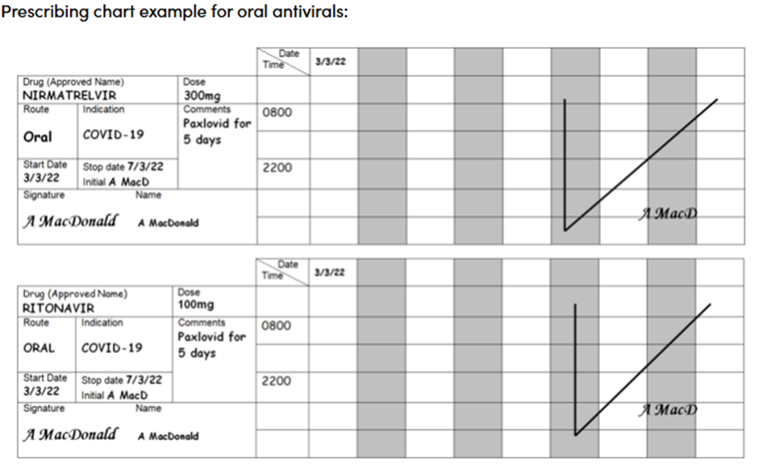
NB: If discharged BEFORE day 5: Add the antiviral to the immediate discharge letter, noting “Already supplied from Pharmacy” in the “Days” box
Baricitinib (JAK1 & JAK2 inhibitor)
- This is unlicensed and use should be discussed with Infectious Diseases before prescribing.
- NICE NG191 has limited information
Tocilizumab
If tocilizumab has been administered then the following is essential handover communication on discharge
Tocilizumab can cause immunosuppression that renders patients at risk of bacterial and fungal infections.
- Low clinical threshold for identification and management of infection must be used.
- CRP level may be a less reliable marker of active infection and procalcitonin may be negative.
All handovers of clinical care must explicitly mention that an IL-6 inhibitor has been given and the date of administration. This includes:
- Between hospitals if patients are transferred
- Between levels of care and clinical teams within hospitals
- Between hospitals and primary care
Clinicians MUST ensure the GP is aware the patient has received an IL-6 inhibitor and provide information to the patient to such effect:
- Supply the manufacturer’s patient information leaflet
The following standard text should be added to the hospital discharge letter:
- Your patient received tocilizumab on ....../....../......
- Immune function will be suppressed for the next 3 months.
- Clinical assessment is required to diagnose and manage infection as inflammatory markers will be unreliable
CRP: C‑reactive Protein
EMC: Electronic Medicines Compendium
IL‑6: Interleukin‑6
IV: Intravenous
JAK: Janus Kinase
LFT: Lateral Flow Test
mL: Millilitre
mg: Milligram
NICE NG: NICE Guideline
NICE: National Institute for Health and Care Excellence
PCR: Polymerase Chain Reaction
SMPc / SPC: Summary of Product Characteristics