


High consequence infectious disease (HCID) pathway

Warning

Audience

  • All NHS Highland
  • Primary and Secondary Care
  • Adults and Children
This pathway is for local implementation of national guidance to allow safe management of patients who may have a HCID.

What is a HCID?

  • High Consequence Infectious Diseases (HCIDs) are diseases that have been categorized as requiring high levels of infection control intervention to protect healthcare workers and public. They are listed here: High consequence infectious diseases (HCID) - GOV.UK

National guidance:

HCID clinical pathway: quick reference guide

Pathway  step

ACTION

1

Patient identified as needing assessment for HCID

  • Eg, due to travel history and infection presentation

Place patient away from other people and continue assessment by phone.

  • See 'Patient placement while awaiting assessment'

2

Take full travel and presentation history by phone

  • See 'History and remote assessment' and 'HCID risk assessment triage algorithm'
3

If concern re possible HCID, discuss with Infection Specialist

  • See 'Contact details'
  • See 'Infection Specialist assessment'

4

Suspected HCID: Next steps

  • Patient isolated
  • Staff wear HCID PPE
  • Refer to Regional Infectious Diseases Unit
  • Arrange transfer
  • Continue patient care
  • Public Health convene PAG (Patient Assessment Group)

All staff follow: 

5

Patient stepped down or transferred to Regional Infectious Diseases Unit

Infection specialist contact details

Who to contact


North NHS Highland

Argyll and Bute HSCP

Suspected HCID (adult)

Monday to Friday 9am to 5pm

  • NHS Highland Duty Infectious Diseases Consultant

Out of hours

  • NHS Highland Consultant Microbiologist
    Note: If appropriate, NHS Highland Microbiologist may advise referrer to discuss directly with Grampian ID Consultant on-call

Monday to Friday 9am to 5pm

  • NHS Highland Duty Infectious Diseases Consultant

Out of hours

  • NHS Highland Consultant Microbiologist
    Note: If appropriate, NHS Highland Microbiologist may advise referrer to discuss directly with GGC ID Consultant on-call
Suspected HCID (child)

Local paediatrician first, then

Paediatric Infectious Diseases Consultant, GGC

How to contact 

Contact

Contact number

NHSH Infectious Diseases Consultant on call
(Monday to Friday, 9am to 5pm)

01463 704000 Raigmore switchboard

NHSH Duty Consultant Microbiologist
(any time)

01463 704000 (Raigmore switchboard) or 
01463 704206 (Lab office)

NHSH Infection control Duty Nurse, North Highland
(Monday to Friday, 9am to 5pm)  

01463 704000 (Raigmore Switchboard) and ask to page Duty Infection Control Nurse

NHSH Infection control Duty Nurse
(Monday to Friday, 8am to 5pm)

Generic contact details to be added
GGC Infectious Diseases Consultant on call 
Queen Elizabeth University Hospital Switchboard
(any time)
0141 201 1100

NHS Grampian Infectious Diseases Consultant
(any time)

0345 456 6000

Consultant in Public Health Medicine (CPHM) and Health Protection Team for NHS Highland

Working hours: 01463 704886.
Out of hours:  01463 704000 (Raigmore switchboard)

Scottish Ambulance Service

0345 602 3999

Imported fever service

0844 778 8990 (Infection Specialist only)

Paediatric Infectious Diseases Consultant, GGC

0141 201 1100 

Patient placement while awaiting assessment

Example scenario: the possibility of a HCID has been raised (for example, due to travel history) but more detailed risk assessment for HCID is pending.

Where the patient presents

Patient placement

Community
  • Patient to stay where they are.
  • History taken by telephone.
Primary Care
  • Patient to be placed in a single room or asked to wait outside or sit in their car if suitable.
  • History taken by telephone.
Secondary Care ED / Outpatient setting
  • Follow your site HCID plan. Your site lead nurse or duty manager should be familiar with this.
  • If in doubt place patient in a clinical space appropriate for their clinical presentation, away from other patients (single room preferred).
  • History taken by telephone.
Inpatient setting
  • Urgently inform the charge nurse and the patient’s consultant of the concerns. Advise that you have concerns about HCID but patient has not yet been fully assessed.
  • Nurse in charge minimise contact with other patients / staff and visitors but does not usually move patient at this stage.
  • Take further history by phone. 
Notes
  • If direct clinical care needs to be given prior to full risk assessment then make dynamic risk assessment and either don HCID assessment PPE before giving direct clinical care, or use standard precautions.
  • If patient doesn’t have own phone then department roving handset or mobile can be used. If not already plastic covered then the department device should be placed in a clear plastic bag before passing to the patient to allow decontamination after use.

History and remote assessment

Take full travel and presentation history remotely. The following checklist may be helpful. Face to face assessment is NOT recommended at this stage. 

  1. Travel history (including dates, countries and regions),
  2. Any history of fever or feeling feverish, date of onset
  3. History of symptoms, dates of onset
  4. Activities, living conditions and animal contact during travel
  5. Contact with unwell people (including dates of last contact, countries and region where contact occurred)
  6. How unwell patient is in terms of systemic symptoms and trajectory
  7. Whether patient has respiratory symptoms
  8. Information relevant to differential diagnoses
  9. Immunosuppressed?

Once you have taken the history, if you have any concerns call infection specialist (see contacts). If no concern regarding HCID then leave this pathway and follow standard clinical care pathways.

NHS Highland triage algorithm or national resources High consequence infectious diseases (HCID) can be used to assess risk for HCID.

NHS Highland have developed a HCID triage tool that departments can use to help staff identify patients who are at risk of HCID.

  • You can consider using this tool if your patient is relatively well and stable. See HCID risk assessment triage algorithm. 
  • If your patient is unwell or unstable go straight to discussion with infection specialist.
Instant access Near-me video call can be accessed by logging into your near me account and choosing the ‘consult now’ feature. This allows you to invite the patient into a videocall using their mobile phone number or e mail.

Deteriorating patient at home or in the community

Unwell patient at home or in community setting pending full assessment

If 999 call warranted:

If the clinician judges that the patient is clinically deteriorating and warrants a 999 call:

  • Proceed to call 999
  • Inform ambulance control of patient travel history and whether 'suspected HCID'.
    • Scottish Ambulance will call on any appropriate resources they have available to attend to a patient deteriorating at home.
  • Ensure to complete history and assessment prioritising informing infection specialist of incident / development.
    • Infection specialist then urgently informs CPHM who arrange a PAG.

If 999 call NOT warranted:

  • Urgently complete history and remote assessment, prioritising informing infection specialist of patient.
    • Infection specialist then urgently informs CPHM who arrange a PAG.

PAG discussion for a patient deteriorating at home or in community will include SAS. The usual preferred pathway is for SAS attendance to patient. If SAS are unable to attend in the required timeframe, the PAG may recommend that the patient’s exposed family members transport the patient to nearest RGH or Raigmore.

All RGHs and Raigmore should have a HCID plan in place with a designated single room suitable for stabilisation of an unwell patient pending SORT ambulance retrieval.

Receiving clinician MUST be told of HCID status of patient so they can arrange safe receipt of patient into the healthcare facility.

Infection specialist assessment

Infection specialist to decide whether case should be managed as a suspected HCID

  • This may require further telephone assessment of the case, and discussion with Imported Fever Service.
  • If NOT to be managed as suspected HCID: then revert to standard pathways.
    • Rediscuss with infection specialist over subsequent days if ongoing concern.

Patient designated as 'suspected HCID': next steps

This is a HIGH IMPACT situation and is likely to have knock-on effects for healthcare delivery in the location. 

  • Roles and responsibilities, including communication cascades are stated in section: Ongoing management of suspected HCID: Roles, responsibilities and actions.
  • All healthcare professionals involved MUST fulfil the responsibilities listed.
  • Action Cards for the each lead healthcare professional are to be used to check all responsibilities completed.

1. Isolate patient and instigate infection control procedures

Responsible person: Lead Nurse for location
  • If patient is at home they should self-isolate in a room by themselves.
  • If patient is in a multi-patient location in a healthcare facility (eg ward or triage bay) they should be moved to a suitable single room following the site HCID plan.

Each hospital in NHS Highland MUST have a HCID plan that includes the rooms suitable for temporary housing of a patient with suspected HCID. Decision to move the patient is taken by Consultant microbiologist in discussion with Duty Infection control nurse and hospital manager. Organising and delivering the move is led by the location duty manager.

2. Refer to Regional Infectious Diseases Unit

Responsible person: NHS Highland infection specialist
In hours: ID Consultant; Out of hours: Consultant Microbiologist

  • For adults the NHSH infection specialist who has assessed the patient as suspected HCID refers the patient.
    • Patients in Argyll and Bute are referred to GGC Regional Infectious Diseases Unit, Queen Elizabeth Hospital.
    • Patients from all other sites in NHS Highland are referred to Grampian Regional Infectious Diseases Unit. Aberdeen Royal Infirmary.
  • For children, the NHS Highland Paediatrician will discuss with Glasgow Infectious Diseases Paediatrician.
  • See section: Contact details

3. Arrange transfer

Responsible person: Primary Care: GP; Secondary Care: Site Manager

  • Logistics for transfer will be arranged by a PAG (Problem Assessment Group), convened by Consultant in Public Health Medicine (CPHM), and including receiving Infectious Diseases Consultant and SAS.

4. Continue to care for patient pending transfer

Responsible person: Lead Clinician for location

  • Clinical management is the responsibility of the clinicians attending the patient with advice from infection specialist and other specialists as required.
    • If the patient is at home the GP remains responsible until the patient is retrieved by ambulance or received into secondary care.
    • Patient care should be given by the most experienced staff to prevent the need for re-assessment. This minimises the number of staff exposed.
  • Adherence to infection control guidance is critical. 
    See section: Infection prevention and control
  • Patient specimens, including blood samples, should NOT be taken without authorisation of Consultant Microbiologist. If samples are indicated, see section: Laboratory samples

5. Protect the public

Responsible person: Consultant in Public Health Medicine (CPHM)

    • CPHM will lead any actions required.

Infection prevention and control: Additional information

Patients designated 'suspected HCID' represent a high infection control risk.


PPE

  • A store of HCID assessment PPE should be available in each NHSH hospital. Location of the PPE should be specified in the site HCID plan. Follow your site plan regarding getting additional sets of PPE.
  • Staff should not care for a patient with suspected HCID unless they have been trained and deemed competent in the donning and doffing of the PPE. High Consequence Infectious Diseases (HCID) | Turas | Learn (nhs.scot)

Patient placement

  • All NHSH hospitals should have a HCID plan which assigns a space for temporary isolation of patients with suspected HCID pending transfer, including designated ‘donning’ and ‘doffing’ areas for putting on and removing PPE. The plan should include whether any adjacent clinical spaces need to be closed.
  • The isolation room should be a single room, ideally negative pressure but neutral pressure is ok if negative pressure not available. Positive pressure rooms should NOT be used. Room should have ensuite facilities or at least a dedicated commode, as well as significant areas of surrounding space. It is vital that there are clearly segregated areas for 'donning' and 'doffing' PPE, as described in National Infection Prevention and Control Manual: Addendum for High Consequence Infectious Disease (HCID)
There must be NO through-flow of staff or patients i.e. the area must be contained and controlled. This may require complete/ partial closure or reconfiguration of the unit to achieve.

Waste

  • Waste from possible HCID patients should be stored in the patient’s room until instructions given by Infection Control Doctor regarding disposal.

Linen

  • Contaminated clothing or linen are potential sources of transmission.
  • Do NOT shake clothing or linen
  • Linen must NOT be returned to laundry until authorised by Infection Control Nurse or Duty Microbiologist. It should be stored securely in the location of the patient.

Exposed locations

  • Any location exposed to a patient categorised as ‘suspected HCID’ should be closed immediately to new transfers / admissions / discharges until risk assessment by infection control doctor or nurse has been performed, and any cleaning required completed.

Infection prevention and control in community setting

  • There are no national guidelines specifically for community setting. Bespoke guidance will be given by the infection control doctor and Consultant in Public Health on a case by case basis.

Laboratory samples

Normally NO clinical specimens are taken from patients with suspected HCID in NHSH. Normally the patient is transferred to a Regional Infectious Diseases Unit, and samples are taken there.

Samples can be taken in NHSH on a case by case basis as directed by Microbiology or Infectious Diseases consultant. This may be to assess urgently for a likely differential diagnosis (such as malaria), or to do some diagnostics that may allow stepdown of the case from HCID pathway.

Point of care testing equipment, including blood gas machines, should NOT be used without prior approval of infection specialist. 

Authorisation

Each patient sample MUST be authorised by Duty Consultant Microbiologist BEFORE they are taken. The Duty Consultant Microbiologist then informs the receiving laboratories of the samples.

Samples that may be authorised

  • For reference laboratory testing for the HCID: sample type and test depends on the HCID in question
  • For other tests: only if clinically indicated
    • EDTA and serum blood tubes (for local FBC, U&E, etc) ONLY if clinically indicated
    • EDTA (FBC tube) sample for malaria testing
    • Blood cultures
    • Viral throat swab (for testing for respiratory pathogens by PCR)
    • Urine in plain universal for legionella and pneumococcal antigen test
NB: in some areas in Argyll & Bute the colouring of tubes differs from the above.

Transport within NHS Highland sites

For transport of samples from patient to a laboratory on the same site as the patient, samples are transported by hand in ‘HCID sample containers’. (These are the same as the containers used for viral haemorrhagic fever).

  • These containers should be available at each A&E department.
  • Their location should be specified in the site HCID plan.
  • If not, these are available from Microbiology during office hours, and Raigmore A&E out of hours.
  • One container is required for each laboratory, eg. Blood Sciences and Microbiology.
  • Each box contains a hard plastic container with lid, bubble wrap, and absorbent material.
  • Consultant Microbiologist will inform the Laboratories that specimens are expected.

Onward Transport

For onward transport from the Laboratory, or transport from one NHS Highland site to another, specimens MUST be packaged in Category B transport containers.


Collecting Samples

  1. Collecting blood requires:
    • A doctor who takes the blood
    • An assistant who waits at the door of the room
    • A trolley stationed outside the room in the clean zone should be available to use as a 'work station' for the assistant 
  2. Assemble equipment to take into room:
    • disposable tourniquet
    • dedicated sharps bin
    • clinical waste bag
    • prelabelled specimen tubes
    • extra alcohol wipes to wipe gloved hands and tubes
  3. Assemble materials for assistant:
    • Separate specimen bag for each sample, with each bag containing absorbent tissue
    • Specimen request forms must be removed from the specimen bag at the perforation, and left in clean zone away from patient room.
  4. Assemble materials for packaging:
    • Separate hard container for each lab (i.e. one for Blood Sciences, and one for Microbiology)
    • Cushioning material, such as bubble wrap or paper towels
    • Label the container with the destination lab to avoid mix-ups
  5. Put on PPE as per section: Infection prevention and control.
    • Assistant PPE is gloves, apron, eye protection and surgical mask
  6. Doctor to take samples from patient as usual with room door shut.
    • Remember, the viral swabs need to be removed from the transport medium and discarded into the clinical waste PRIOR to replacing the tube cap.
    • Ensure cap is screwed down tightly.
    • After filling the tubes, the doctor should wipe his/her hands with an alcohol soaked wipe, then wipe each specimen tube individually.
  7. Approach door and signal for assistant outside to open door but not enter room.
    • Assistant to hold open separate specimen bag containing absorbent tissue for each tube.
    • The doctor from the patient’s room should drop a single blood bottle into each bag using a 'no touch technique'.
    • The bags are placed on the trolley.
  8. Assistant and doctor remove PPE in normal way.
  9. Away from patient room in clean area:
    • Wearing clean gloves, assistant to close each bag, wrap the bag in cushioning material (such as bubble wrap or paper towel, and put into separate hard container for each lab.
    • Put on clean gloves
    • Close lid of hard container.
      • If there is an outer cardboard box: put hard container in box with request form.
      • If there is no outer box: carry the hard container and the request form separately. Don't put the request form into the hard container.
  10. Samples and request forms
    • To be delivered by hand to laboratories. Do NOT use pneumatic tube.

Ongoing management of suspected HCID: Roles, responsibilities and actions

Role and Responsibility

Actions

Attending healthcare professional

  • Clinically responsible for patient
  • Continue to look after patient until handed over to SAS or location
  • Inform NHSH Duty microbiologist of patient
  • If GP: arrange ambulance for transfer in
    consultation with receiving Consultant in with receiving Infectious Diseases

A high security (SORT) ambulance is required: Inform SAS that patient is suspected HCID, there may be significant delay in retrieval 

Lead Nurse for location

  • Responsible for managing patient placement, nursing and impact on location
  • Manage local patient and staff movement to minimise contact with patient. Do not move patient location until instructed by Duty Infection Control nurse or Microbiologist
  • Provide nursing needs in accordance with infection control

Infectious Diseases Consultant

  • Responsible for Clinical advice; onward referral and communications listed

Within working hours (Mon to Fri, 9 to 5) this will be the NHS Highland Duty Infectious Diseases Consultant. 

Outside these hours this will be the RIDU (Regional ID Unit) Infectious Diseases Consultant

  • Advise attending healthcare professional regarding management of patient (pending transfer)
  • Advise NHSH Duty Microbiologist of immediate situation including any need for blood tests
  • If not already done, refer patient to ID consultant in regional infectious diseases unit with view to transfer.
    • For Argyll and Bute this is GGC
    • For all other areas of NHS Highland this is Grampian
  • Update NHS Highland CPHM (this may be in PAG)

NHSH Duty Microbiologist

  • Responsible for Infection Control, laboratory liaison and communications listed
  • If ID consultant not yet involved, refer to ID consultant, as above
  • Inform CPHM
  • Inform lead infection control nurse and together advise on infection control
  • Inform laboratory leads if samples being taken (usually samples not taken in NHSH)
  • Inform NHSH location duty manager

Consultant in Public Health Medicine (CPHM) 

  • Responsible for protecting public
  • Inform receiving board CPHM
  • Arrange and chair PAG
NHSH location duty manager
  • Inform domestic services manager
  • Assist all health professionals on site to obtain appropriate backup
  • If patient in secondary care, arrange ambulance for transfer in consultation with receiving Consultant in Infectious Diseases

A high security (SORT) ambulance is required: Inform SAS that patient is suspected HCID, there may be significant delay in retrieval 

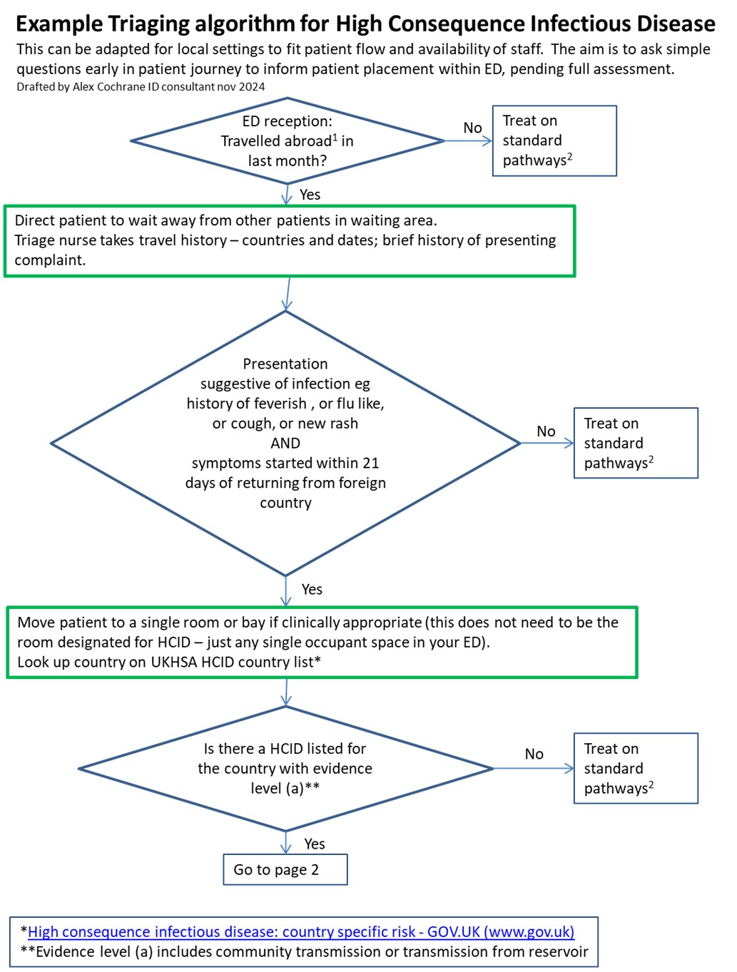
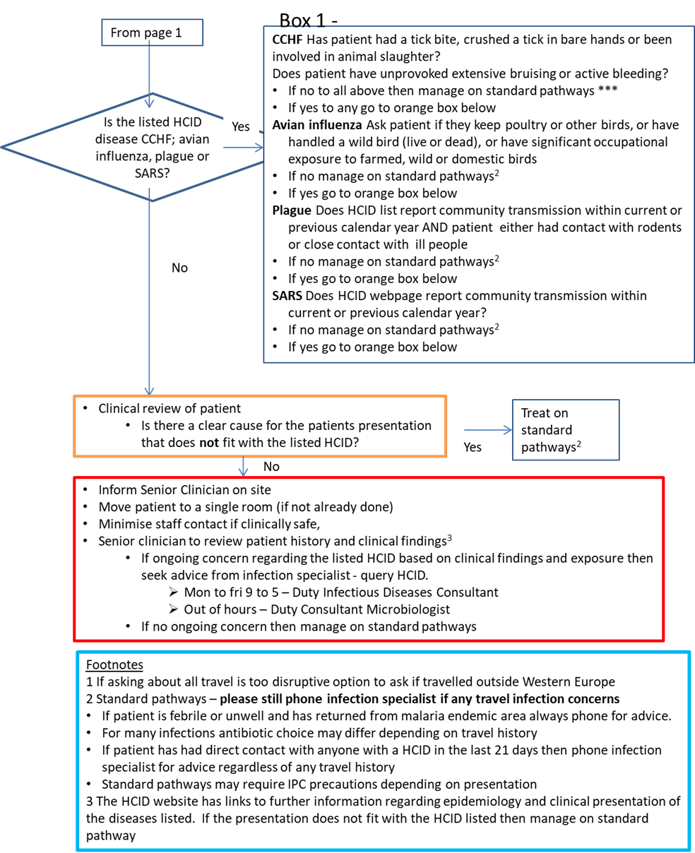
Additional resource: HCID risk assessment triage algorithm

Assess HCID risk:

  • If you have concerns call the Infection Specialist (see contacts).
  • If NO concerns regarding HCID, then leave this pathway and follow standard clinical care pathways.

NHS Highland HCID triage algorithm

Page 1

Page 2
Abbreviations

  • CPHM: Consultant in Public Health Medicine
  • ED: Emergency Department
  • EDTA: Ethylenediaminetetraacetic Acid
  • FBC: Full Blood Count
  • FFP3: Filtering Facepiece Respirator (Class 3)
  • GGC: Greater Glasgow and Clyde
  • HCID: High Consequence Infectious Disease
  • HSCP: Health and Social Care Partnership
  • ID: Infectious Diseases
  • IPC: Infection Prevention and Control
  • PAG: Problem Assessment Group
  • PCR: Polymerase Chain Reaction
  • PPE: Personal Protective Equipment
  • RIDU: Regional Infectious Diseases Unit
  • RGH: Rural General Hospital
  • SAS: Scottish Ambulance Service
  • SORT: Specialist Operations Response Teams
  • U&E: Urea and Electrolytes

Editorial Information

Last reviewed: 01/10/2025

Next review date: 31/10/2028

Author(s): Infectious Diseases Department.

Version: 1.1

Approved By: TAM subgroup of the ADTC

Reviewer name(s): A Cochrane: Consultant in Infectious Diseases and Microbiology.

Document Id: TAM736