

 TAM (Treatments and Medicines) NHS Highland
Pathway step |
ACTION |
|
|
1 |
Patient identified as needing assessment for HCID
|
Place patient away from other people and continue assessment by phone.
|
|
2 |
Take full travel and presentation history by phone |
|
| 3 |
If concern re possible HCID, discuss with Infection Specialist |
|
|
4 |
Suspected HCID: Next steps
|
All staff MUST follow role-specific action cards:
|
|
5 |
Patient stepped down or transferred to Regional Infectious Diseases Unit |
|
High consequence infectious disease (HCID) pathway (Guidelines)

Warning
What's new / Latest updates
26/01/2026: Minor modifications for clarity, including to action cards.
- Action card source document is now HCID-NHSH patient pathway version 1.2_210126
- HCID clinical pathway: Quick reference guide: Suspected HCID next steps: Added: 'Key personnel informed of the patient', 'See: communication cascade'. Removed: 'Arrange transfer' & duplication of information.
- Infection specialist assessment: Details added re communication with lead clinician
- Removed as duplication: 'NHS Highland triage algorithm or national resources High consequence infectious diseases (HCID) can be used to assess risk for HCID'.
- Patient designated as 'suspected HCID': next steps: Added: List of roles who have action cards. Removed as duplication: 'Roles and responsibilities'
- Section removed as duplication: 'Ongoing management of suspected HCID Roles, responsibilities and actions'
- Action Card 1: Name changed from: Suspected HCID ongoing management: Attending Health Care Professional, To: Suspected HCID ongoing management: Lead clinician for the patient (Usually GP or Consultant)
31/12/25: Minor modifications made to improve the readability of the guidance:
- Direct contact details for Argyll & Bute Infection and Control nurses have been removed. Generic contact details to be added.
- Advice regarding patient with suspected HCID using ward phone (to be wrapped in plastic) has been added.
- Advice added under 'History taking and 'remote assessment' on when to leave the pathway (if no concern re HCID).
- Additional face to face assessment information has been removed as extraneous information.
- Separate section on patient transportation removed as this information is elsewhere in the guidance.
- Section: 'Ongoing management of suspected HCID: Roles, responsibilities and actions' has been amended with explanatory text included for the terms used.
- Terms 'clean' and 'dirty' have been removed as these terms are obsolete.
Objectives
This pathway is for local implementation of national guidance to allow safe management of patients who may have a HCID.
Audience
- All NHS Highland
- Primary and Secondary Care
- Adults and Children
What is a HCID?
- High Consequence Infectious Diseases (HCIDs) are diseases that have been categorized as requiring high levels of infection control intervention to protect healthcare workers and public. They are listed here: High consequence infectious diseases (HCID) - GOV.UK
National guidance:
- High consequence infectious diseases (HCID) - GOV.UK: Contains background information, including a list of HCIDs by country.
- For infection control advice see: National Infection Prevention and Control Manual: Addendum for High Consequence Infectious Disease (HCID)
Example scenario: the possibility of a HCID has been raised (for example, due to travel history) but more detailed risk assessment for HCID is pending.
Where the patient presents |
Patient placement |
| Community |
|
| Primary Care |
|
| Secondary Care ED / Outpatient setting |
|
| Inpatient setting |
|
| Notes |
|
Infection specialist to decide whether case should be managed as a suspected HCID or not.
This may require further telephone assessment of the case, and discussion with Imported Fever Service.
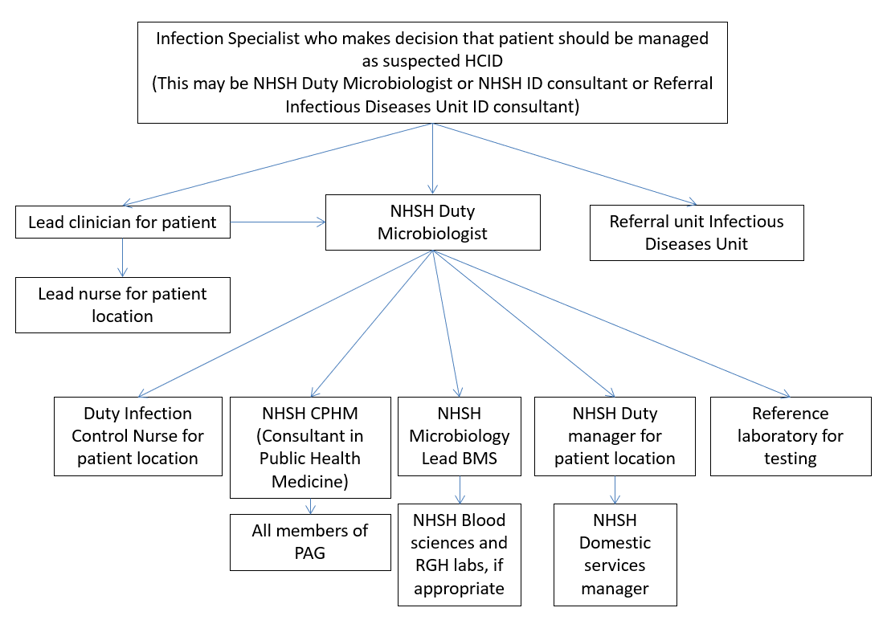
If patient IS suspected HCID, the infection specialist MUST:
- Tell the lead clinician for the patient (usually the GP or Consultant) that “the patient is to be managed as suspected HCID”
- Tell the lead clinician that this is a high impact situation, which is likely to have knock-on effects to service delivery
- Signpost the lead clinician to their action card and inform them that they need to follow all the actions to ensure effective management and communication
- Follow the actions in own Action Card
If patient is NOT to be managed as suspected HCID:
- Then revert to standard pathways
- Inform lead clinician of decision and advise them to discuss with infection specialist over subsequent days if ongoing concern.
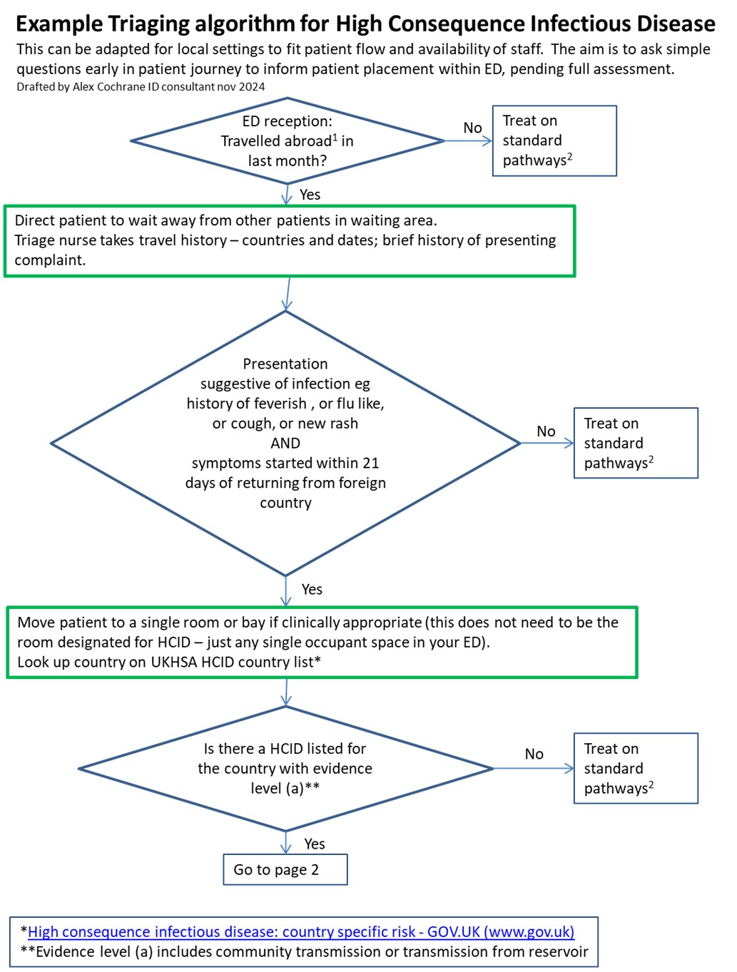
Assess HCID risk:
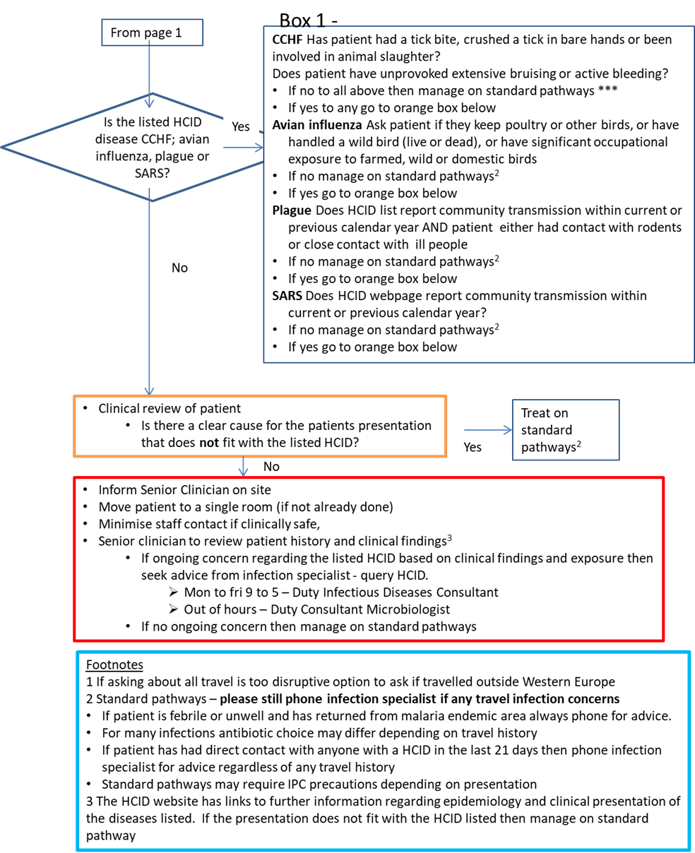
- Follow the NHS Highland HCID triage algorithm below
- Or national resources High consequence infectious diseases (HCID) - GOV.UK.
- If you have concerns call the Infection Specialist (see contacts).
- If NO concerns regarding HCID, then leave this pathway and follow standard clinical care pathways.
NHS Highland HCID triage algorithm
Page 1
Page 2
- CPHM: Consultant in Public Health Medicine
- ED: Emergency Department
- EDTA: Ethylenediaminetetraacetic Acid
- FBC: Full Blood Count
- FFP3: Filtering Facepiece Respirator (Class 3)
- GGC: Greater Glasgow and Clyde
- HCID: High Consequence Infectious Disease
- HSCP: Health and Social Care Partnership
- ID: Infectious Diseases
- IPC: Infection Prevention and Control
- PAG: Problem Assessment Group
- PCR: Polymerase Chain Reaction
- PPE: Personal Protective Equipment
- RIDU: Regional Infectious Diseases Unit
- RGH: Rural General Hospital
- SAS: Scottish Ambulance Service
- SORT: Specialist Operations Response Teams
- U&E: Urea and Electrolytes