Warning

Audience

  • North NHS Highland only
  • Primary and Secondary Care
  • Adults and Children
Lyme disease is more common in Highland than in other regions of the UK, so clinicians should have a high index of suspicion.

Lyme disease is caused by infection with Borrelia burgdorferi, a bacteria transmitted by tick bite.

  • In Highland ticks capable of transmitting Borrelia burgdorferi are found in:
    • Heathland
    • Woodland
    • Grassland, including gardens and parks.

NOTE: Patients often don’t remember the tick bite

Lyme disease should be considered in ALL patients with compatible clinical presentation who have been exposed to tick habitat over the relevant timeframe. Timeframe differs for early versus late manifestations of Lyme disease so, depending on the clinical presentation, it may be relevant to ask about tick habitat exposure over many years.

Lyme disease affecting skin: Erythema migrans (EM)

Presentation

  • EM is an early manifestation of Lyme disease, usually occurring between 3 and 30 days after tick bite (but the tick bite is often not remembered)
  • The lesion starts from a macule or papule and expands over a period of days to weeks to form a red or bluish-red patch, with or without central clearing. Usually reaches more than 5cm within a week of appearing.
  • EM is often NOT the ‘text book’ target lesion.
  • Multiple EMs can occur
  • EM may be associated with systemic features of infection such as fatigue, headache, arthralgia, myalgia (full list in NICE guideline); but lack of these should not put you off the diagnosis.
  • Insect bites, including tick bites can produce a hypersensitivity reaction, which usually appears in the first 48 hours, and are often raised and itchy. Unlike erythema migrans, these bite reactions do not usually continue to expand after 3 days post appearing.

See NICE NG95: lyme-disease-rash-images (nice.org.uk)

Diagnosis

Diagnosis should be made based on clinical features and exposure history, and rashes likely to be EM should be treated. If rash not suggestive of EM early after a tick bite it is reasonable to observe for evolution of the rash.

Blood tests are NOT routinely indicated as often negative in early stages.

Discuss atypical rash with Dermatology or Scottish Microbiology Reference Laboratory, Lyme disease and tick-borne infections: nhs.SMIRL@nhs.scot, sending a photo of rash, if available. 

Skin biopsy from the expanding edge of the rash can be sent to Scottish Microbiology Reference Laboratory: Lyme disease and tick-borne infections for Borrelia PCR (inform laboratory prior to sending). A positive result confirms the diagnosis of Erythema migrans, but a negative result DOES NOT exclude it.
Lyme disease affecting the skin: Borrelia lymphocytoma (uncommon)

Presentation

This is an early manifestation of Lyme disease, usually appearing within 6 months of tick bite.

Diagnosis

  • Blood tests for Lyme disease (serum for Borrelia IgG and IgM). This is normally positive on presentation, if negative repeat in two to four weeks.
  • Discuss with paediatrician or dermatologist. Biopsy often indicated to exclude other serious diagnoses.

Lyme disease affecting the skin: Achrodermatitis chronica atrophicans (ACA)

Presentation

This is a late manifestation of Lyme disease, often appearing years after infection. 

NB: Difficult to differentiate from common skin changes of old age

Diagnosis

  • Blood test for Lyme disease (serum for Borrelia IgG). Borrelia IgG will be present at high level.
  • Skin biopsy for histology and borrelia PCR may be indicated.

Lyme disease affecting the nervous system (neuroborreliosis)

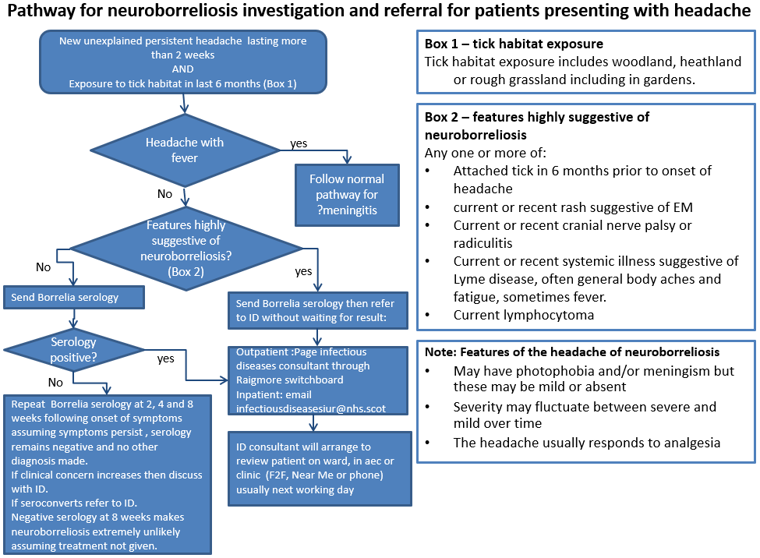
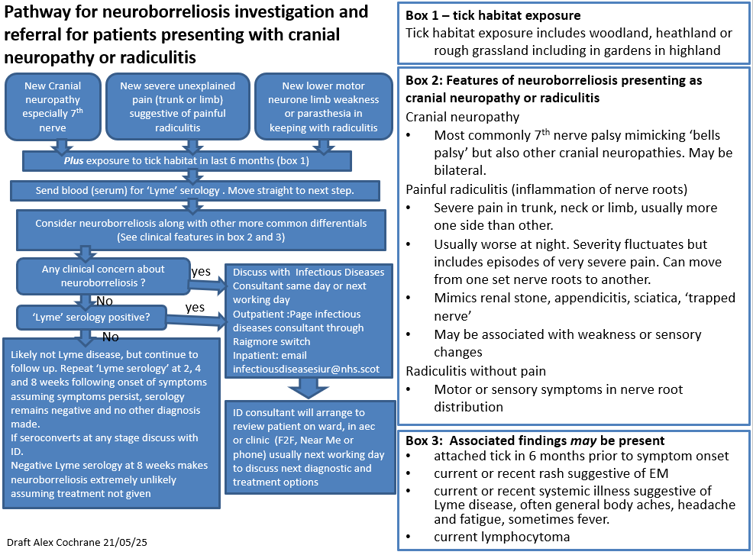
Lyme disease can affect different regions of the nervous system. This is usually in the first 6 months after the tick-bite, though the tick bite may not be remembered. Some rarer manifestations may occur later. Prompt treatment (within a few days of presentation) can improve outcome.

Common manifestations

  • Cranial nerve neuropathy (most commonly 7th nerve, mimicking Bells Palsy)
  • Headache: caused by Lyme meningitis
  • Radiculitis (inflammation of nerve roots causing severe pain, with or without sensory or motor deficit)
  • Patients  often present with two or more of the above manifestations.

Rare manifestations (outside the scope of this guidance)

  • Mononeuritis multiplex
  • Myelitis or encephalitis
  • Peripheral neuropathy (associated with the skin manifestation ACA)

Associated symptoms

  • Patients with neuroborreliosis may have a current or recent EM rash, and may describe recent or current non-specific symptoms such as general body aches and fatigue. See: NICE NG95: Lyme disease for fuller list of non-specific symptoms associated with Lyme disease. 

Diagnosis

Diagnosis is not straightforward as Lyme disease is one of many causes for these presentations, and blood tests are not always helpful in early stages. See sections below for clinical pointers and referral pathways for each manifestation. 


Lyme disease affecting the heart

Lyme disease can rarely cause conduction abnormalities, most often heart block. Myocarditis and pericarditis have also been reported. Concerns about serious cardiac manifestations of Lyme disease should be discussed with a cardiologist.

Lyme arthritis

Lyme arthritis manifests as acute or subacute inflammation of large joints (mono or oligoarthritis), often presenting with a relapsing and remitting course. The commonest presentation is with a painful knee with effusion, with or without acute inflammation. It can mimic inflammatory arthritis, gout, osteoarthritis or a mild septic arthritis.

It is classically a late manifestation of Lyme disease, so the tick bite may have been years previously. The patient is Borrelia IgG positive, unless significant immunosuppression .

Clinical pathway for diagnosis in Primary Care, Orthopaedics & Rheumatology

Acute or subacute or recurrent mono or oligoarthritis of large joint (knee, hip, ankle, elbow, shoulder)?

If NO:

  • Lyme arthritis unlikely, manage as per standard practice.

If YES:

Exposure to tick habitat in the 10 years prior to onset of symptoms (includes almost everyone living or working in Highland)?

Tick habitat in Highland includes woodland, moorland and rough grassland, including gardens. 

If NO: 

  • Lyme arthritis unlikely, manage as per standard practice.

If YES: 

Consider Lyme arthritis alongside other differentials

  • Send blood (serum) for Lyme disease (the test done will be Borrelia burgdorferi IgG/IgM)
  • If aspirating the joint for other reasons before Borrelia serology result available: send joint fluid for Borrelia PCR 

If Borrelia IgG is positive:

  • Email Infectious Diseases through the IUR nhsh.infectiousdiseasesiur@nhs.scot with patient name, CHI and clinical details. Infectious Diseases will then follow up and advise on treatment.
  • If effusion present and referrer competent to aspirate joint: send joint fluid for Borrelia PCR, as well as other relevant tests, depending on differential diagnosis.  
  • Continue to consider other differentials. The Borrelia IgG may be historic and does not confirm Lyme arthritis. 

If Borrelia IgG is negative:

  • This is NOT Lyme arthritis, manage as per standard practice. 
  • In profound immunosuppression Borrelia IgG may be falsely negative: discuss with Infectious Diseases. 

Joint fluid for Borrelia PCR

Lyme arthritis can be confirmed by detecting Borrelia burgdorferi by PCR in joint fluid or synovial biopsies. The test is very specific but not very sensitive (ie it can rule in but cannot rule out Lyme arthritis). It is indicated for patients with clinical Lyme arthritis who are Borrelia IgG positive in blood. 

  • Send an aliquot of joint fluid to microbiology and include “query Lyme disease” in the clinical information, and “Borrelia PCR” in the test request box.
  • If Borrelia serology is pending at time of joint aspiration the lab will store the joint fluid until serology result available.

Borrelia infection presenting with non-specific symptoms

Infection with Borrelia borgderferi can cause ‘flu-like’ non-organ specific symptoms. As per NICE NG95; where such symptoms persist they should prompt investigation for Borrelia infection. 

Management

  • Erythema migrans is usually managed in primary care
  • Non-erythema migrans is usually managed in secondary care, or in primary care after consultation with secondary care.
  • Antibiotics: information and follow up as below and Overview | Lyme disease | Guidance | NICE
  • Provide patient information on avoiding tick bites and looking for and removing attached ticks
  • If child: seek paediatric opinion unless single EM with no systemic symptoms (NICE NG95)

Antibiotic treatment

NICE Guideline (NG95) on diagnosis and treatment of Lyme disease (April 2018). 

The antibiotic guidance has been summarised in a useful infographic by the BMJ but please refer to the full NICE Guidance for additional information.

Please note the high doses of amoxicillin throughout and the higher dose of doxycycline for CNS disease.
  • In children (people under 18) discuss management of Lyme disease with a specialist, unless they have a single erythema migrans lesion with no other symptoms. See NICE recommendation 1.3.2.
  • Children weighing above the specified amounts, but under the age of 12, should be treated with the dose for adults and children aged over 12 years.
  • Ask women (including young women under 18) if they might be pregnant before offering antibiotic treatment for Lyme disease (see NICE recommendation 1.3.18 on treatment in pregnancy).
  • For Lyme disease suspected during pregnancy, use appropriate antibiotics for stage of pregnancy.
Erythromycin should NOT be used to treat Lyme disease.

Persisting symptoms after treatment

Referral to ID and expert advice

  • ALL patients with possible neuroborreliosis: Referred to ID (see clinical pathway above)
  • ALL patients with likely Lyme arthritis (clinical findings and positive Borrelia burgdorferi IgG): Discuss with ID
  • ALL patients with Lyme carditis: Refer to cardiology. Cardiologists to discuss with ID
  • Children with any Lyme disease manifestation other than EM without systemic symptoms: Seek advice from paediatricians (NICE NG95: Lyme disease)

Urgent referral to Infectious Diseases: Page ID Consultant on call through Raigmore switchboard.

Non-urgent referral is by standard pathways

Clinical and diagnostic advice can also be obtained from Scottish Microbiology Reference Laboratory: Lyme disease and tick-borne infections nhs.SMIRL@nhs.scot  

Tick bites: removal and statement on antibiotic prophylaxis

Attached ticks should be removed as soon as they are found.

Early removal reduces the risk of infection. They can be removed using a plastic tick removal device (preferred) or, if this is not available, then use fine point tweezers or finger nails. Try to avoid squeezing the tick's body during removal.

This is achieved by the plastic tick removal devices, which are designed to get under the tick and lift it off. Alternatively get the fine tips of tweezers or fingernails under the tick's body, close to the skin, and pull tick off. See video on NHS inform: How to remove ticks.

Note: community pharmacy staff can provide advice on tick removal but they do NOT offer a tick removal service. 

In some countries antibiotic prophylaxis is recommended after a tick bite, and patients may ask for this. In the UK antibiotic prophylaxis is not currently recommended by NICE due to assessment of the benefit versus harm of this approach. See 'What advice should I give to a person bitten by a tick?': Scenario: Management | Management | Lyme disease | CKS | NICE.

Further information on the rationale behind this is available in: Prophylactic antibiotics for tick bites: the Pink One edition no 138 Spring 2025.pdf (NHS Highland intranet access required).

Patients may also ask for the tick to be tested to see if it is carrying Borrelia burgdorferi (the cause of Lyme disease). This is NOT currently offered, or recommended, as positive results do not necessarily mean a person has been infected, and negative results may offer false reassurance. See: What to Do After a Tick Bite | Ticks | CDC.

Patient asking about tests not available on NHS or 'co-pathogens'

See NICE NG95 (section 1.2.22 and 1.2.23), which provides advice on Lyme testing outside the NHS.

Patients may ask about ‘lymphocyte activation tests’, you can signpost them to a animation on the Victory study conducted in Europe, which showed these tests to be unreliable: Victory English on Vimeo

Patients often ask to be tested for ‘co-infections’. Tests for a wide range of tick borne diseases are available on the NHS, but tests are only indicated if the patient’s symptoms fit the clinical characteristics of the disease in question. Further advice can be obtained from Scottish Microbiology Reference Laboratory: Lyme disease and tick-borne infections nhs.SMIRL@nhs.scot 

Patient information

Editorial Information

Last reviewed: 27/02/2025

Next review date: 29/02/2028

Author(s): Infectious Diseases.

Version: 1.1

Approved By: TAM Subgroup of the ADTC

Reviewer name(s): Dr A Cochrane, Consultant in Infectious Diseases and Microbiology, Dr J Douglas, GP, A Macdonald, Area Antimicrobial Pharmacist.

Document Id: TAM676

References