Warning

Audience

  • All NHS Highland
  • Primary and Secondary Care
  • Adults only

Parkinson’s disease is a neurological disease affecting mobility, mood and the autonomic nervous system. It can have an impact on movement and function, mental health and other ‘non motor’ aspects (bladder, bowel, blood pressure, cognition etc) in varying amounts between individuals.

Referral

Key Points for referral of person suspected to have Parkinson’s

  • Refer people with suspected Parkinson’s disease (PD) early, before beginning treatment, to a clinician with relevant expertise, who should be involved in both initiation and ongoing monitoring of drug therapy.
  • All patients given a diagnosis of Parkinson’s disease should have an early referral to the Parkinson’s nurse team.

Referral:

Adults under the age of 65 years with suspicion of PD: refer to Neurology Outpatients Clinic, to be seen in Raigmore Hospital.

Adults over 65: in general, should be referred to Older Adult Medicine, who have Parkinson’s clinics held at Caithness General Hospital, Wick, Raigmore Hospital, Inverness and County Hospital, Invergordon and Fort William and in peripheral clinics, eg Skye.

The PD service for patients from Argyll & Bute H&SCP is shared between Dr Jamieson (over 65s) and GGC.

  • Therapy for PD should be multi-disciplinary; drug treatment is only one aspect; physiotherapy, speech and language therapy, occupational therapy, pharmacy and other disciplines may be involved.
  • Drug treatment of PD aims to alleviate the symptoms whilst seeking to reduce the potential to develop dopaminergic complications.
  • A clinician with expertise in PD should be involved in drug treatment decisions on the initiation and ongoing monitoring of therapy as the disease progresses. Drugs used in the treatment of PD are detailed in the Highland Formulary.
  • Tremor generally responds poorly to most drugs. Expectations need to be created at the outset.
Common conditions and medicines that can worsen Parkinson’s

Nausea and vomiting 

Domperidone is now no longer recommended for long-term use, however in some patients with PD the benefits may outweigh the risks. Prescribe after an ECG has been completed.

Domperidone is associated with a small increased risk of serious side-effects and is now contra-indicated in those with underlying cardiac conditions and other risk factors, see Gov Drug safety update: Domperidone, risk of cardiac side effects. In patients with PD it is useful as an antiemetic and to treat orthostatic hypotension, please discuss with a specialist before discontinuing treatment and for further information see Association of British Neurologists (ABN) advice

Other antiemetics may cause worsening of PD symptoms, including metoclopramide and prochlorperazine.

Dizziness and instability 

Balance disturbances are common in PD and unlikely to respond to treatment; consider hypotension,  drug treatment may be used with caution, in particular avoid prochlorperazine. Referral to physiotherapy may be indicated.

Depression 

For patients on monoamine-oxidase-B inhibitors (eg selegeline) consider mirtazapine as first-line therapy. Local preference.

Correct formulations 

Ensure accurate prescribing of all modified-release (m/r), immediate release (IR), dispersible and combination preparations (Stanek / Stalevo). Doses of MR and immediate-release preparations are not interchangeable.

Confusion and hallucinations 

Patients with Parkinsonian syndromes have a lower threshold for confusion and hallucinations; if these symptoms develop consider drug-related causes, the standard medical causes of delirium and the need for specialist referral. If patients have significantly disturbed or distressing behaviour, antipsychotics such as haloperidol should be avoided. If necessary, lorazepam may be used- see SIGN annex 4 ?
Dementia is common in PD; see treatment guidance in Shared care guidelines for prescribing cholinesterase inhibitors and memantine for dementia 

Anti-cholinergics

There is a particular risk of confusion with anticholinergics see cholinergic burden (see resources). In symptoms of veractive bladder use drugs that have the least anticholinergic properties, with regular review for efficacy. www.acbcalc.com

Orthostatic hypotension

Measure postural blood pressures in patients presenting with light-headedness or dizziness. Advise simple measures as first-line treatment:

  • 2 litres fluid daily
  • compression stockings
  • raise head of the bed by 15 degrees.
  • Avoid large meals and alcohol
  • Increase salt intake

Review antihypertensives, and consider other medicines which can lower BP e.g. tamsulosin;  often in PD, BP levels reduce over time and medication may not be required. See Post-fall medication review (Guidelines) | Right Decisions

Medicines to consider: Midodrine, fludrocortisone (or domperidone, can be considered under specialist advice [off-label].)

Orthostatic hypotension (Guidelines)

Excess salivation

Speech and language therapy can help as there tends to be an associated swallowing problem. Oral application of atropine sulfate drops 1% may be helpful [off-label]. See also: Saliva management: sialorrhoea (Guidelines).

Inpatient management

Parkinson's disease is associated with an increased risk of complications for inpatients and an increased length of stay in hospital, which can be averted with good care.

If you need advice on the management of someone with Parkinson’s, please contact: nhsh.mfte@nhs.scot


Medication

Parkinson's medicines are TIME CRITICAL MEDICINES

See: Time critical medicines (Guidelines)

Note: If compliance of Parkinsons’ medicines is NOT achieved, this will impact on mobility, swallowing, communication, eating independently, mood and anxiety, along with general function in activities of daily living.

  • In hospital, it is important that Parkinson’s medications are given at the times patients take them at home.
  • The drug prescription chart should reflect patients’ usual drug timings rather than the hospital drug round timings.
  • Parkinson’s medicines need to be prescribed as the correct preparation and dosage, as well as at the correct timing. MR, IR, and dispersible preparations are available.
  • Sometimes the use of an audible alarm for nursing staff may be an effective way to achieve compliance, if medicines are to be administered out with routine hospital drug round timings.

Medication that can worsen Parkinson’s or cause delirium:

  • Metoclopramide, prochlorperazine (Buccastem®), promethazine, codeine, dihydrocodeine, tramadol, antipsychotics e.g haloperidol
  • Caution with anticholinergics e.g. oxybutynin, cyclizine, chlorpheniramine. See Polypharmacy guidance: Anticholinergics | Right Decisions

Blood pressure

  • Be aware that hypotension/ postural hypotension is common as part of the autonomic dysfunction in Parkinson’s. This may require the reduction or discontinuation of antihypertensives.

Management of nausea

  • Consider reason for nausea; medications and constipation are often involved.
  • The choice of antiemetic is limited because of adverse effects.
    • Domperidone could be used after ECG completed.
    • Ondansetron may be indicated depending on the cause of the nausea but is associated with severe constipation. It is contraindicated in patients prescribed apomorphine and used with caution in patients with cardiac issues.

General care

In people with Parkinson’s be aware that there is a higher risk of:

  • Delirium, especially if it has occurred before. If it develops look for common triggers: constipation, urinary retention, infection, pain, medication changes.
  • Swallowing difficulties and excess salivation
  • Orthostatic hypotension
  • Urinary difficulties
  • Constipation

Acute deterioration of Parkinson’s symptoms suggests acute illness, missed medication or new medication acting as dopamine blockade.


Other complications associated with Parkinson’s

Falls 

  • are multifactorial, and can relate to many issues including postural instability, freezing, postural hypotension, osteoarthritis and cognitive deficits.
  • Physiotherapy input is essential; walking aids may or may not be relevant.
  • A medication review after a fall is required. Post-fall medication review (Guidelines) | Right Decisions

Neuroleptic malignant syndrome 

  • may occur on withdrawal of medication or if medication is missed.
  • It can present with delirium, (either hyper or hypo-active) rigidity, fever, and dysautonomia (tachycardia, fever, hypertension or labile BP, sweating).
  • CK may be elevated.
  • It can be fatal.

Dyskinesia:

  • involuntary movements which may be normal for a patient.
  • It may indicate that they are receiving higher doses of medication than normal, or absorption of medicines is different.

Surgery

Place patients first on operating list where possible, ensure usual morning medication given.
  • Consider duration of surgery and consequences of missed doses and when oral medication can resume.
  • Pre-assessment: consider medication compliance and whether temporary use of a rotigotine patch to cover period of surgery is required.
  • Post-operatively: it is important to consider the need for early physiotherapy, hydration and nutrition, along with a healthy bowel habit.
  • Medication: ensure good concordance pre-admission and maintain this throughout admission.
  • Elective admissions: It is important to consider how to maximize an individual’s health pre-admission. This should take consideration of a general medical review, including nutrition, hydration, mobility and function, and cognition. 

Advanced treatments for Parkinson’s

Seek advice from the relevant Parkinson’s team, as required.

Deep Brain Stimulation (DBS)

  • Deep Brain Stimulators are used in people with Parkinson’s and sometimes severe tremors. MRI scan is contraindicated.  Monopolar diathermy has been used with caution in patients with a DBS implanted, see manufacturer’s advice. (Heating of electrodes may occur and has resulted in 2 documented cases of severe neurological damage with coma.)

Apomorphine

  • Apomorphine is a potent dopamine agonist given by subcutaneous injection. There are small numbers of people where it is prescribed either in intermittent injection or with a pump. It is not normally used in the short term as a replacement therapy.
  • If the patient is able to self-administer with their own pump, then this is the best option. If the patient is not able to self-administer, apomorphine runs in mL/hr and routine hospital pumps can be used at the same rate as pre-admission.
  • Apomorphine is stocked in pharmacy, if the patient is not able to bring in their own. This is a time critical medicine so would require to contact the on call pharmacist if out of hours.
  • Rotation of injection sites is routine to avoid skin reactions.

Duodopa®

  • Intrajejunal levodopa infusion. There are frequent difficulties with equipment failure/ tube dislodged.
  • This is a non-formulary medicine that is not stocked at Raigmore Hospital. The patient will need to provide their own Duodopa®.
  • Continue at prescribed rate, providing gastric emptying is not delayed and the PEJ tube is patent.
  • Individual patients should have their own protocols for conversion to oral medications if Duodopa® is unable to be administered and they retain a safe swallow. Check recent clinic letters for dosing switch to oral medication.
  • For patients who's Duopdopa® system is not functioning, and who are unable to take medication effectively by the oral route, rotigotine transdermally can be initiated at a dose calculated from the PDmedcalc. The conversion will be from the dose of levodopa described on their clinic letter.

Produodopa®

  • Subcutaneous infusion of foslevodopa / foscarbidopa administered via pump over 24 hours. This runs in mL/hr, and routine hospital pumps can be used if a patient is not able to self-administer.
  • This is a non-formulary medicine that is not stocked at Raigmore Hospital. The patient will need to provide their own Produodopa®.
  • Rotation of injection sites is routine to avoid skin reactions.
  • Individual patients should have their own protocols for conversion to oral medications if Produodopa® is unable to be administered and they retain a safe swallow - check recent clinic letters for dosing switch to oral medication.
  • For patients whose Produodopa® system is not functioning, and who are unable to take medication effectively by the oral route, rotigotine transdermally can be initiated at a dose calculated from the PDmedcalc. The conversion will be from the dose of levodopa described on their clinic letter.

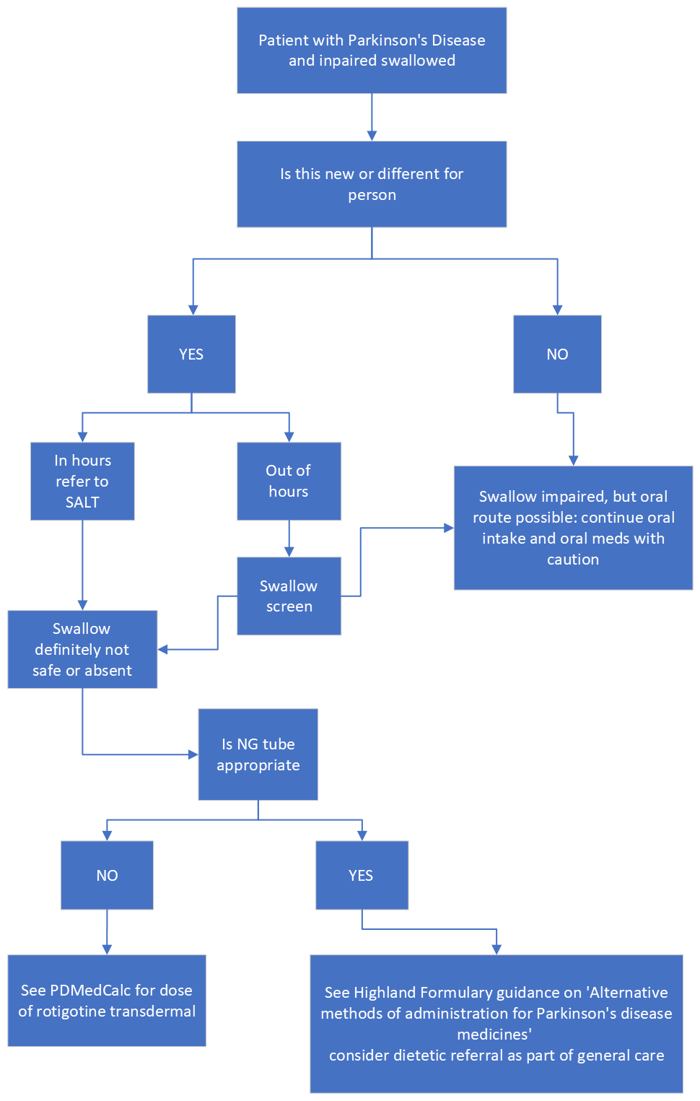
Impaired oral intake

Patients who are unwell may be deemed ‘nil by mouth’ if awaiting surgery or investigations, or their swallow may not be effective due to their Parkinson’s, an acute illness or general weakness and frailty.

Appropriate referrals should be made to the SLT and Dietetics teams

Every effort should be made to ensure that Parkinson’s medicines are NOT stopped abruptly.

Advice is given below on:

  • How to switch from oral tablets or capsules to dispersible forms of Levodopa to be administered via nasogastric tube.
  • How and when to convert to a transdermal dopamine agonist patch.
  • To establish which medications are suitable to be given via a nasogastric tube, see section on 'Administration via enteral feeding tubes or for those with an impaired swallow'. 

Any patients undergoing a switch away from their normal medication should be referred to the relevant Parkinson’s team for a review within one working day of admission.

Medicine for the Elderly contact details: nhsh.mfte@nhs.scot 

Advice for patients with no oral route available

  1. If NG tube appropriate: see section on 'Administration via enteral feeding tubes or for those with an impaired swallow' and refer to the PDMedCalculator
  2. If NG tube not appropriate: convert levodopa and dopamine agonists to rotigotine patch by referring to the PDMedCalculator 
  3. Other Parkinson’s medication
    • MAOIbs such as rasagiline and selegiline can be withheld for short periods of time if necessary.
    • Opicapone is not essential in the acute situation and can be withheld.

Rotigotine patches

The conversions are estimates and clinical review of patients is always necessary to achieve maximal benefit of medication. In particular, people with delirium and dementia are likely to need lower doses to avoid worsening confusion.

  • Prescribe as 24-hour patch.
  • Round to nearest 2mg (to max of 16mg).
    • Patches available as 1mg/2mg/3mg/4mg/6mg/8mg strength.
    • More than one patch can be applied.
    • DO NOT cut patches.
  • Review rotigotine patch after 72 hours at the latest:
    • Consider whether return to routine medication achievable.
    • If changing back to oral medication, remove rotigotine patch at the time of the next oral Parkinson’s medication.
  • If new prescription, DO NOT discharge from hospital on rotigotine patch, unless PD team aware.

Administration via enteral feeding tubes or for those with an impaired swallow

The table below gives information on changing medicines to an alternative formulation e.g capsules to dispersible tablets when the patient has a reduced swallow or if a feeding tube has been inserted.

  • This is general information and may not apply to all patients. If necessary, seek advice from the prescriber, specialists or Medicines Information.

Administration by enteral feeding tube

  1. Flush enteral feeding tube with 15 to 30mL water.
  2. Crush and/or disperse tablet in 10 to 15mL water (or more if required).
  3. Immediately administer dose using an oral syringe.
  4. Rinse crusher, medicine pot and syringe with 10mL water and administer rinsing fluid.
  5. Re-flush enteral feeding tube with 15 to 30mL water.
  6. Flush tube between each medication and at the end.
  • Use tap water to flush enteral feeding tubes.
  • For administration beyond the stomach sterile water is advised.
  • In fluid restricted patients revise the recommended flush volume to meet prescribed fluid restriction.

Notes:

  • Always clearly prescribe the route of administration, eg ‘crush tablet and give by nasogastric (NG) tube’.
  • Crushing or dispersing non-dispersible tablets means that the medicine will be administered outwith the terms of its product license with liability being assumed by all those involved in the medicines administration process, including prescriber, dispensing pharmacist and nurses administering the medicine.
  • Use tablet crushers designed specifically for this purpose, these can be obtained through PECOS system.
  • Where tablets are dispersed ensure that the whole tablet content is rinsed from tablet crushers, medicine pots and oral syringes and administered to the patient.
  • Poorly soluble, crushed tablets may pose an aspiration risk for patients with swallowing difficulties. Aim for a liquid with a uniform consistency.
  • Crush or disperse tablets immediately prior to administration.
  • The information in the table has been obtained from a variety of resources including the manufacturer, NEWT guidelines and Drug Administration via Enteral Feeding Tubes.

Covert medication is the administration of medication in a disguised form without the individual’s knowledge.  This is a clinical decision and should NOT be used for someone capable of deciding about medical treatment.  To avoid this, advise the individual that they are receiving their medication by NG, PEG, patch, etc.  If they do not have capacity or are unconscious this may need to be discussed with their welfare attorney or guardian. See Policy for the Administration of Medicines by Nurses and Midwives in NHS Highland.

Administering medicines via an enteral feeding tube or orally in patients with an impaired swallow

Drug 

Alternative methods of administration

Notes
Ropinirole tablets (Requip®)

Tablets can be crushed and mixed with water or soft food for patients with swallowing difficulties.

The tablets can be crushed and mixed with water for administration via enteral feeding tubes.

Tablets rapidly disintegrate when placed in 10mL water to give a fine dispersion. Administer immediately after preparation.
Ropinirole modified-release tablets (Requip® XL) Change to immediate-release ropinirole tablet For conversion to immediate-release tablets, split total dose in 3 and prescribe three times a day

Pramipexole tablets

(Mirapexin®)
Tablets may be crushed and mixed with water for oral administration or enteral feeding tubes. The tablets are light sensitive and should be administered shortly after crushing.
Pramipexole modified-release tablets (Mirapexin Prolonged-Release®) Change to immediate-release pramipexole tablets For conversion to immediate-release tablets, split total dose in 3 and prescribe three times a day
Domperidone tablets

Use oral suspension

or tablets will disperse in water or can be crushed and mixed with water for oral use or enteral feeding tube administration.
The suspension should be diluted with an equal volume of water for administration via enteral tubes. Suspension contains sorbitol.
Co-beneldopa dispersible tablets (Madopar®)

Dispersible tablets can be dispersed in water and given via enteral feeding tubes.

The dispersible tablets can be crushed and given on soft food.

As absorption of the medicine is affected by food, it is important that if this method of administration is chosen, it is used consistently.
Tablets disperse in 10ml of water within 2 minutes to give a cloudy  dispersion. Administration after food may delay/reduce absorption of levodopa. See notes below regarding enteral administration of preparations containing levodopa.
Co-beneldopa immediate release capsules (Madopar®)

Use dispersible Madopar® tablets

Madopar® capsules and dispersible tablets are dose equivalent. Onset of action may be quicker for dispersible tablets; monitor the patient for any change in effect due to altered bioavailability.

It may be appropriate to prescribe a small "when-required" dose to cover any unexpected "on-off" effects.

See notes at end regarding enteral administration of preparations containing levodopa.
Co-beneldopa modified-release capsules (Madopar® CR)

Change to equivalent dosage of dispersible Madopar® tablets

It may be appropriate to prescribe a small "when-required" dose to cover any unexpected "on-off" effects. See notes below regarding enteral administration of preparations containing levodopa.

Co-careldopa tablets (Sinemet®)

Tablets can be dispersed in water

OR change to dispersible Madopar®

Lower strengths disperse within one minute. 25/250 strength disperses within one to 5 minutes. Give immediately when dispersed as the drug will degrade. The dispersed tablets may settle at the bottom of the container/syringe; ensure that the whole dose is administered. Direct dose conversion between Sinemet® and Madopar® may not be appropriate in all patients.

For conversion to Madopar®, withdrawal of therapy and retitration of dose may be necessary. Seek advice. See notes below regarding enteral administration of preparations containing levodopa.

Co-careldopa modified-release tablets

Change to immediate-release Sinemet® tablets and increase dosing frequency

or change to dispersible Madopar®

Direct dose conversion between Sinemet® and Madopar® is not directly equivalent, but is acceptable . See notes below regarding enteral administration of preparations containing levodopa.

Co-careldopa plus entacapone tablets (Stanek®)

Use the separate components    (co-careldopa and entacapone)

or change to dispersible Madopar®

See entries in table for administration of entacapone and co-careldopa

If changing to Madopar®, dose adjustments may be necessary, seek advice. See notes below regarding enteral administration of preparations containing levodopa.

Selegiline tablets

Disperse tablets in water or tablets can be crushed and mixed with soft food

Selegiline tablets can be dispersed in water and should disperse within one minute. This method is suitable for use with enteral feeding tubes or for patients with swallowing difficulties.

Rasagiline

Tablets may be crushed and mixed with water or soft food.

Crush and mix with water for enteral feeding tube administration.


Entacapone tablets

Tablets can be crushed and given in jam, honey, or orange juice or tablets can be dispersed in water.

Disperse in water for feeding tube administration.

Either place the tablet in a syringe with 10mL water and shake for 5 minutes or place in medicine pot with 10mL water and allow to disperse (takes 1 to 5 minutes). The dispersion is a bright orange colour and will stain enteral tubes, skin and clothing. Entacapone does not fully dissolve in water, so if giving via enteral feeding tube, the tube should be well flushed after administration. Avoid crushing tablets as this produces red dust which will stain. 

Amantadine capsules

Capsules may be opened and the contents mixed with water or soft food

or change to syrup

The capsules can be opened and the contents mixed with water for administration via enteral tubes.  

If the syrup is used, monitor total daily intake of sorbitol.

Notes: Problems with enteral administration of preparations containing levodopa (Madopar®, Sinemet®)

  • Levodopa is absorbed mainly in the jejunum. Administering directly to the site of absorption (J or NJ) may result in unexpected drug levels and side-effects.
  • High protein in the gut provided from enteral feed may alter absorption of levodopa and cause fluctuations in response to the drug. Drug administration should be consistent in relation to feed administration times.

Abbreviations

  • BP: Blood pressure
  • DBS: Deep brain stimulation
  • ECG: Echocardiogram
  • IR: Immediate release
  • MR: Modified release
  • PD: Parkinson's disease
  • SLT: Speech and language therapy

Editorial Information

Last reviewed: 11/06/2025

Next review date: 11/06/2028

Author(s): Medicine for the Elderly.

Version: 2

Approved By: TAM Subgroup of the ADTC

Reviewer name(s): Dr D Gray, Associate Specialist, A Warren, Pharmacist , S Sutherland, Parkinson’s Disease Specialist Nurse , Dr L Cormie, Consultant in Older Adult Medicine.

Document Id: TAM281

Related resources

Further information for Health Care Professionals

(Scroll down to see all references)

References

Further information for Patients

(Scroll down to see all information)

Self-management information