Suspected seizure: ED / AMAU (Guidelines)

Warning

Initial assessment

  • Clinical assessment according to ABCDE and manage in appropriate monitored area
  • Exclude hypoglycaemia and treat if present
  • If ongoing reduced conscious level: manage in appropriate area, involve senior and consider CT
  • If significant head injury: follow ED / NICE guidance: ED Head Injury Guidance (NHS Highland intranet access required)
  • If convulsive seizure lasting longer than 5 mins, or recurrent seizures without recovery in between: then treat according to: Prolonged seizure / status epilepticus in adults (Secondary Care) (Guidelines)

History and examination

Main aims of assessment:

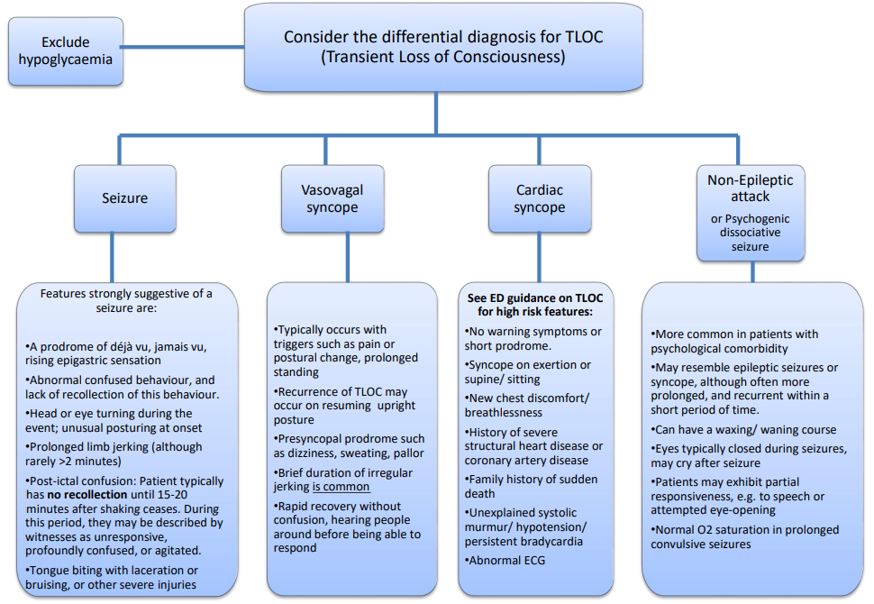
  • Distinguish an epileptic or psychogenic non-epileptic seizure from syncope: See diagnostic flow chart below, and ED TLOC guidance (NHS Highland intranet access required)
  • Identify whether the seizure is a symptom of an acute disorder, rather than the first presentation of epilepsy. See acute symptomatic seizures section.  
  • The diagnosis is usually made by taking a careful history.
    You may be the only person to get a clear history and eyewitness account. By the time the patient is seen in the First Fit clinic the story may be less accurate or complete.
  • All patients should have a physical examination, including neurological and cardiac examination.

Common causes of acute symptomatic seizures:

  • Intoxication with or withdrawal from alcohol: Unplanned alcohol withdrawal (Guidelines)
  • Recreational drugs such as cocaine or synthetic cannabis.
  • Overdose of prescribed medication e.g. tricyclic antidepressants.
  • CNS infection (meningitis, encephalitis): Consider in patients who are encephalopathic, have meningism or a fever.
    Note: simple febrile seizures DO NOT occur in adults.
  • Metabolic abnormalities, especially hyponatraemia and hypoglycaemia.
  • Acute intracranial pathology: Particularly head injury, intracranial bleed (or less commonly infarct),
    tumour.
  • Eclampsia

Differential diagnoses

Differential diagnosis flowchart

Investigations

Bloods:

  • FBC, UEs, Mg, Ca, LFTs including GGT, CK, CRP, glucose or BM.
    Note: a high WCC is common after a convulsive seizure, and does not necessarily indicate infection.

ECG:

  • ALL patients with loss of consciousness. Remember to note the QT interval

Neuroimaging:

CT head should be performed in the ED whenever an intracranial lesion is suspected:

  • New focal neurological deficit or signs of raised intracranial pressure
  • Persistent altered mental state
  • Fever or other signs of meningitis / encephalitis
  • Sudden onset or persistent headache
  • Focal or partial onset before generalization
  • Head injury
  • History of malignancy
  • Immunocompromise, including HIV infection
  • Alcohol dependence (discuss with senior to avoid repeated scans in frequent attenders)
  • Anticoagulation or bleeding diathesis
  • Consider in patients unlikely to return for follow up

Urine pregnancy test:

  • ALL women of childbearing age.

CXR and toxicology screening:

  • ONLY if clinically indicated.

If suspicion of CNS infection:

  • Treat empirically and consider LP.

Referral and discharge

  • Consider onward referral for inpatient assessment. See below. 
  • Patients who have fully recovered, with no neurological deficit and normal initial investigations, can be discharged.
  • ALL patients should be given a copy of the First Fit Leaflet (NHS Highland intranet access required)
  • Give driving, safety and first aid advice, and document this in the medical notes
  • Refer patients who have had a first epileptic seizure to the First Fit Clinic, using the Suspected 1st Seizure Referral form (NHS Highland intranet access required).
  • Patients with suspected NEAD or established epilepsy may be referred via the general neurology referral pathway. 
Discuss patients with neurosurgical team, if neuroimaging shows a significant abnormality, such
as traumatic brain injury, intracranial bleed or brain tumour.
Urgently refer ALL patients with new onset seizures between 20 weeks gestation and 6 weeks post-partum to the obstetric team.

Refer to the acute receiving medical team if:

  • Suspicion of cardiac syncope: See differential diagnosis.
  • Prolonged (>5 mins convulsive seizures), or recurrent seizures needing inpatient management.
  • Persistently reduced GCS or focal neurological signs
  • Acute symptomatic seizures such as:
    • Metabolic cause (Alcohol withdrawal seizures, Wernicke’s encephalopathy, electrolyte
      derangement, hypoglycaemia)
    • Significant head injury
    • CNS infection
    • Therapeutic or recreational drug overdose
    • Intracranial structural cause (eg brain tumour, intracranial bleed)
  • Other clinical concerns such as elevated NEWS, hypotension, living alone

Abbreviations

  • ABCDE: Airway, breathing, circulation, disability, exposure
  • BM: Blood glucose monitoring
  • Ca: Calcium
  • CK: Creatinine kinase
  • CNS: Central nervous system
  • CRP: C-reactive protein
  • CT: Computed tomography
  • CXR: Chest x-ray
  • ECG: Echocardiogram
  • ED: Emergency Department
  • FBC: Full blood count
  • GCS: Glasgow coma scale
  • GGT: Gamma-glutamyl transferase
  • HIV: Human immunodeficiency virus
  • LFTs: Liver function tests
  • LP: Lumbar puncture
  • Mg: Magnesium
  • NEAD: Non-epileptic attack disorder
  • NEWS: National early warning score
  • TLOC: Transient Loss of Consciousness
  • U&Es: Urine and electrolytes
  • WCC: While cell count


Editorial Information

Last reviewed: 27/06/2025

Next review date: 30/06/2027

Author(s): Neurology Department.

Version: 2

Approved By: TAM subgroup of the ADTC

Reviewer name(s): Dr A Brockington.

Document Id: TAM285