

 TAM (Treatments and Medicines) NHS Highland
- Do not send urine for culture in asymptomatic elderly with positive dipsticks
- Only send urine for culture if two or more signs of infection, especially dysuria, fever greater than 38oC or new incontinence.
- Do not treat asymptomatic bacteriuria in the elderly as it is very common.
- Treating does not reduce mortality or prevent symptomatic episodes, but increases side effects & antibiotic resistance.
Diagnosis of UTI (Guidelines)

!
Warning
|
Urinary Symptoms In Adult Women under 65 Do Not Culture Routinely In sexually active young men and women with urinary symptoms consider Chlamydia trachomatis |
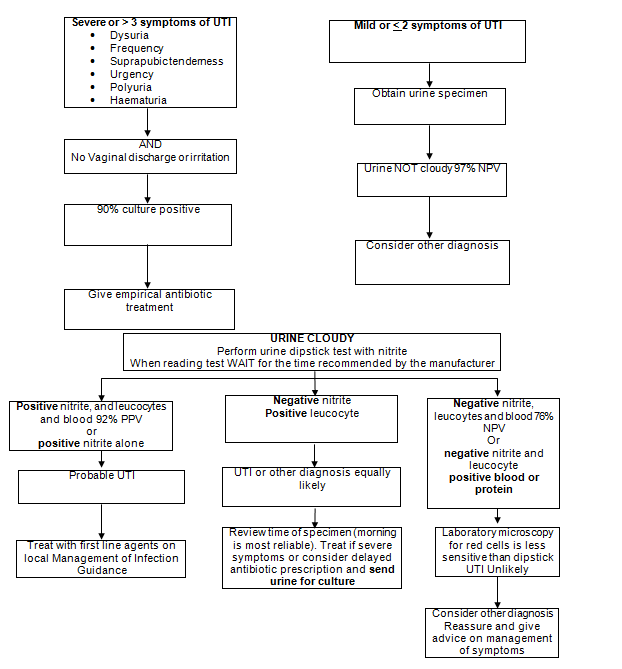
Urinary tract (UTI) (Antimicrobial)
Urine culture in woman and men over 65
Urine Culture in Women and Men with Catheters
- Do not treat asymptomatic bacteriuria in those with indwelling catheters, as bacteriuria is very common and antibiotics increase side effects and antibiotic resistance.
- Treatment does not reduce mortality or prevent symptomatic episodes, but increase side effects & antibiotic resistance.
- Only send urine for culture in catheterised if features of systemic infection. 1,5,6C However, always:
- Exclude other sources of infection.
- Check that the catheter drains correctly and is not blocked.
- Consider need for continued catheterisation.
- If the catheter has been in place for more than 7 days, consider changing it after starting antibiotic treatment
Do not give antibiotic prophylaxis for catheter changes unless history of symptomatic UTIs due to catheter change.
When else should I send a urine for culture?
- Pregnancy:
If symptomatic, for investigation of possible UTI. In all at 1st antenatal visit - as asymptomatic bacteriuria is associated with pyelonephritis & premature delivery. - Suspected pyelonephritis(loin pain and fever).
- Suspected UTI in men.
- Failed antibiotic treatment or persistent symptoms. E. coli with Extended-spectrum Beta-lactamase enzymes (ESBL)are increasing in the community. ESBLs are multi-resistant but usually remain sensitive to nitrofurantoin or fosfomycin.
- Recurrent UTI, abnormalities of genitourinary tract — more likely to have a resistant strain.
Sampling in women and men
Refrigerate specimens to prevent bacterial overgrowth or use specimen pots with boric acid (fill to the line).
- In women: the specimen should be mid-stream. Cleansing with water and holding the labia apart are not essential. Cleansing with antiseptic leads to false negatives.
- In men: the specimen should be mid-stream.
- People with catheters: using aseptic technique, drain a few mL of urine, then collect a sample from catheter sampling port.
Is a Follow-up Urine sample Needed?
Follow-up urine samples are not usually indicated, except when treating asymptomatic bacteriuria in pregnancy.
How do I interpret a Culture Result?
(see page 27 of Microbiology Department User Manual)
The following usually indicates UTI in patient with urinary symptoms. 1Higher counts have even higher positive predictive value.
- Single organism greater than or equal to 104 colony forming units (CFU)/mL1
- Or greater than or equal to 105 mixed growth with one predominant organism
-
Or Escherichia coli or Staphylococcus saprophyticus greater than or equal to 103(CFU)/mL1
Do not treat asymptomatic bacteriuria in the elderly as it does not reduce mortality or prevent symptomatic episodes.
White blood cells
White cells greater than or equal to 104/mL are considered to represent inflammation.
In adults ‘no white cells present’ indicates no inflammation & reduces culture significance.
Pregnancy is associated with physiological pyuria.Sterile pyuria
In sterile pyuria consider Chlamydia trachomatis(especially if 16 to 24 years), other vaginal infections, other non-culturable organisms, including TB or renal pathology. Epithelial cells/mixed growth
Presence indicates perineal contamination, which reduces significance of culture. Red cells
May be present in UTI, patients with persistent haematuria post UTI should be referred - see Urology Guidelines on Occult or non visible Haematuria
Lab microscopy for red cells is less accurate than dipstick due to red cell lysis in transport.
Abbreviations
| Abbreviation | Meaning |
| UTI | Urinary tract infection |
| NPV | Negative predictive value |
| CFU | Colony-forming unit |
Editorial Information
Last reviewed: 17/02/2025
Next review date: 29/02/2028
Author(s): Urology Department.
Version: 2
Approved By: TAM subgroup of the ADTC
Reviewer name(s): I Wilson, Consultant Urologist.
Document Id: TAM417