Devices for respiratory conditions (Formulary: Respiratory)

Respiratory system, inhaled drug delivery, see:  

INHALER AIDS & COUNSELLING DEVICES

Important: Therapy notes

These devices are NOT prescribable on the NHS and may be purchased by patients or are for use by clinicians during inhaler assessment.

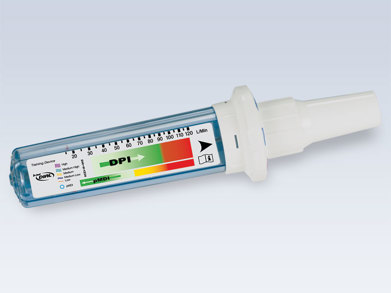
In-Check DIAL® 

  • A useful guide for inhaler use checking as part of inhaler assessment.
Patients should receive regular face-to-face review to ensure correct inhaler technique, self-management (where appropriate) and concordance with agreed treatment.

Consider referring patients with COPD to pulmonary rehabilitation.

To achieve optimal compliance with inhaled therapy consider the following:

  • base the choice of inhaler device on patient acceptability, suitability and cost.
  • patients should only be given a device they can demonstrate they can use; many adults struggle to use metered dose inhalers (MDI) therefore dry powder inhalers (DPI) or other breath activated devices should be considered.
  • always take appropriate time to teach and check inhaler technique.
  • where possible use the same inhaler device if a patient requires a number of different inhaled medicines.
  • reduce the number of inhalers by use of appropriate combination products.

Useful resources:

  • NICE Patient decision aid: Asthma inhalers and climate change. British Thoracic Society, National Institute for Health and Care Excellence, and Scottish Intercollegiate Guidelines Network. NICE guideline NG245. November 2024.
  • Asthma and Lung UK: How to use your inhaler.
  • Beat asthma: Resources for families and children, young people with asthma, schools, primary healthcare professionals, secondary healthcare professionals. 
  • My Lungs My Life

MUCUS CLEARANCE DEVICE

Important: Formulation and dosage details

Formulation:

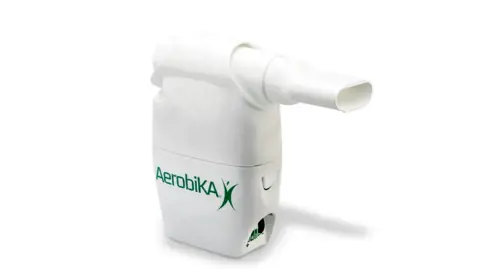
OPEP (Oscillating positive expiratory pressure) mucus clearance device (Aerobika®)

  • Licensed medical device. Can be ordered via PECOS. Code: AER94A.


Dosage:

  • For adults and children. To aid the loosening and removal of mucus build-up in the lungs for conditions such as cystic fibrosis and COPD.

Patient information:

NEBULISERS

Important: Therapy notes

In hospital:

  • Nebulised bronchodilator solutions should always be driven by oxygen when administered to a patient with asthma and by air when administered to a patient with COPD or any other diagnosis.

In primary care:

  • In both COPD and asthma, only prescribe nebulisers in primary care following a formal assessment through the Respiratory Clinic; evidence suggests that maximising inhaled therapy through a spacer device is the preferred choice.
  • For chronic domiciliary use electric compressors should be used to deliver nebulised therapy as the flow rate from an oxygen concentrator is insufficient to nebulise solutions effectively.
  • In acute asthma in primary care, nebulisers should be driven by oxygen provided a minimum flow rate of at least 6 litres/min is available. As an alternative to air-driven nebulised therapy, high-dose salbutamol may be delivered by a large volume spacer (Volumatic®) to children aged over 2 years and adults.
There is NO place for nebulised sodium chloride 0·9% solution in either COPD or asthma.

PEAK FLOW METERS

Important: Therapy notes


Important: Formulation and dosage details

Formulation:

Peak flow meters standard range and low range are available on prescription in the community and in hospital via PECOS.

Standard Range (For adults and children)

  • Lower limit: NOT greater than 150 L/min
  • Upper limit: NOT less than 700 but NOT greater than 850 L/min

Low Range (For adults and children with severely restricted peak flow)

  • Lower limit: NOT greater than 50 L/min
  • Upper limit: NOT less than 275 but NOT greater than 400 L/min

Dosage:

For available products and prescribing advice see: Scottish Drug Tariff: Part 3 appliances

Prescribers should ensure that patients have received adequate training when a meter is supplied. This should include advice on recording and interpretation of results, adjustment of personally administered medication and when to seek urgent medical advice in the event of abnormal readings.

Detailed user instructions and a purpose-designed record chart are provided with each meter.

Important: Formulation and dosage details

Formulation:

Replacement mouthpiece / adaptor

Dosage:

These are not interchangeable between brands or manufacturers. Each individually wrapped and labelled. Suitable for both standard and low range models for use by adults or children.

Notes:

For available products see: Scottish Drug Tariff: Part 3 appliances

SPACERS

Important: Therapy notes

Useful resources:

Spacer devices improve lung deposition and reduce oropharyngeal deposition of drugs delivered via a metered-dose inhaler.

  • A spacer device is recommended for all patients inhaling high-dose steroids (greater than beclometasone 800 micrograms per day or equivalent) via a pressurised, metered-dose inhaler, and when inhaler technique is sub-optimal.
  • If patients are able to use a spacer without a mask, that is preferable.
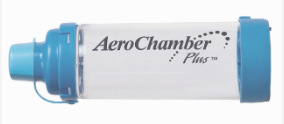
  • Lung deposition data is superior for the Volumatic® as compared to the AeroChamber® Plus.
  • Where a number of different inhalers are prescribed for the same patient they should be compatible with the selected spacer device, where possible.
  • Advise patients to clean devices no more often than once a month and replace every 6 to 12 months. After cleaning, spacers should be air-dried, not dried with a towel.

Important: Formulation and dosage details

Formulation:

FIRST LINE large volume spacer

Dosage:

  • For use only with Clenil Modulite®, Flixotide®, Serevent® and Ventolin® pressurised, metered-dose inhalers.

Important: Formulation and dosage details

Formulation:

SECOND LINE where having a smaller volume spacer is a priority

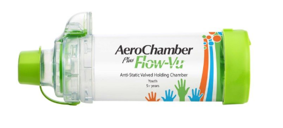
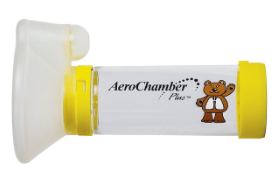
AeroChamber Plus Flow Vu Anti-Static with or without mask: Which chamber is right for me?

Dosage:

  • For use with all pressurised, metered-dose inhalers.
  • To note that masks are available with all sizes, if needed. 

Editorial Information

Version: 2.1

Document Id: F367